Lessons from the Jesuits for leading with purpose in times of change

In an era of unprecedented disruption and increasingly rapid change, leaders in Silicon Valley and around the world find themselves challenged to be not simply reactive, but boldly constructive. The Jesuits, over their nearly 500-year history, have a set of ideas and principles—called cura apostolica—that can help leaders chart out their paths in ways that are grounded in their most enduring values and ongoing mission as well as responsive to the needs and challenges of the moment. Recently, I drew together a remarkable set of leaders in Jesuit institutions to collect some of these “leadership lessons of the Jesuits.”
Here at Santa Clara, we see ourselves as creative stewards of something special, and deeply needed, in our unique mission (which the Jesuits refer to as an “apostolate”) as the Jesuit university in Silicon Valley. As President Julie Sullivan stated at the launch of our Impact 2030 Strategic Plan, “The world needs Santa Clara University to be looking to the horizon—to the frontiers as did our Jesuit founders—in a timeless search for truth, reflective discernment, and transformative action.” Cura apostolica echoes this, grounding us in the calls that first led to the establishment of Jesuit schools and creatively pointing us to the future as our mission grows and responds to our changing times and context. Book cover courtesy Georgetown University Press.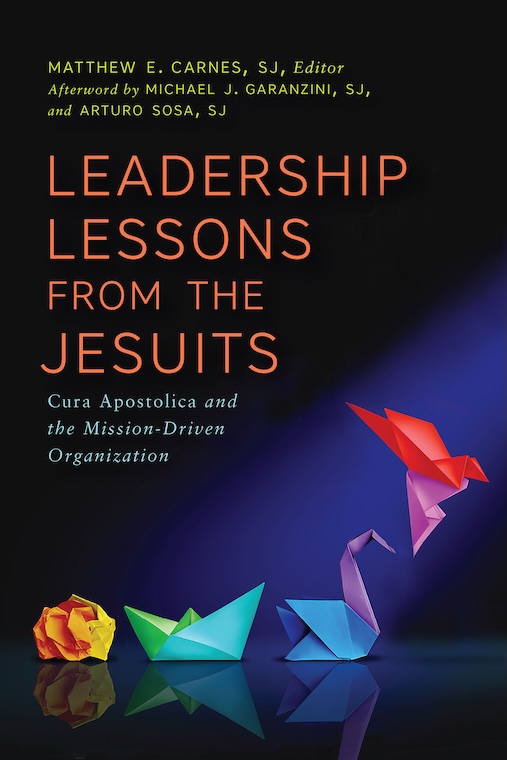
So, what key lessons does cura apostolica teach us? First, to be an effective leader, one must know intimately, and even cherish, the mission that gives rise to the institution. Great leaders study the history and original inspiration of their apostolate, and they constantly ask how that initial spark can set new flames today. They treat the mission with reverence and respect, seeing it as a distinct gift—a treasure—but not one that is meant to be placed on a pedestal or hidden in a safe. Rather, they consistently bring it out and seek to give it fresh expression, and they hold it lightly enough that it can adapt and evolve.
Next, outstanding, mission-driven leaders realize that great missions cannot be separated from great people. They recognize that those who carry and give life to the mission—including stakeholders of every kind, from managers and staff to customers and board members, and even their families—are the lifeblood of the organization. These leaders recruit their teams carefully, invest in them generously with mentorship and support, and encourage and challenge them so that they can flourish in the roles and responsibilities they hold.
Finally, a true commitment to the mission requires the leader to look beyond one’s particular, current institution or workplace. This kind of leadership sees itself in service to something bigger, a larger purpose, and it is willing to sublimate oneself or one’s small corner of the mission in favor of the more far-reaching mission. It sees no particular institution as absolute, but instead keeps its eyes fixed on the larger horizon: education, rather than this school; health, rather than this clinic; truth, rather than this library or website.
Cura apostolica focuses us intently on the values that matter most, and in doing so, it frees us to lead collaboratively and courageously with conviction, ingenuity, and trust. Matthew Carnes, S.J. Photo by Miguel Ozuna.
Matthew Carnes, S.J., is a professor of political science, the vice president of Mission and Ministry, and executive director of the Ignatian Center for Jesuit Education at Santa Clara University. He is the editor of the book “Leadership Lessons from the Jesuits: Cura Apostolica and the Mission-Driven Organization,” released in July.

The Ignatian Center promotes and enhances the distinctively Jesuit, Catholic tradition of education at Santa Clara University. Based on the belief that from deep personal reflection grows mindful action toward a greater good, Ignatian spirituality focuses on a holistic approach to learning, a commitment to open and inclusive dialogue, and finding God’s will for better decision making.