Cornel West encourages the Santa Clara community to find their voice and use it for good
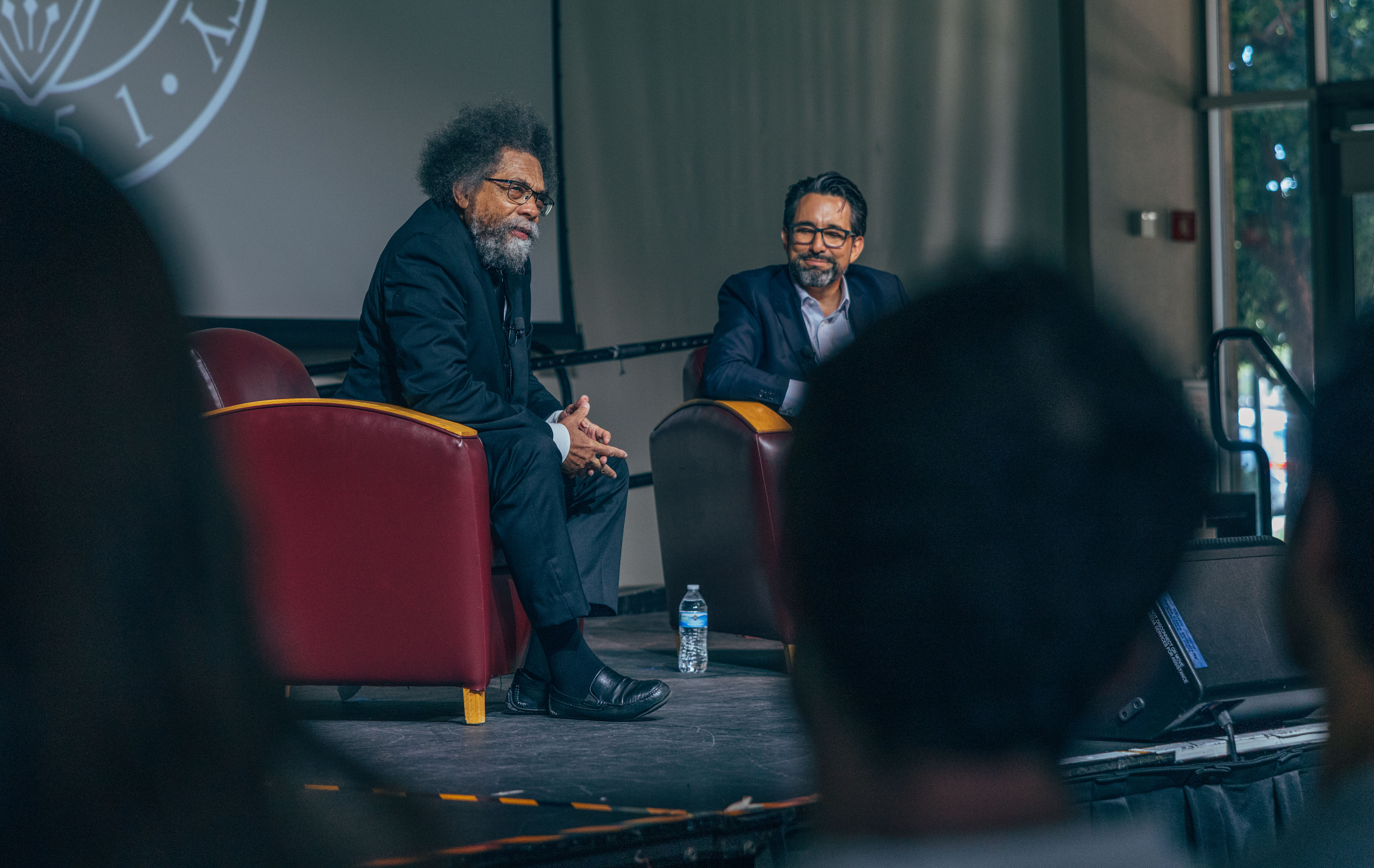
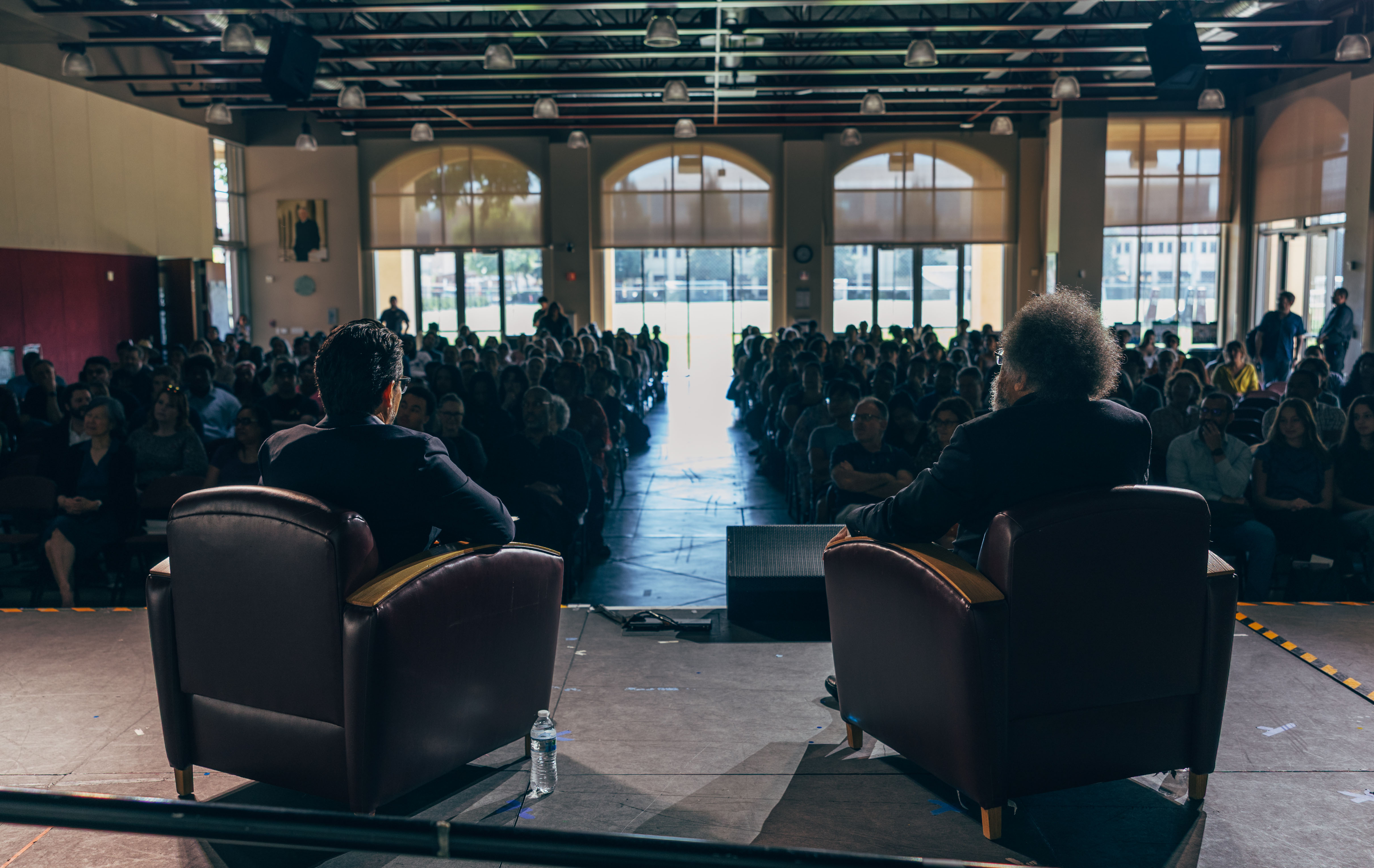
In the latest installment of Santa Clara University’s Compelling Conversation series, hosted by the Office of the Provost and Executive Vice President, philosopher and activist Cornel West encouraged more than 300 students, faculty, and staff with a singular message: understand your purpose and use it for the greater good.
"How do you find your voice? Courage and integrity,” West said during a conversation with Christopher Tirres, Santa Clara professor of religious studies. “No matter how smart you are, no matter how good you sound on your horn—we want to hear you, your voice. We don’t want to hear your training. We want to hear what’s inside of you.”
As the first Black man to receive a Ph.D. in philosophy from Princeton University and an author of 20 books, including Race Matters and Democracy Matters, West has spent more than four decades advocating for social justice and prophetic faith, with love at the center of all his work. During the talk, he was candid about injustices in the world and emphasized that integrity, compassion, and perseverance matter now more than ever.
Here are highlights from the conversation on May 22.
On each generation’s calling, choosing integrity over power, and how Santa Clara can continue that legacy
“Every generation has got to produce unleashed love warriors, freedom fighters, joy sharers, wound healers—visionary servants of something bigger than their own egos [and] narcissistic predicaments.”
“It’s better to have some integrity and love in your heart and be relatively defeated than be evil triumphant—a gangster on the way to hitting up against the wall of history. That’s the great tradition and we’re bouncing back. Santa Clara University is part of it. I’m serious about it. There’s something happening in this place. There really is.”
“Everywhere I go, I see clouds of witnesses, different people making choices to be forces of good in a variety of different forms. They don’t have the institutional power, infrastructure, or collective resources—but they’re doing some wonderful things given what they do have access to. That’s beautiful. In institutions of higher learning, you see these possibilities.”
On the true meaning of personal success
“Your vocation is what you feel at the deepest level of your heart, mind, soul, and body—not just the various market strategies you might come up with to make money, to gain access to some economic status. We all need money. Absolutely. But success must always be secondary to integrity, secondary to the love of family and others, [and] secondary to your fundamental sense of who you are as a human being.”
On the importance of integrity
“Part of the escalating decadence of the culture of professionalism among the professional managerial classes of our declining and decaying empire is that people are not honest and candid. They don’t have integrity. They pose, they posture. They say things that other people want them to say. They don’t want to go against the grain. They don’t want to pay the cost of noble discontent… because the cultural professionalism that reinforces specialization—with all the different jargons for the highly specialized discourses—creates a conformity, and the aim is upward mobility rather than soul formation.”
“Integrity becomes more and more important—and that cuts across politics, religion, and educational institutions. That’s why when you have persons of integrity in places, especially high places, it makes all the difference in the world.”
On his 2024 presidential run and what he was really after
“I want people to think hard about an election and vote for who [they] want to vote for. No candidate owns the vote. They make their case and people choose. [I wasn’t] running for office, [I was] running for Jesus—and it spill[ed] over to running for justice. All I was doing was trying to convince the country to understand the best of itself. And the best of itself has been persons who, given their finitude and fallibility, have tried to stand up for the quest for truth, beauty, and justice, and in some cases the Holy, and have the younger generation see what it looks like.”
On finding joy in spite of current events
“I’m not an optimist. I’m a blues man. Blues ain’t got nothing to do with optimism, but it produces prisoners of hope who wrestle with despair every day. I draw a distinction between retail despair and wholesale despair. People come up to me all the time, and say, ‘Brother West, I don’t see why you’re not pessimistic.’ Of course I’m pessimistic—I’m a sensitive human being, I see what’s going on. But I’m a retail pessimist. Pessimism doesn’t have the last word. We know how grim and dim [the world] is—we’re not denying anything at all. But we’re going to keep loving our kids, our families, others—not just in our own neighborhoods, tribes and clans, but loving others around the world. For me, always putting the priority on the most unloved: the widows, the orphans, the Godless, the fatherless, the motherless… and in that sense, it’s a joy that can never ever be crushed.”
On keeping each other and ourselves accountable
“The crucial thing for any of us willing to make that leap in the genuine quest for truth, beauty, goodness, or maybe even the Holy, is that we’re all cracked vessels. We all are fallible. We all need to learn and listen. We need to keep each other lovingly accountable. In the end, we all want to be connected at that deep human level.”

Each year, the Provost and Executive Vice President hosts Compelling Conversations. This speaker series welcomes notable speakers to engage with the Santa Clara University community on important contemporary issues.