What if the meaning of life could be found in emptiness?

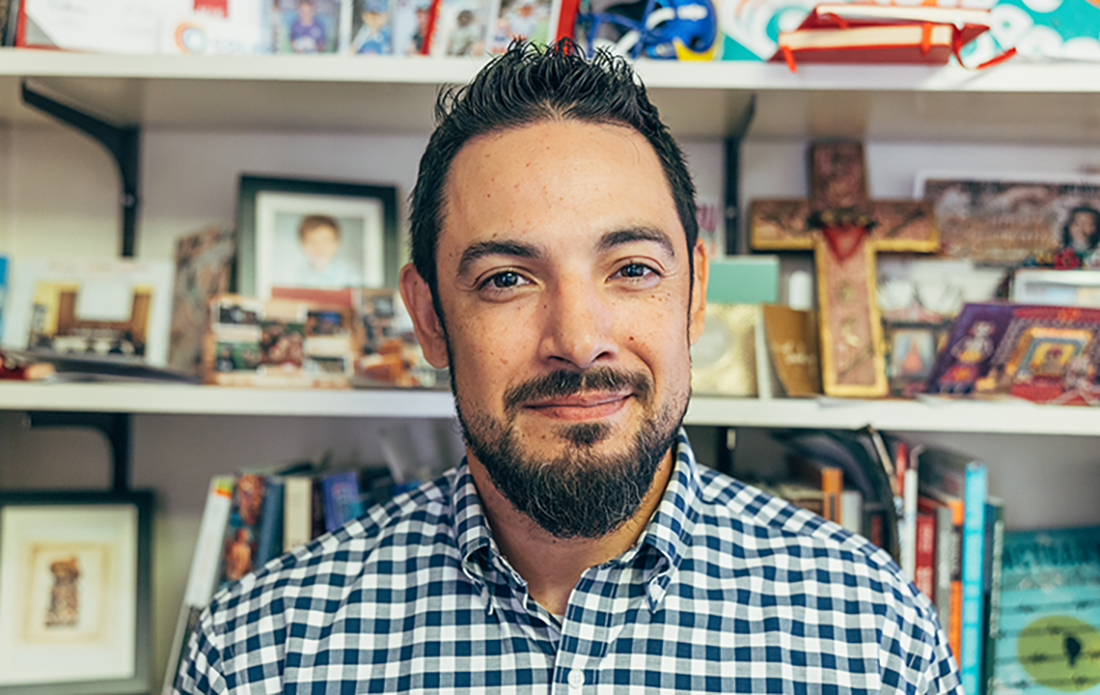
On a recent trip back to her home state of Alaska, Meilin Chinn, an associate professor of philosophy at Santa Clara University, visited the small coastal town of Homer, 225 miles south of Anchorage, known to many as “the end of the road.”
Surrounded by a halibut-rich bay and nestled between looming mountains and dense forest, she reflected on how her relationship to place shaped how she understood the world.
For many, Chinn says, quiet places like rural Alaska evoke emptiness, or a notion that suggests a hole where something meaningful ought to be. But growing up in Bethel, another Alaskan town surrounded by a wide expanse of nature, she learned that it was in those gaps where the most meaning can be found.
“In Homer,” she says, “the landscape serves as a literal barrier to human infrastructure. Being there, it was a relief to not feel the footprint of humans, to feel like we’re actually very small in the scope of things.”
In a culture obsessed with constant growth, movement, and noise, Chinn focuses her research on the quiet space between things, particularly people and their environments. A faculty member at Santa Clara since 2015, she studied philosophy at Georgetown as an undergraduate, and then headed to the University of Chicago for her master’s in social sciences with an emphasis on philosophy.
Along the way, she became interested in the relationship between the individual and society, but she also started to notice that aside from some French existentialists, people in the Western philosophical tradition weren’t really talking about what the Buddhists call ‘emptiness.’”
As a queer woman of mixed Chinese and Irish heritage, Chinn found the field’s obsession with Western notions of “unchanging essences” like the “self” and “rationality” increasingly hollow. If Western philosophy insisted that nothing, including people, existed in the space between categories, what did that mean for her?
This realization led her to what she calls “jumping ship”—leaving traditional Western philosophy to pursue a Ph.D. in Chinese philosophy at the University of Hawaii, one of the only English-language programs where she could seriously study Asian philosophical traditions at the time. She embraced a worldview that sees emptiness not as a lack, but as a generative force that allows all things to transform and emerge through connection.
The rhythm of silence
What does it mean to be transformed by emptiness? To find meaning in it? It’s a deeply intellectual notion and perhaps hard to conceptualize, but Chinn says it can happen whenever we stop talking and start listening.
One of her research projects explores the age-old question of how music is meaningful, including how music and sound are sensed, the relationship of music to truth, and musical spacetime. According to her, music is the perfect metaphor to understand the transformative power of “emptiness,” because unlike a word that points to an object, music exists as a process of emerging and disappearing, like life itself.
“When you’re deeply listening to music, the self is emptied out into the music,” Chinn explains, citing Daoist thinker Ji Kang. “We’re able to bring harmony and catharsis to the self by emptying our emotions—we become the music.”
The same loss of self happens for the musicians, too. She points to jazz musicians as the ultimate practitioners of this philosophy. To play well, a musician must perform a “double move”: they must deny the ego to truly hear their collaborators, yet remain acutely present and skillful in their own contribution. This “emptying” is not a loss of self, but a transformation.
And just as a song relies on the silence between notes to create rhythm, our lives echo these cycles of stillness. Consider the rhythms of rising with the sun, or celebrating a birthday or New Year’s Eve. Meaning in our lives often relies on “the melancholy of endings” to make room for new beginnings.
“Summer has to end for fall to begin,” Chinn notes.
Finding a home in emptiness
The human connection to these natural rhythms is also at the heart of Chinn’s work on environmental ethics at Santa Clara.
Through a grant from the Markkula Center for Applied Ethics, she’s developing an interactive website and learning module with a student web designer that allows users to explore the feng shui landscapes of China and the ahupuaʻa systems of Hawaii.
While pop culture often treats feng shui as a guide for arranging furniture, Chinn is returning to its original roots in understanding landscape harmony. Users will be able to click through a virtual feng shui forest, learning how traditional Chinese philosophers understood the relationship between mountain formations, water flow, and human settlement. They’ll also trace the ahupuaʻa—a traditional Hawaiian land management system that connects the mountains to the sea in a unified watershed.
“I’m interested in expanding the vocabulary of environmental ethics,” Chinn continues. “A lot of current environmental language has concepts of individualism embedded in it—even the ethical language. ‘Nature’ is a concept made by humans who are themselves part of nature and vice versa. These traditions offer different ways of thinking about our relationship to place, seeing the human being as a microcosm of the macrocosm of the environment.”
Through this work, Chinn helps students see themselves not as “lone atomic individuals,” but as embodied beings who are inseparable from their physical surroundings. When you’re not living in alignment with your environment, you feel that disruption, she explains, perhaps in terrible traffic flows or a lack of natural light that disrupts circadian rhythms.
“Why do you feel better living in seaside Monterey than in urban downtown San Jose? That’s a feng shui question,” she adds. “It’s a question of how we fit into the natural world and find the right arrangements for both human and environmental flourishing.”

The Huilua Fishpond in Oʻahuʻs Ahupuaʻa O Kahana State Park is an example of how traditional Hawaiian land management brings water down from the mountains and into seaside ponds like this.
Making it up as we go
The feng shui and ahupuaʻa website, launching this spring, reflects Chinn’s broader commitment to what she calls “alternative practices”—ways of engaging that remind people that even in an increasingly digital-first world, they are physical beings in physical environments.
For example, in her classroom, she’s returning to physical books and handwritten work, hoping to offer her students a different relationship to knowledge and to themselves.
“Everyone knows what it feels like to look at your phone too much all day,” she says. “I want to give the gift of what it’s like to read slowly with a physical book, write things out by hand, and to have a live, unmediated-by-technology discussion with other human beings.”
At a time when students (and much of the wider world) feel overwhelmed by information yet starved for meaning, Chinn’s philosophy offers a surprising antidote. By embracing spaces of ambiguity, Chinn invites us to see a well-lived life as a creative process, not a series of checkboxes.
“The secret is that once you see reality for what it is—a constant, interconnected process—liberation follows,” Chinn says. “Living is an art form, and we have to make it up as we go along. That’s actually good news.”

Philosophical inquiry promotes analytical thinking and precise expression as it explores the relation of human beings to the world: what we are, how we know, what values are, how we live. The major provides excellent undergraduate preparation for a variety of careers including law, government, finance, media, writing, and computer programming.