Are we building Babel or Jerusalem? Santa Clara scholars respond to the Pope’s challenge to ‘disarm’ AI
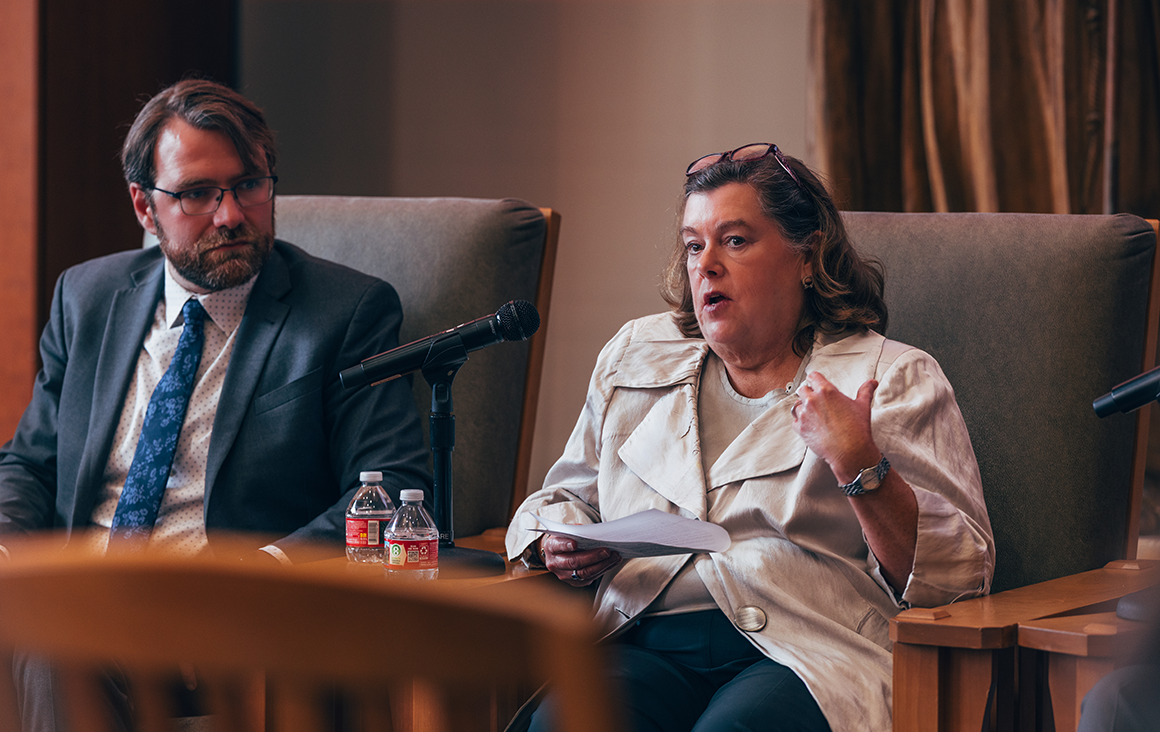
When Pope Leo XIV’s encyclical, “Magnifica Humanitas: On the Protection of Human Dignity in the Age of Artificial Intelligence,” dropped at 2:30 a.m. California time on Monday, five Santa Clara University scholars got to work. They printed it out. They read it cover to cover. They annotated, discussed, and debated. By Tuesday evening—a mere 39 hours later—they were ready to share what they found during a public panel of campus community members.
“This is the lion’s roar,” proclaimed Brian Patrick Green, the director of technology ethics at the Markkula Center for Applied Ethics, who has served as an advisor to the Vatican on AI ethics, holding up his printed copy of the encyclical.
This expert panel brought together Green and four other scholars in ethics, technology, and religious studies for a lively discussion moderated by Matthew Gaudet, director of ethics programs for the School of Engineering and a member of the Vatican’s AI Research Group.
Santa Clara University has long held a rare position at the intersection of the Catholic intellectual tradition and the global technology industry as the “Jesuit University in Silicon Valley,” noted Kendra Sharp, dean of the School of Engineering, who opened the event. In fact, Jesuit School of Theology professor Léocadie Lushombo was among the six guests who joined Pope Leo in Rome for the encyclical's release—one of only two female theologians invited to take the stage with him.
Signed on the 135th anniversary of Rerum Novarum—the 1891 letter that launched Catholic Social Teaching in response to the Industrial Revolution—Pope Leo XIV’s first social encyclical arrives at a moment of widespread anxiety about where AI is taking us. Jobs are being disrupted. Autonomous weapons are proliferating. A handful of companies and governments are racing to seize control of a technology that is reshaping how billions of people work, communicate, and understand the world.
According to the panel experts, Pope Leo does not reject AI. But he insists the world stop and reckon with a harder question: Are we building a Tower of Babel—a monolithic future defined by the concentration of power and the exploitation of the vulnerable—or are we rebuilding Jerusalem, a civilization grounded in cooperation, shared dignity, and what the Pope calls “a disarmed and disarming peace”?
“This is our first response,” Gaudet told the audience. “But it will not be our last word.” Read on for highlights from the panel.
Note: Some quotes have been lightly edited for clarity.
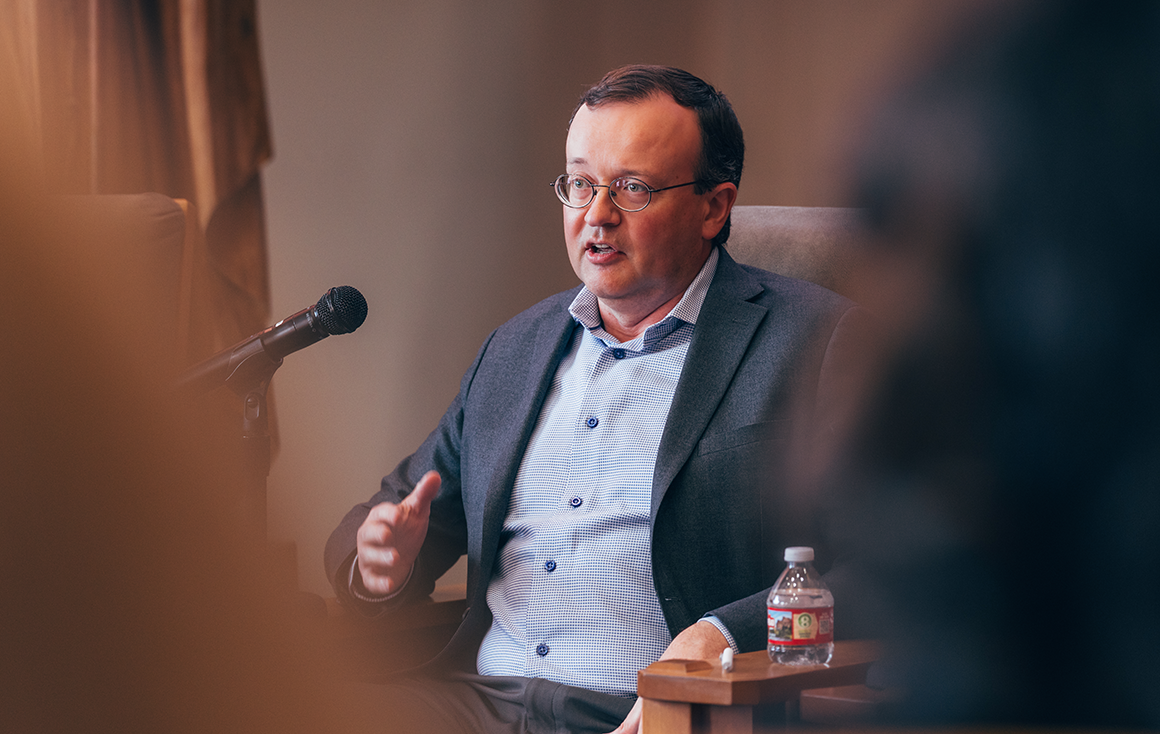
Brian Patrick Green of the Markkula Center
Brian Patrick Green, Director of Technology Ethics, Markkula Center for Applied Ethics
“Pope Francis listened. And around ten years ago, executives came to him and said, ‘AI is going to be big. Just be prepared for it.’ And so he got people working on these topics. This encyclical takes together all that listening and turns it into something that goes out into the world and then does something.”
“Pope Leo describes this metaphor of the Tower of Babel, where the entire world has been homogenized into a monolithic, monotone future. We are all consumers being exploited or enslaved in the same way by technology. It’s totalitarian. On the other hand, he cites ‘Jerusalem’ as this metaphorical, pluralistic, polyphonic city that we can contribute to building together. Everybody has their part, and all together we build something where everyone wants to be. It’s diverse, it’s pluralistic, and it’s cooperative. It’s not this totalitarian, monolithic thing that we get obsessed with and drive toward that one thing.”
“Right now, everyone’s not just talking about artificial intelligence. It’s artificial general intelligence, which is going to be as good as a human being. So what are the rest of us to do? Well, we get replaced. And what the Pope is saying is that that isn’t the future we’re aiming for. We’re not looking to replace people. We’re looking to have technology help us do things that are going to make a better future together.”
Ann Skeet, Senior Director of Leadership Ethics, Markkula Center for Applied Ethics
“The business community is offering up a vision of AI that a lot of people can’t relate to or don’t really want. And so here comes Pope Leo offering a much more palatable vision—one that puts us, the human, at the center of it.”
“Pope Leo reminds us that the limitations of being human are a feature, not a bug. The fact that we suffer, that we get sick, that we age—these are things that also allow us to have compassion, generosity, and awareness of the needs of others. Those are the true human intelligence.”
Julie Hanlon Rubio, Shea-Huesman Professor of Christian Social Ethics, Jesuit School of Theology
“Pope Leo worries about false narratives and how they fuel a false realism that war is inevitable. And underneath all of this, he sees a relational poverty—a relational poverty that the technocratic paradigm is shaping.”
“The remedy, according to Pope Leo, is ethics. And specifically, a rich understanding of the dignity of the human person—a human person who is embodied, made for relationship, and made for seeking truth.”
Ahmed Amer, Associate Professor of Computer Science and Engineering; Faculty Scholar, Markkula Center for Applied Ethics
“The best engineers are good engineers—and I mean that from a pragmatic and technological sense as much as a moral one. The better software engineer is the one who builds software whose users are happy with and ultimately get benefit out of, not software they get addicted to, and then rue the day they joined that platform or got that app.”
“What good is holistic engineering education if the rest of us are not also better educated about the nature of technology, and if our engineers are placed in environments with perverse incentives that do not allow them to be their best selves and build the best things for us?”
Nicholas Hayes-Mota, Assistant Professor of Social and Theological Ethics, Department of Religious Studies
“Catholic Social Teaching is a dynamically evolving and changing tradition. Every time a Pope issues one of these documents, they add new elements—and sometimes change them in pretty significant ways. It’s the church’s process of shared discernment.”
“We are in an arms race. And so the call, if we want to move toward Jerusalem, is to step back and ask: Where is this leading us? What values are informing the development of this technology? And are we creating the structures that will actually hold us accountable to ensure it’s leading us toward the future we want?”

Grounded in the University’s Jesuit values and Silicon Valley’s ecosystem of innovation, the new Cunningham Shoquist Center for Applied AI and Human Potential, Santa Clara's fourth center of distinction, will serve as an interdisciplinary hub where faculty, students, staff, and industry partners collaborate to contemplate, design, and deploy AI technologies that will benefit society.