Breaking News
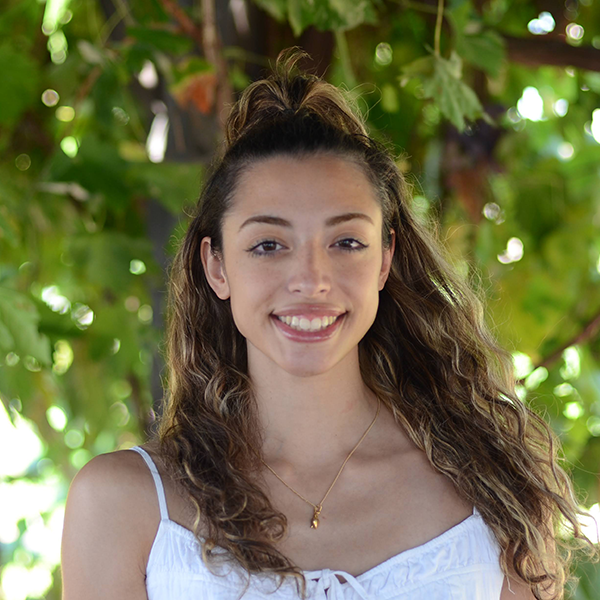
Exploration and Environment: One Senior’s Path Through Science
Sofia ‘Ximena’ Garcia-Isabelli ’26 turned curiosity about the natural world into hands-on research and discovery.
By Kate Vander Vort ’27
Originally from Spokane, Washington, Sofia ‘Ximena’ Garcia-Isabelli ’26 pursued a major in environmental science with minors in biology and geospatial analysis, fields that allowed her to explore a wide range of interests.
“I cannot imagine doing something not environmental science-aligned,” Garcia-Isabelli said. “It is such a multi-faceted area of study that has so many overlapping fields and applications it feels like there are infinite pathways to go down.”
At SCU, she embraced those possibilities through research, leadership, and hands-on experiences both on and off campus.
Research and Discovery
Garcia-Isabelli’s time at SCU has been deeply rooted in research. As a REAL program recipient, she worked with Dr. Dawn Hart on a Sea Star Wasting Disease monitoring project and developed her own research focused on intertidal creatures called chiton.
She also participated in Dr. Elizabeth Dahlhoff’s Team Beetle research in the Eastern Sierras, studying willow leaf beetle populations at high elevations.
These opportunities allowed her to engage directly with the natural world while building skills across multiple areas of environmental science.
Leadership and Community
In addition to her research, Garcia-Isabelli took on leadership roles that connected students to the environment. As president of the SCU Fungi Club, she organized off-campus naturalist hikes around the Bay Area, encouraging students to explore and learn beyond the classroom.
She also served as a fellow with the Silicon Valley Power Sustainable Futures Fellowship, working with the Center for Sustainability to create policy recommendations for the City of Santa Clara.
Her campus involvement extended further through her roles on the board of Ballet Folklórico de SCU and as a community facilitator in Casa Italiana Residence Hall.
Learning Through Experience
One of Garcia-Isabelli’s most meaningful academic experiences took place during a winter quarter course that extended into spring break, ENVS 144: Natural History of Baja California.
The class spent the quarter learning about and studying the natural history of Baja, California, and then lived it. They spent 10 days over spring break in desert canyons and along the coast of Baja California, disconnected from daily life and focused on observing the natural world through field journals.
“That trip pushed me, and it was the first time I ever snorkeled—and it was with whale sharks!” she said.
Courses at SCU also played an important role in shaping how Garcia-Isabelli views the natural world.
ENVS 79: Environmental Thought and BIOL 1C influenced her perspective on science and the environment, particularly through ideas about how people understand and interact with nature.
“In that course we had to watch Emma Marris’ TED Talk ‘Nature is everywhere—we just need to learn to see it,’ and that has guided me on what nature means and how we can approach it for future generations,” she said.
Exploring New Technologies
Garcia-Isabelli’s academic interests also led her to geospatial analysis, an emerging field that became the focus of her senior capstone. Her project examined cenotes in the Yucatán Peninsula, using geospatial tools to better understand environmental features and their significance for local communities.
“I chose to work on a project that was very geospatial analysis-heavy as I wanted to pursue that for graduate school,” she said. “With the technology, you have the ability to uncover objects like cenotes and Mayan ruins that are hidden by a dense rainforest.”
For her last quarter at SCU, she is continuing to work on the project through the Water and Climate Justice Lab.
Embrace the Challenge
Looking back, Garcia-Isabelli is most proud of her ability to persist through challenges and take full advantage of the opportunities available to her.
I am most proud of my ability to keep pushing forward when dealing with novel difficulties. I feel as if I have taken advantage of the small class sizes and explored my personal interests with the mentorship of my professors.
Her advice to incoming students reflects that same mindset: “Stick with things that are hard! It always pays off!!”
Looking Ahead
After graduation, Garcia-Isabelli is excited to continue exploring geospatial analysis and hopes to pursue opportunities in Los Angeles, a place she has wanted to live since middle school.
With a foundation built on curiosity, exploration, and hands-on learning, she leaves SCU prepared to continue studying, and protecting, the natural world.