Breaking News
Food Justice and Flood Resilience in the South Bay Area
Students in Chris Bacon's capstone conducted community-based participatory action research, with four teams developing mixed-methods projects. The first project integrated surveys, interviews, and policy analysis in response to requests from the County of Santa Clara’s (SCC) Office of Sustainability and Resiliency and Destination Home to analyze strategies for linking values-based local food purchasing with supportive housing investments. Another project, built through our collaboration with the Environmental Justice and Common Good Initiative and Veggieluton Community Farm, produced the South Bay Food System Dashboard, focusing on adding community voice and producing a short film. A third project partnered with Joint Venture’s Silicon Valley, as students analyzed the obstacles and opportunities to support edible food recovery from agricultural land and farmers' markets, supporting food security and reducing climate impacts. The three aforementioned projects advance the SCC Food System Workplan's goals of building a robust regional food economy, supporting food recovery, and enhancing community engagement in support of food sovereignty. A final project, in partnership with Climate Resilient Communities and Alviso in Action, conducted over 70 surveys and 25 interviews to assess residents' perceptions of flood risk and propose mitigation strategies.
We are deeply grateful to students for their hard work, to our partner organizations and community residents, and, especially, to the individual mentors for their thoughtful guidance and commitment to ethical engagement that advances learning, research, and community change.
Click on the PDFs to download the students’ final capstone posters.
Cultivating Community: Storytelling & Food Access in East San José (PDF)
Annabel Harris, Nash Fuetsch, Emma Hardie, Shivani Glynn
Efforts to address food insecurity are often analytical, measuring quantitative data rather than understanding people's lived experiences. This project aims to uplift the voices, knowledge, and lived experiences of community-based food leaders and small-scale farmers. Developed in collaboration with Veggielution, this study centers mixed-status households, low-income residents, small farmers, immigrant families, and food entrepreneurs whose perspectives are frequently underrepresented in agricultural policy and food system decision-making. Through interviews and anonymous community surveys, participants were invited to share their experiences with food access and institutional barriers, as well as the ways they cultivate resilience, collaboration, and opportunity in their communities. As a result of our research and interviews, we produced two short documentary films that amplify the voices of community food leaders to be shared on Veggielution’s website and public storytelling platforms. The project builds on the South Bay Food Justice Data Dashboard by adding qualitative context to the maps and figures. Findings will support Veggielution’s future outreach, programming, and storytelling efforts. This project contributes to broader efforts to strengthen community-based food systems and advocates for transformative action.
Developing Recovered Food Hubs in Silicon Valley (PDF)
Caitlin DeLaMora, Vansh Malik, Jenna Martinez, Anna Keenan
Santa Clara County (SCC) produces over 50 million pounds of surplus food, yet 31% percent of county residents are reported to be at risk of food insecurity, lacking reliable access to proper, affordable nutrition. Additionally, SCC produces approximately 40,000 tons of food waste annually. Food waste decomposes in landfills, producing greenhouse gas emissions, posing a pressing public health and environmental issue. California’s food waste law (SB 1383) addresses this challenge. We aimed to provide actionable insights that enable local farmers to donate more surplus produce, identifying ways to divert food loss from local farms to recovered food hubs, turning potential loss into a community resource that can be distributed to combat food insecurity. We used a mixed-methods approach, combining semi-structured stakeholder interviews and surveys to identify the primary barriers to farm-level food donation. This research demonstrated how farmers' conditions affect their likelihood of engaging food recovery programs, directly informing the operational design of Joint Venture’s recovered food hubs. Misalignment between regulatory mandates and operational realities; specifically, the complexity of claiming the tax incentives of SB 1383, significant logistical barriers in cold-chain management, and high labor costs of continuous staff retraining render food recovery impractical for many commercial generators. In the future, pragmatic donation options need to be offered to farmers.
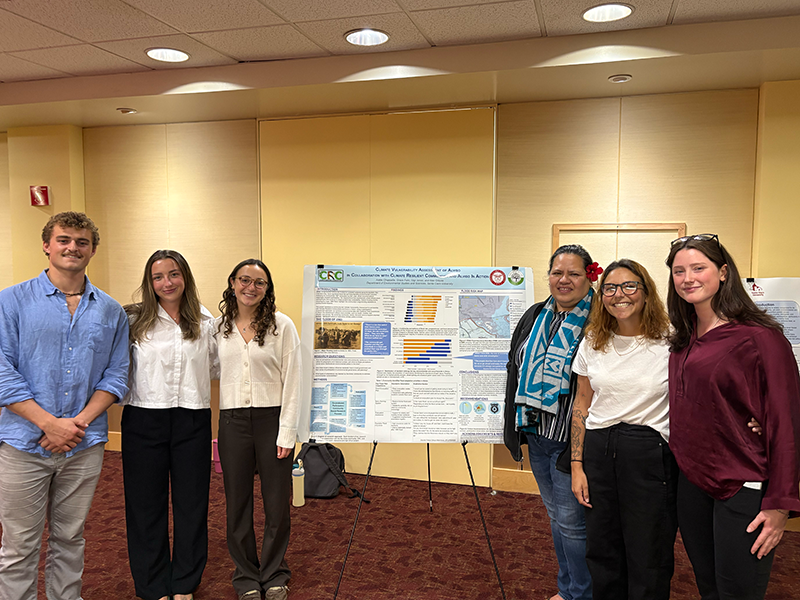
Community-based Climate Vulnerability Assessment of Alviso (PDF)
Grace Falci, Addie Chappelle, Alex Crouse, Gigi Jones
Located at the southern end of San Francisco Bay, Alviso is a historically underrepresented community facing disproportionate impacts of climate change. San José has directly contributed to Alviso’s infrastructure instability, particularly after its controversial 1967 annexation, which excluded Alviso residents from municipal planning processes. Alviso currently ranks in the upper quartile statewide for environmental burden with high exposure to hazardous waste, linguistic isolation, impaired waterways, and solid waste facilities. Our study produced a Community-Led Climate Vulnerability Assessment that centers resident knowledge and integrates it with environmental data to support equitable climate planning. We used a participatory, co-production research approach that integrated GIS mapping, CalEnviroScreen 5.0 data, archival research, and 27 qualitative interviews and 78 surveys with community members. We examined residents' perceptions of environmental risk and resilience, the adaptation strategies they prioritize, how Alviso’s political history shapes trust in local government, and tangible interventions. By emphasizing shared authority and reciprocal relationships in knowledge production, this project elevates lived experience as the cornerstone of data. The resulting assessment is accessible to residents and decision-makers alike, offering a practical tool for justice-centered climate adaptation, long-term resilience, and community-based evacuation planning in Alviso.
Barriers to Food Security in Santa Clara County Supportive Housing (PDF)
Olivia Reifschneider, Will Jaspen, Addison Lewis
Although Silicon Valley is one of the wealthiest areas in the nation, the food insecurity rate is 19.3%. Among residents of supportive housing sites, which are shelters for unhoused communities, high rates of food insecurity persist at approximately three times the expected level. Santa Clara County (SCC) has 3,832 temporary housing beds, which can support about 1/3rd of unhoused people in SCC. However, providing shelter alone is insufficient. Despite the known overlap between housing and food vulnerability, little integrated research has examined how these vulnerabilities exacerbate one another. We seek to determine the extent to which supportive housing residents in SCC are food-insecure and the County and its connected non-profits can address this. Preliminary findings suggest the need to create a more centralized, communicative network to reduce food waste. The findings also highlight the importance of diversifying county funding to better support food system stakeholders, particularly non-profits sustaining this network despite limited support. By conducting interviews and surveys with supportive housing residents, housing managers, and food supplier representatives, we hope to present our findings to policymakers to advocate for changes to food system policy for supportive housing sites across the County. When both food and housing insecurity stem from poverty, they must be addressed in tandem.
Community-based Climate Vulberability Assessment of Alviso Team