Breaking News
New Article: William Rush
Published research study on climate-driven environmental changes during major ancient global warming event
William Rush, Assistant Professor in ESS, published a peer-reviewed article exploring environmental and climate dynamics during the Paleocene-Eocene Thermal Maximum (PETM) in the journal Paleoceanography and Paleoclimatology, “Continuous sediment sourcing and changes in weathering during the PETM in the Salisbury Embayment.” Rush and his co-authors investigated how ancient landscapes and water cycles responded to a surge in global temperatures.
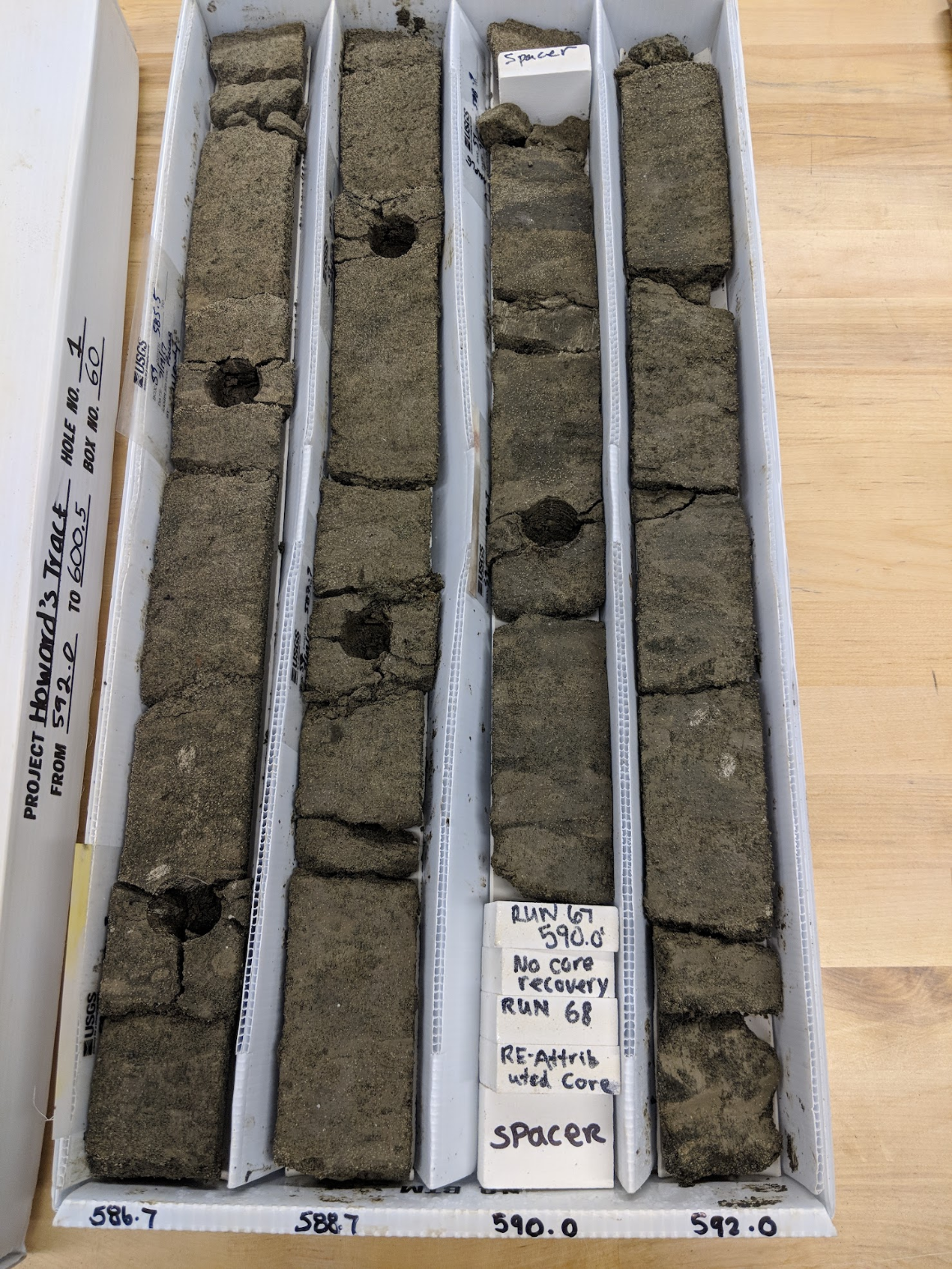
Focusing on the Salisbury Embayment, a broad shallow extension of the Atlantic Ocean over parts of modern-day Maryland, Virginia, Delaware, and New Jersey, the team analyzed samples from sediment cores drilled on the coastal plain. Using lithium, strontium, and lead isotopes, along with high-resolution atmospheric modeling, the researchers tracked changes in weathering and sediment transport across the Paleocene-Eocene boundary. The research team discovered that while the regional climate experienced a sudden rise in temperatures and a dramatic intensification of extreme precipitation events at the onset of the PETM (the Paleocene–Eocene thermal maximum), the actual geographic source of the sediment entering the basin remained continuous and steady. Instead of shifting the source of the mud and sand, climate disruption significantly accelerated both physical weathering and chemical alteration on land, rapidly churning through the sediments. This attempts to address a debate within the community about how weathering systems, and in turn carbon drawdown, respond to rapid climate change.
These findings provide crucial context for understanding how modern landscapes and hydrological systems might adapt to current climate shifts. Because the PETM represents an interval of global warming that occurred about 56 million years ago, it is one of the closest ancient analogs to human-driven global warming. Mapping, mapping how severe rainfall and heating affected historical weathering helps geologists and climate scientists better predict future shifts in continental erosion, soil stability, and sediment movement, and helps us better understand how the climate system recovers from perturbations.
Image by Will Rush shows a soil core from Howard's Tract on the Eastern Shore of Maryland, containing a sediment sequence across the Paleocene-Eocene boundary, roughly 55 million years ago. The holes are where samples were taken.