Stories
Fall 25 Faculty Updates
Dr. Micah Lattanner and colleagues recently published a meta-analysis in the 2025 Annual Review of Public Health titled "State of the Science of Structural Stigma and LGBTQ+ Health: Meta-Analytic Evidence, Research Gaps, and Future Directions."
The study reviewed two decades of research on LGBTQ+ structural stigma — laws, policies, and social norms that disadvantage sexual and gender minorities — and its effects on health. Findings show that structural stigma is associated with adverse health outcomes comparable to other well-known social determinants of health. The paper highlights future directions to advance LGBTQ+ health equity.
Stella Palumbo (Public Health major) and Carly Peterson (Public Health major), along with Dr. Lattanner and collaborators, submitted a manuscript funded through the Santa Clara Unhoused Initiative titled Housing is Health: A Longitudinal Study of Individual and Social Factors Predicting Long-Term Retention and Health Outcomes in Permanent Supportive Housing.
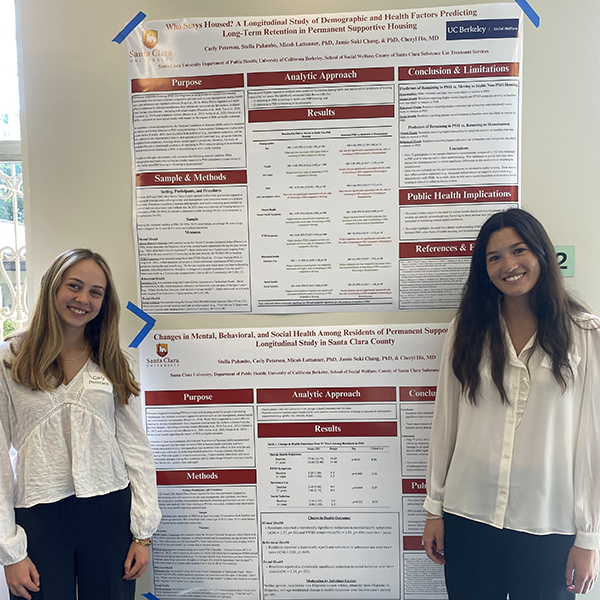
The study followed residents in a Santa Clara County permanent supportive housing (PSH) program for two years. Results showed that PSH residents experienced improvements in quality of life, health satisfaction, mental health, PTSD symptoms, substance use, and social isolation. Findings highlight PSH as both a housing and health intervention.
Dr. Alice P. Villatoro recently published “Stigma Affects How Parents Respond to their Children’s Mental Health, But Does Child Gender Complicate the Story?” in Stigma and Health. This study explored how different dimensions of mental illness stigma shaped whether parents sought formal mental health providers (e.g., psychiatrist, counselor), medications, or informal support for their adolescents, and whether these patterns differed by their child’s gender. Results showed that when parents recognized and labeled a mental health problem, they were more likely to seek formal providers, particularly for girls but not boys. Conversely, parents who held negative views about people with mental illness were less likely to have their child use medication, again with stronger effects for girls than boys. Although this study examined gender as a binary construct, Villatoro and colleagues underscore the urgent need for future research on how stigma may differentially impact help-seeking for parents of children with diverse gender identities. These findings deepen our understanding of how stigma and gender intersect to influence access to mental health help-seeking and point to the need for equity-focused mental health interventions.