Stories
Experiencing the Global Church: From the United States to Kenya and Back
The Collaborative Theology Initiative (CTI) seeks to respond to Pope Francis’ call for a theology that is synodal, contextual, global, transdisciplinary, intercultural, interreligious, and responsive to the needs of the Church and the world. CTI strives to form and sustain new working relationships among Jesuit theology centers around the world, and to better prepare students to contribute to theology as a work of the Society of Jesus, ministering to the universal Church of the 21st century.
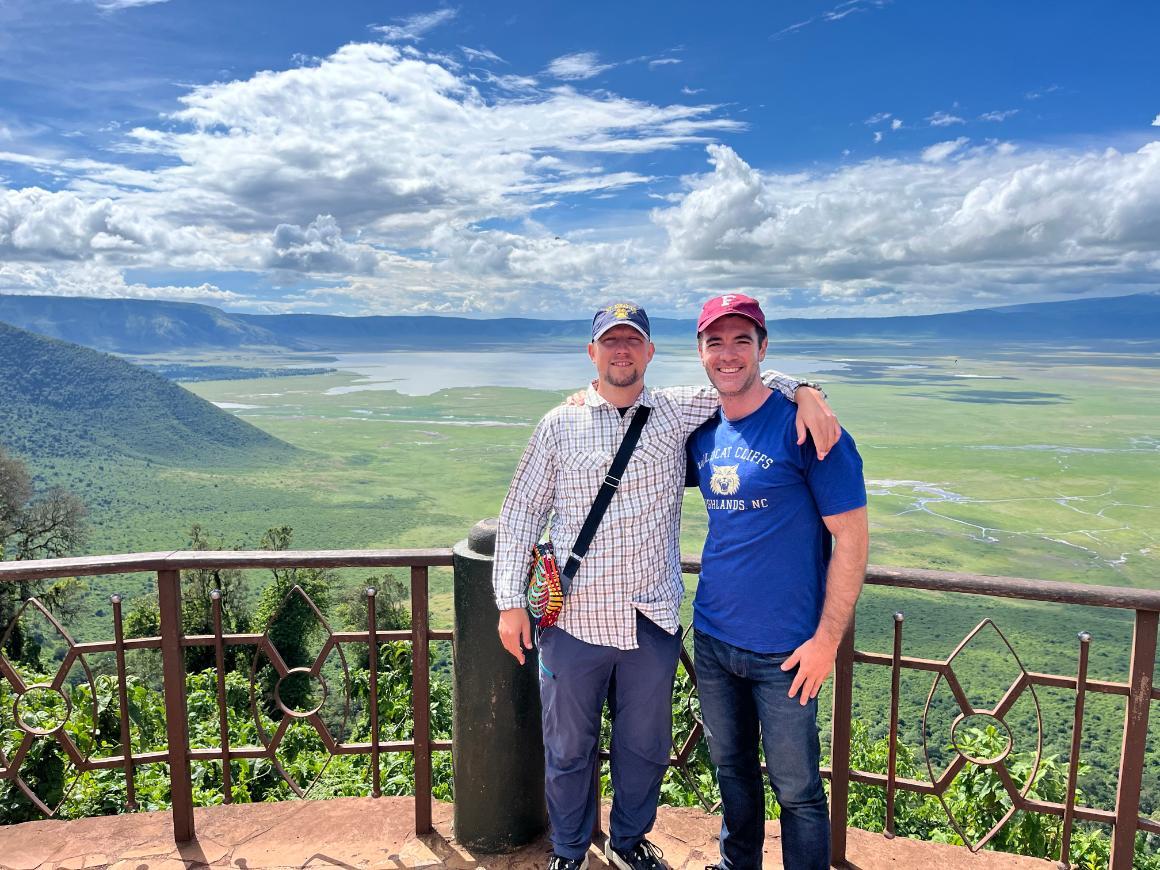
Through the CTI, Jake Braithwaite, S.J., and Nathan Krawetzke, S.J., JST alumni, spent the Spring semester of 2025 at Hekima University College in Nairobi, Kenya. Braithwaite completed his MDiv, STL, and ThM degrees at JST-SCU in 2026 and is now serving as Parochial Vicar at St. Ignatius of Loyola Parish in Chestnut Hill, MA. Krawetzke graduated with his MDiv from JST-SCU in 2026 and serves as Parochial Vicar at St. Mary Student Parish in Ann Arbor, Michigan, serving the students of the University of Michigan. As they share below, their time in East Africa was life-changing, and they experienced the universality, diversity, and vitality of the Catholic church. Krawetzke and Braithwaite learned about the opportunity to study at Hekima University College from stories other Jesuits shared over the years, and it was one of the reasons they chose JST-SCU.
Traveling to another country, particularly one you haven’t visited before, allows you to discover its people, culture, and traditions. Even more so when you live and study there for an extended period. Although you had heard about Hekima, was there anything that surprised you or was unexpected when you first arrived?
Jake:
Americans have the stereotype that Africa is a country, so I tried to keep in mind, “I'm going to Kenya. I'm going to have an experience in Kenya.” But the ironic thing about going to Hekima is that it's not particularly Kenyan; that is, there aren't many, if any, Kenyans on the faculty or among the students. They're mostly from other places, and most of them aren't even from East Africa, so we were immediately thrust into this experience of the pan-African church.
One of the early things to figure out and navigate is how people from all over Africa relate to one another, with the most obvious thing being language: among African Jesuits, the two primary language groups are French and English, and guys from Madagascar prefer to speak Malagasy. You sort of had to learn how to navigate what the different cultures are among the different language groups.
Nathan:
For example, we talked and debated about colonization in our history class, and in my Christology class as well. People get fired up, but the professors didn't shy away from some of these topics. So, they would ask whether it was good for the church to have these missionaries at this time or whether it was good for the church to Africanize at this time, and you'd be forced to be on one side or the other, and they would just tell you right then which side you'd be on. So, getting to see guys from all these different countries, different ethnic groups within the countries, different linguistic groups, and then how the questions about these things play out and to see the variety of thoughts, experiences, and understanding. People have very different perspectives, and that was eye-opening for me. It also made me think a lot about how we do theology and the questions we ask. They're in their different contexts and are asking different questions because the things they care about are also different.
As you're continuing your ongoing formation as a Jesuit, was there anything that was specifically significant in that formation process? As you're looking at this chapter of your formation, an important one, was there something that you'll carry with you in terms of being a Jesuit and your formation as a Jesuit from Hekima?
Nathan:
I would say two things. The first is that, had I not gone to Hekima, I don't think I would have developed a very fond affection and love for the men who are over there. I don't know that I would be as concerned about the future of the Society, not just here but also there. We often talk a lot about how we Jesuits are a universal society, but the experience at Hekima really enfleshed that for me in a greater way. This allows me to actually reflect and think about how things are not just impacting here, but also impacting these men, their ministries, and their apostolates over there, and how we can better support one another.
The other thing I would say is that I was very inspired by a lot of the different works going on. There, the Society is starting these new ventures, but you have over 100, 200 religious congregations in Nairobi. They're doing all this great work in orphanages, schools, or in situations where there are terrorists, or they're cash-strapped, or they don't have certain resources, whether financial or otherwise. Just to be able to be amongst the people who take these conditions very seriously and attack the problems with great love, to me, it was just very edifying, inspiring, and makes me want to be a better Jesuit, better follower of Jesus. So, I'm really grateful to all the men and women that I met there who were able to share that with me.
Jake:
I agree with Nathan a lot, so I'll just give a few more specific examples. In the house that I lived in, I lived with the first-ever Liberian Jesuit –He was just ordained this summer, so he's the first-ever Liberian Jesuit priest– and with another guy who is from Burkina Faso. There are many examples of this, but these are just two guys. The problems of the African Society of Jesus are essentially the opposite of those in the United States. They have so many men, younger men, that want to join that they don't know where to put them, but they don't have the institutional bandwidth that we have, which is hard to build.
Talking with this guy from Liberia, his name is Friday; he's really interested in building up schools and parishes and things in Liberia where the Jesuits have never been before, and he is the product of the first parish that was there. He'll be the leader in creating what happens in that country. As we know from what happened in the United States, this could have ramifications for 200 years in ways that we can't imagine. So I agree with Nathan that I care a lot more about what's going on there because I know Friday.
Then, in terms of the way that the Jesuits are growing there, this guy from Burkina grew up in this tiny village. He went to school when his grandmother had money, which wasn't often. One day, he and his friend were out playing soccer, and his friend said, "Oh, I'm going to go take this test. Do you want to come?" The friend didn't pass the test, but he did. And it was the test for the seminary. The priest who was running it asked him, "Are you Catholic?" And I don't think he was at the time. He was baptized and confirmed soon after. He just took the test. He's brilliant, and he's a pro. I mean, he's really, really smart. He has now his mother tongue; he has French, English, Greek, and Hebrew; I think he has Latin. He's going to be a philosophy professor at a university. I asked him, “If you hadn't taken that test, where would you be right now?” And he said, “I would be running a small business by the side of the road in my hometown.” The fact that we, as Jesuits, can nurture and find this talent that's all over, filling up the novitiates across the continent, is inspiring to me. The mission lives on very strongly in these men.
When you look at this kind of global partnership between JST and Hekima, having these interactions and collaborations, what do you think their importance is in the world we live in today? Why is it important to have these exchange opportunities and close partnerships?
Jake:
The first and the most important thing, I think, I'll borrow a word that Nathan said before, is the enfleshing of these things that have existed only in my mind before. For example, the guy who sat next to me in class every day was not a Jesuit but was a Pallottine, and his family is from Goma in the DRC. I was reading in the New York Times in my little sophisticated app about the conflict in Goma as M23 was coming in and taking over the city, and it was happening to his family. So, to be able to talk to him about those real issues and to think about the way that our government is interested and not in taking a role in ending that conflict. I could do that here; it's possible, but it's much easier to do it there when I'm embedded in it, being able to understand what's happening across the world through friendship.
Nathan:
I would say it gives a great sense of perspective. We have a lot of international students here at JST, right? And even the Jesuit conference in Hekima, their provinces are made up of so many different countries, right? So, they're always international, while U.S. Jesuits may come from different provinces in the United States, but we don't necessarily have to cross into another nation or language. I think that, for us, there's a great benefit. We gain a perspective of global Catholicism; we also get to know people who come from different places, but I think it also relativizes, in a good way, certain issues that we magnify in our own local context. For example, in the United States, one of the big battles is over the Mass. Should it be more traditional or progressive? When we were in Hekima, you could have multiple different languages at Mass. We'd have French, Portuguese, Malagasy, Latin, and English in the same Mass. The experience at Hekima gave us a broader perspective on the global problems in the church and the kinds of problems that are more parochial and that we might magnify.
For Nathan and Jake, as for many other students throughout the years, studying at Hekima University College in Nairobi, Kenya, through the collaborative work of global Jesuit theologates, was a life-changing experience. The opportunity to glean another culture, get to know women and men committed to their vocations and ministries, and experience a different context with its lights and challenges contributes to a more profound theological reflection and enriches both the academic and ministerial work of the JST-SCU community.