Nicaraguan smallholders thin shade trees, but maintain high species diversity
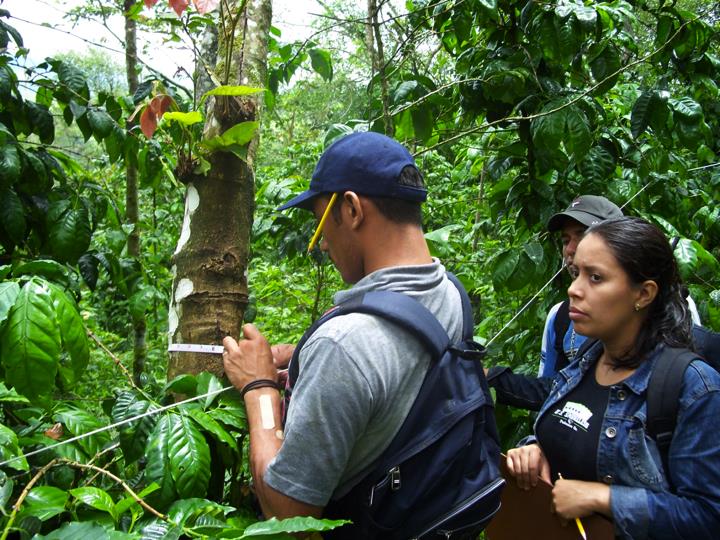 The majority of the world’s coffee producers are smallholder farmers, managing land in tropical regions globally recognized for high levels of biodiversity and capacity for carbon sequestration. Though researchers have recognized the potential for coffee smallholders to conserve biodiversity by maintaining a layer of shade trees and using low-input farming methods, studies have by and large remained at the landscape scale and we know little about long-term species diversity and sequestration patterns in these systems. A recent study published in Agriculture Ecosystems and the Environment was conducted in partnership with the same cooperative that has worked with ESS faculty member Chris Bacon since 2001. The research tracked changes in shade trees, epiphytes, and carbon stocks in smallholder coffee farms in northern Nicaragua over a 10-year period, offering insight in response to this pressing question.
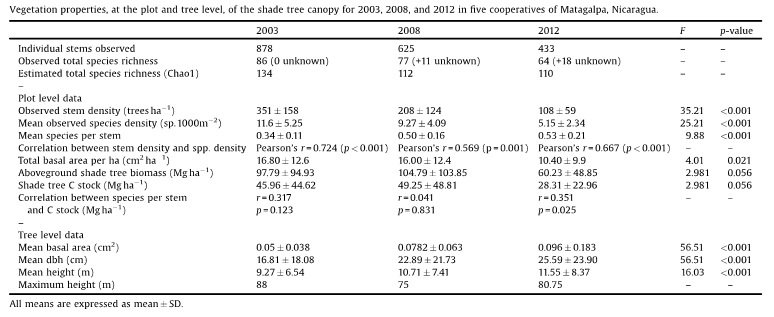 Authors Chris Bacon (Department of Environmental Studies and Sciences Santa Clara University), Katie Goodall (Wellesley College), and Ernesto Mendez (University of Vermont) found that tree density and carbon stocks declined over the decade-long study, but diversity of tree species remained unchanged.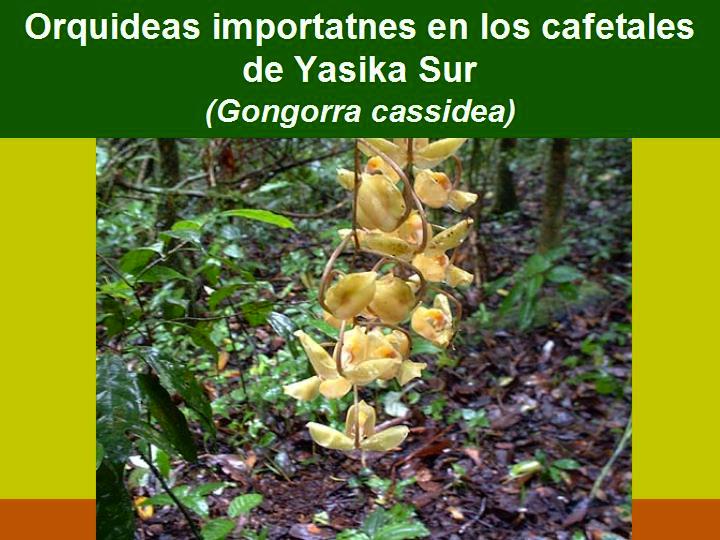
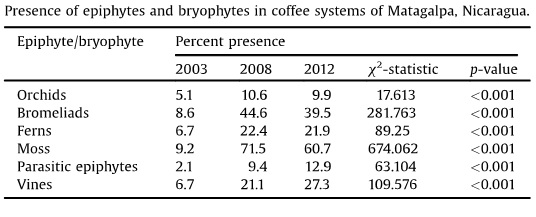
Epiphytic plants increased over the ten-year period despite decreasing host tree densities, suggesting either a change in farmer management or improved habitat conditions for epiphytes. The authors also found that farmers who individually managed coffee farms maintained a greater tree density than collectively managed farms, but that species diversity and carbon stocks were no significantly different.
This research not only highlights the contribution of smallholder coffee production to the conservation of shade tree diversity and epiphyte communities, but also the pressure smallholders may experience to cut shade trees in order to increase coffee yield. You can taste the coffee by asking for the Nicaraguan coffee at the Sunstream Café in the Learning Commons.
Full citation: Goodall, K. E., Bacon, C. M., & Mendez, V. E. (2015). Shade tree diversity, carbon sequestration, and epiphyte presence in coffee agroecosystems: A decade of smallholder management in San Ramón, Nicaragua. Agriculture, Ecosystems & Environment, 199, 200–206. doi:10.1016/j.agee.2014.09.002
Jan 9, 2015