Stories
Walking Through History: Bronco Battalion Cadets Take Staff Ride to South Korea
Standing on the battlefields of South Korea, Six Bronco Battalion seniors transformed classroom strategy into lived understanding through an immersive Korean War staff ride.
By Kate Vander Vort ’27
For seniors in Santa Clara University’s Military Science and ROTC program, learning military history goes far beyond textbooks and classroom discussions. In December 2025, six Bronco Battalion MS IV cadets traveled to South Korea for an immersive staff ride, studying pivotal battles of the Korean War while standing on the very ground where history unfolded.
“For us it is history in a place far away, but for the folks we met it was their own history. That changes how you think about service.”
Staff rides are a long-standing tradition in the U.S. Army, designed as experiential, peer-led learning opportunities. Cadets conduct independent research, assume the roles of historical units or leaders, and brief their peers on key moments of a battle while physically walking the terrain where it occurred. While many programs conduct staff rides locally or around maps and tables, Santa Clara University is uniquely positioned to take this tradition internationally.
“Being able to take cadets abroad and walk meaningful ground makes the experience entirely different,” Von Bargen said.
Prior to departure, all participating cadets were enrolled in MILS 401, a senior-level course that covers officership, ethics, and how to plan, execute and assess training. Throughout the quarter, cadets researched the geopolitical conditions following World War II, the strategic objectives of U.S. and United Nations forces, and the doctrine and tactics of opposing North Korean and Chinese forces. This academic preparation culminated in on-site briefings delivered at museums, memorials, and preserved battlefields across South Korea.
From Map to Terrain
The staff ride began with a visit to the Korean War Memorial and Museum, where cadets examined the international context that led to the June 1950 invasion of South Korea. Discussions focused on the post-war balance of power, early U.S. strategy in Korea, and the lived experiences of U.S., Republic of Korea (ROK), and North Korean People’s Army (NKPA) soldiers.
During the trip, cadets studied two major Korean War engagements in depth: the battle of Osan, fought by Task Force Smith in the first U.S. ground action, and the Battle of the Naktong Bulge, part of the broader Pusan Perimeter campaign. At Osan, cadets analyzed the challenges of U.S. Army preparedness, early strategic miscalculations, and North Korean tactics that defined the opening phase of the conflict.
For cadet AJ Martinez ’26 (Political Science), standing on the battlefield made the quarter’s research feel immediate and personal. “The first thing I felt was how quiet it was,” Martinez said. “That quiet made everything we studied feel heavier. It stopped being ‘history’ and became a place where real people made real decisions with no second chances.” He explained that distances which appeared manageable on a map felt vastly different in person. “At Osan, you realize how limited sight lines are and how hard it is to control a fight when you’re stretched thin. It’s easy to judge decisions from a classroom. It’s different when you’re standing there.”
Along the Naktong River, limited modern development allowed cadets to observe terrain that closely resembles what soldiers encountered more than 75 years ago. Standing on the river approaches and defensive positions helped cadets understand how geography, distance, and weather shaped battlefield decisions during what became the lowest point of the war for U.S. and U.N. forces.
“Seeing the terrain made the decisions feel more human and less theoretical,” Martinez added. “You understand why some positions were harder to reinforce than they appear on paper, and how the river shaped everything from movement to morale.”
“One of the biggest lessons is that maps only tell part of the story,” said Von Bargen. “Until you see the terrain—how far things really are, the sightlines, the elevation—you don’t fully understand how realistic or difficult certain decisions were.”
History That Isn’t Over
A defining moment of the trip occurred at the Osan memorial, where cadets encountered Korean War veterans and surviving spouses paying tribute to fallen American soldiers. As two busloads of veterans arrived and formed lines to honor U.S. service members, cadets were able to speak directly with them and hear what the war still means to those who lived through it.
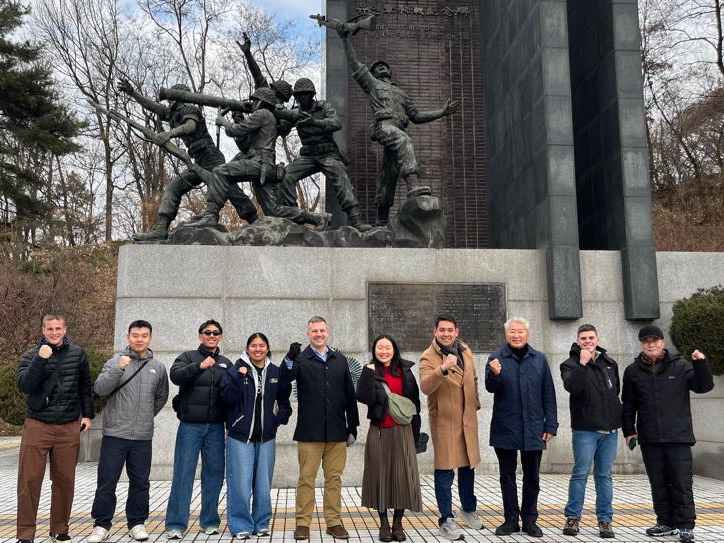
“It was humbling. You can read about sacrifice, but hearing it from someone who lived it makes you listen differently. Seeing widowed spouses there with their families reminded me that service isn’t abstract, it’s commitment and sacrifice that lasts generations.”
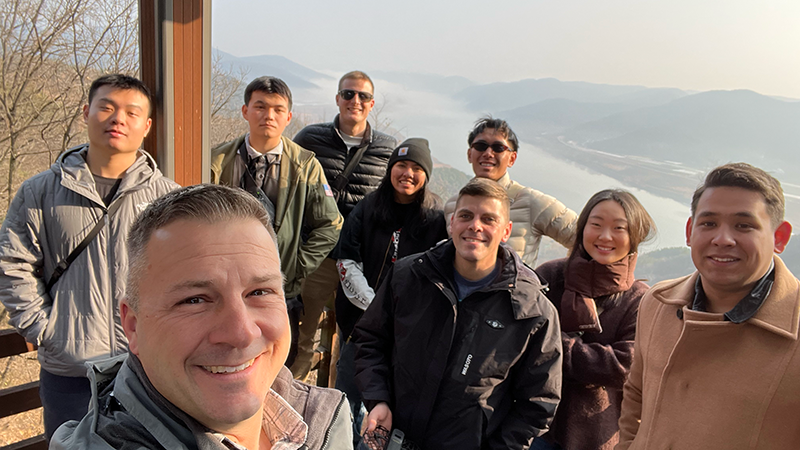
The staff ride also highlighted how the Korean War remains an active, unresolved reality. Cadets visited the Demilitarized Zone (DMZ), an experience rarely open to the public, made possible through special military connections. Standing at the border between North and South Korea offered a stark reminder that the conflict has not ended, only frozen in place.
For Martinez, the visit reshaped his understanding of leadership in the present tense. “At the DMZ, it felt like the mission wasn’t just a lesson, it was still active,” he said. “There aren’t big speeches. It’s daily discipline, attention to detail, and staying sharp even when nothing is happening. That’s when complacency shows up.”
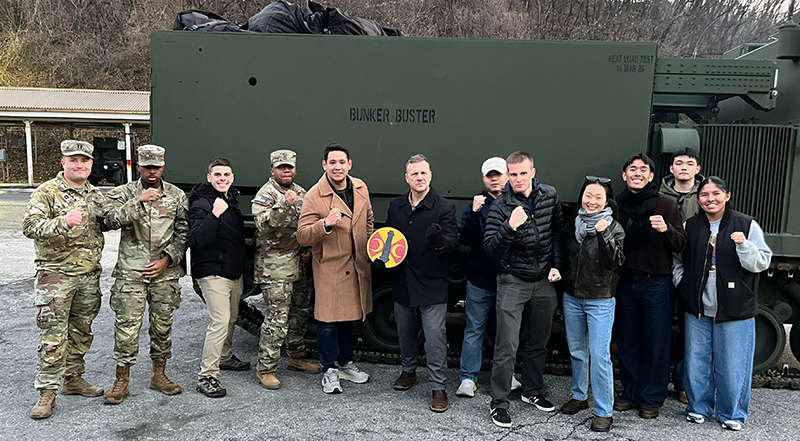
In addition, cadets toured an active U.S. Army artillery unit tasked with defending South Korea in the event of renewed conflict. For many, the visit underscored how quickly lessons from the past could become present-day responsibilities.
Preparing Future Officers
The experience ultimately shaped how cadets envision their future roles as officers. “It reinforced that I want to earn trust through competence and consistency,” Martinez said. “Leadership isn’t just a role, it’s a moral responsibility. The staff ride reminded me that I owe my future soldiers preparation and honesty.”
Experiences like the South Korea staff ride are made possible through donor support. While the Army provides the curriculum and academic framework, it does not fund international travel, and departmental budgets alone cannot cover the full cost.
“Without donor support, this kind of immersive learning wouldn’t be possible,” said Von Bargen. “These experiences shape how cadets understand leadership, sacrifice, and the realities of future service.”
For SCU’s Bronco Battalion seniors, the staff ride was more than a history lesson. It was an opportunity to connect past conflicts to present responsibilities and transform abstract strategy into lived understanding.