Professor Brian Thomas
June 2, 20251
At Santa Clara University's Ciocca Center for Innovation and Entrepreneurship, we talk often about the "entrepreneurial mindset." It's more than a set of traits—it's a way of engaging with the world. Among its essential components—alongside stakeholder empathy, problem-solving, and value creation—is something at once foundational and paradoxical: the willingness to tolerate risk.
Why does that matter? Because the numbers tell a hard truth. Of all venture-backed startups in the U.S., only 3 in 10 receive seed funding. Just 2 in 100 reach Series C. Only 50 out of 1,000 make it to any kind of meaningful exit. And a single startup in 1,000 becomes a unicorn. Entrepreneurship is a gamble where the house nearly always wins.
Still, people step up to the table.
The Entrepreneur as Risk Taker
To launch a business is to invite uncertainty into your life. But what kind of person accepts that invitation? Are entrepreneurs born with a unique appetite for risk, or is it something shaped by context and conviction?
Take Richard Branson. His first venture was a magazine called Student, launched at age 16. Was his risk-taking a product of his youthful bravado or his personality—extroverted, dyslexic, unafraid of failure? Or was it something subtler: a supportive mother, a city alive with energy, an education at a British boarding school that instilled independence?
Whatever the root, the question remains: can we cultivate risk tolerance, or is it innate?
Knowing your own constitution matters more than finding a universal answer. Some founders thrive on uncertainty; others collapse under its weight. And the ability to discern your boundaries—what you're willing to stake, emotionally and financially—is a critical entrepreneurial skill. Perhaps the critical one.
A Climber's Creed
Risk isn't just something managed in boardrooms. It lives in bodies, in instincts, in the part of the brain that scans for handholds on a cliff face.
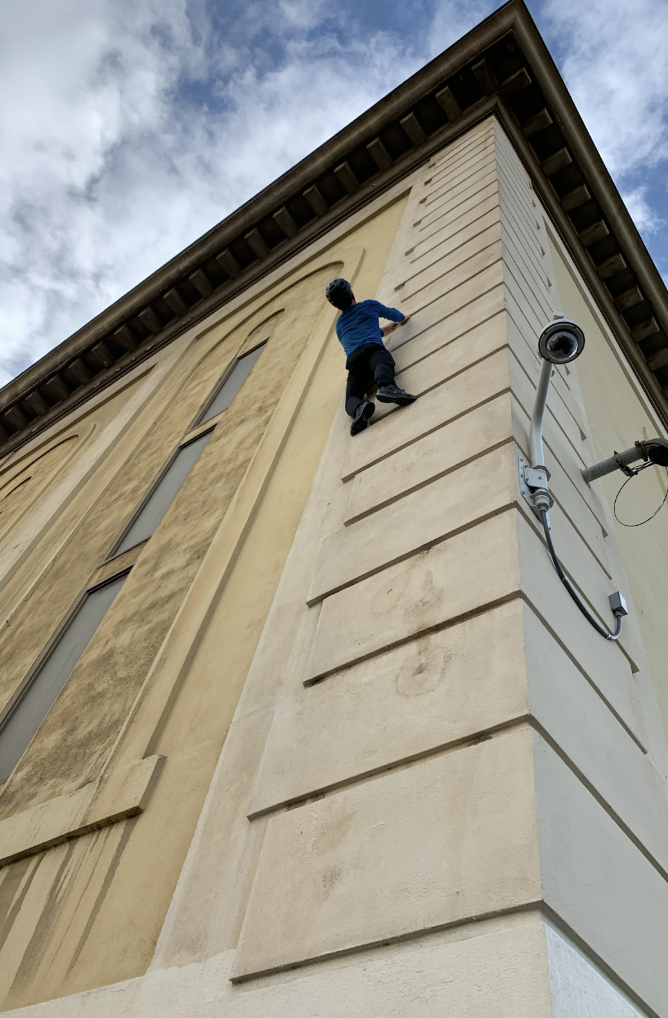
I think of my friend Timmy O'Neill, a professional rock climber. In January 2020, just before the world shut down, Timmy and I were biking through Oakland. We stopped at a railroad crossing to let a freight train pass. I turned to speak, but he was gone. I looked up—and there he was, halfway up a building wall.
No ropes. No hesitation. Just movement.
My thoughts went immediately to the ground. What if he falls? His, I imagine, were elsewhere. How can I reach the top before the train passes?
This is not bravado. Timmy once held the speed record on El Capitan's Nose route in Yosemite. He understands risk at the cellular level. He doesn't ignore danger—he prepares for it. Great climbers mitigate risk through relentless physical training, route assessment, mental focus, and a cultivated sense of flow. They don't expect the mountain to be safe. They train so they can move through it safely.
Climbing, like entrepreneurship, is not for the faint-hearted. But neither is it for the reckless.
"These measures don't eliminate uncertainty. But they do restore a sense of agency—of choosing your risks rather than being chosen by them."
Institutionalizing Doubt
That's where Enterprise Risk Management (ERM) enters the picture. While it may sound like corporate jargon, ERM is, at its heart, a structured form of asking the right questions. What could go wrong? How bad would it be? How likely is it?
Risk mapping is often the starting point. Imagine a two-axis grid: likelihood runs vertically; impact runs horizontally. Plot your risks on that grid, and you'll see—visually—where danger concentrates. In the top-right quadrant are the existential threats: highly likely and highly damaging. A food safety incident for a company like Chipotle, for instance, wouldn't just be probable. It could be catastrophic. In late 2015, the company experienced a significant E. coli outbreak. Fortunately, no deaths were reported. In the aftermath, the company lost $8 billion in market value and suffered lasting damage to its reputation.
From there, organizations explore strategies: accept, reduce, transfer, or avoid. Accepting means living with the risk. Reducing might involve controls or countermeasures. Transferring sends it elsewhere, usually to insurers. And avoiding it altogether might mean reshaping business models or declining certain partnerships. In the case of Chipotle, it accepted minor staff hygiene lapses, adopted DNA-based pathogen testing of ingredients, likely adjusted its liability coverage policy, and avoided raw items on the menu.
These measures don't eliminate uncertainty. But they do restore a sense of agency—of choosing your risks rather than being chosen by them.
Undertaking the Leap
Harvard psychiatrist Steven Berglas once reminded us that entrepreneur comes from the French entreprendre: to undertake. Not to own a business, but to commit to a venture whose outcome is uncertain.
That venture could be a startup. But it could also be a nonprofit, a social movement, a work of art, a research lab. It's a mindset more than a job description—a readiness to leap into the unknown, with preparation in one hand and faith in the other.
Risk is inevitable. Whether on the rock wall or in a tech start-up, the challenge is not to eliminate it. It's to know your limits and engage honestly, skillfully, and—when the time is right—without the rope.
1 This newsletter article was drafted with the support of Perplexity, ChatGPT, and Grammarly
Brian Thomas is a member of the faculty and staff at Santa Clara University's Leavey School of Business. A former corporate executive, investment banker, and development economist, he inhabits the evolving intersection of business, finance, and society.