Stories
Noticing God: How the Spiritual Exercises Inspired a Radical Response in Ministry
But what happens when noticing God awakens a desire to help others notice God in their own lives? For Daniel Valcazar II, M.Div. ‘17, that desire opened a new chapter in his vocational journey and eventually led him to the Jesuit School of Theology of Santa Clara University. His Master of Divinity studies taught him not simply to know more about God, but to encounter Scripture, cultures, traditions, and people with greater attentiveness. He learned to ask questions, examine assumptions, remain with uncertainty, and accompany people whose experiences of faith might be very different from his own.
Note: This article is adapted from a recorded conversation between Daniel Valcazar II, Associate Director, Leadership Giving University Relations and Preston Carmack, Assistant Dean of Enrollment and Marketing Communications at the Jesuit School of Theology of Santa Clara University, recorded in the summer of 2025.
Preston: What led you to want to do theological studies at the Jesuit School of Theology of Santa Clara University? What brought you here, and what was that journey like?
Daniel: The decision ultimately to pursue a degree at JST-SCU came from my experience in Jesuit formation, particularly doing the Spiritual Exercises of St. Ignatius. Through that experience, I realized that I wanted to take what I had experienced and try to live it out more fully. When I looked at the people doing the types of work and ministry that I wanted to do, I found that a number of them had their degrees from the Jesuit School of Theology. It is a great gift to be at a place like JST-SCU, where the educators, staff, and others are so committed to the work of collaborative theological learning. This endeavor is really special. You’re alongside Jesuits, lay women, religious, and people from many different backgrounds. We’re all in it. We’re all bringing all of ourselves to the experience.
Preston: Are there any other specific stories about your time at JST-SCU or in a class that stands out to you, something that really meant something, whether it was a teacher or a conversation with fellow students?
Daniel: There are so many.
When I think of the teachers, I would really like to use my transcript to remember all the classes and what each one was about. But the two that come to mind most right now, especially at this stage of my life, are the classes I had with Dr. Gina Hens-Piazza and the classes with Dr. Jerome Bagget. Gina taught Hebrew Scriptures. In those classes, we weren’t just with our MDiv cohort. There were students from the Ph.D., S.T.L, S.T.D. programs as well. We would talk about what we found in Scripture and how it came across us.
Gina helped us unpack Scripture from different perspectives. Looking at Scripture through a Korean lens is different from looking at it through an Afro-Nigerian lens or an Indian lens. Then there were the classes with Jerome Bagget, particularly around the sociology of religion and the sociology of American Catholicism. What does it mean to be Catholic here, in this particular place?
Preston: What would you say to someone who’s curious about the work JST-SCU and Santa Clara University are doing?
Daniel: There’s space to wrestle with the unknown, to disagree gracefully and with civility, and to recognize that while God moves in mysterious ways, God’s presence is active. Another thing that retired faculty Fr. George Murphy and Sr. Jane Ferdon, O.P., would say is, “God likes to be found. God likes to be noticed.” That’s such a wonderful idea. The opportunity is to consider our strategic plan and the goal of becoming an even more global leader in theology. JST-SCU is already incredibly global, with students from around the world.
One of the beauties of JST-SCU is the gift of Ignatian spirituality and the Jesuit approach.
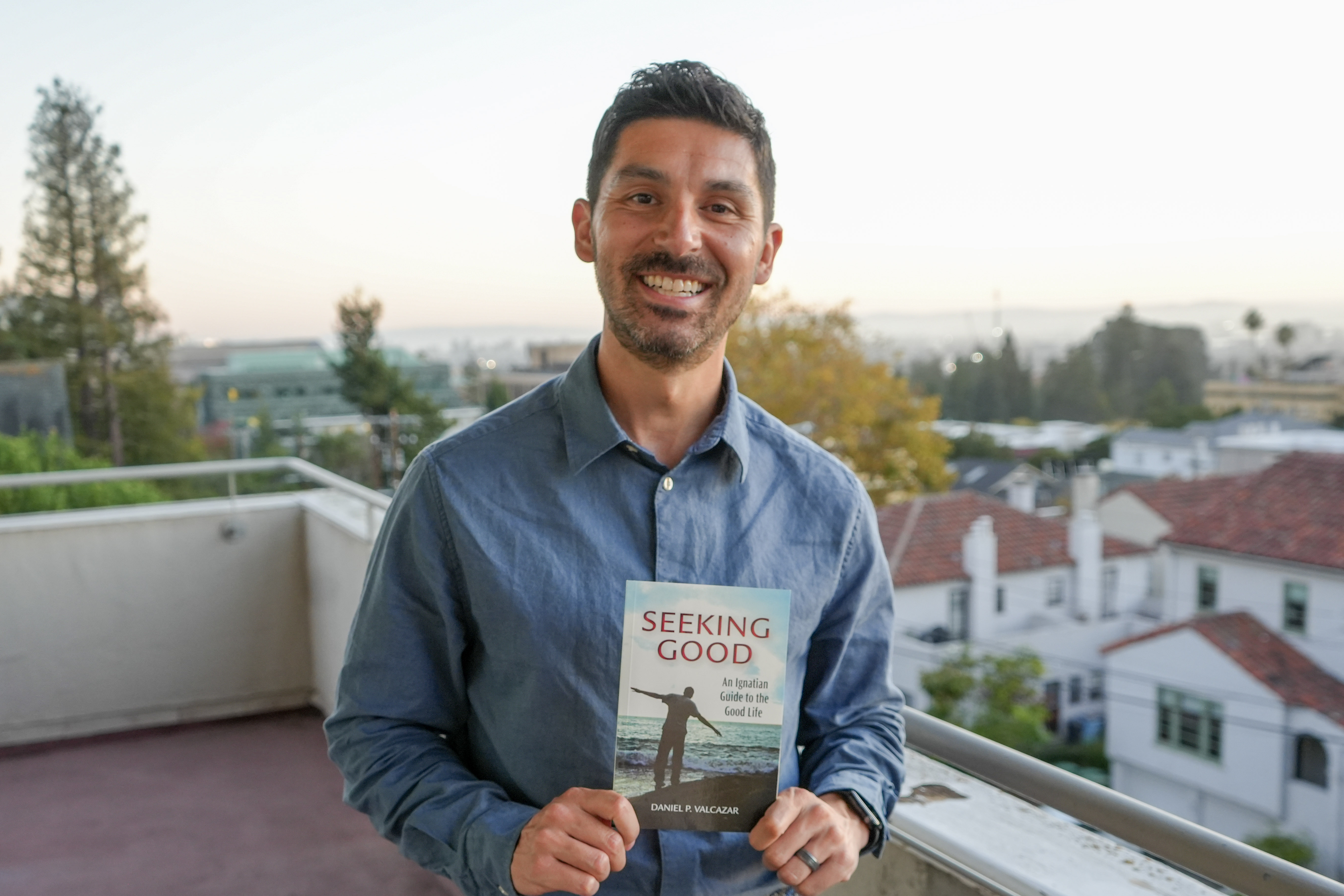
Preston: Can you tell us more about the book you recently authored?
Daniel: I’m honored to have put into writing something that I feel has been building throughout my life, from high school to college and now. The idea is that so many of us are on this life journey. We want the best for our lives, to be successful, to have a good life. Of course, “a good life” means different things to different people. At the same time, we’re living in a context of increasing secularization and immense plurality within virtually every community.
So how do we find shared language? I believe the Spiritual Exercises are the best spiritual practice I’ve encountered. I know not everyone is going to pursue the Exercises. I hope, on the one hand, to help more people explore and discover the Spiritual Exercises. But as a steppingstone toward that, I’ve written a book called Seeking Good: An Ignatian Guide to the Good Life.
Daniel: The book invites readers to reflect on the Exercises amidst everyday life. We’re moving at such a fast pace. So how do we take time to reflect? It might not need to be more than five minutes. It might not need to be more than a minute. We can take a quick moment before walking into a meeting or walking through the door at home and ask:
“How am I showing up? How am I feeling before I go in? Am I stressed? Am I excited? What’s going on for me? The more consistently we take those moments, the more we recognize that we can change course at any moment.
_________________________________________________________
Daniel’s story reveals something deeply sacramental about ordinary life: when people learn to notice and listen with the heart, what appears ordinary can disclose grace. Work can become a ministry. Listening can become accompaniment. Resources can become gifts. Gratitude can become generosity. And a vocation can emerge within the life that we are already living. This same spirituality animates Daniel’s book project, Seeking Good: An Ignatian Guide to the Good Life. He hopes to invite people to ask: “What does good mean to you? How can I seek good more authentically and more effectively?”