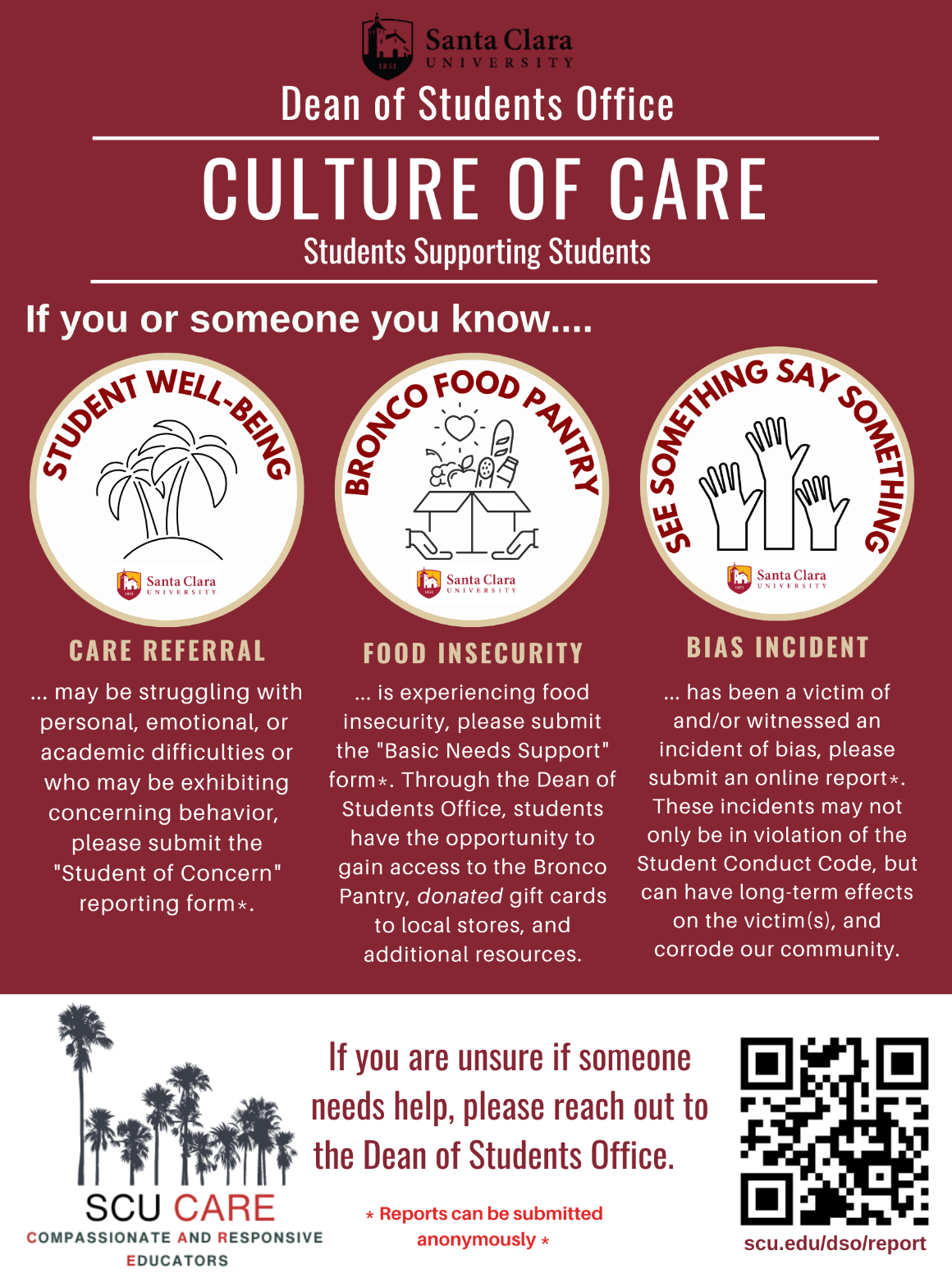
As students, you may know, hear, or see things that faculty and staff may not. With this perspective, it is important that you reach out to the Dean of Students Office if you have concerns about a peer. Reference the information below for resources to help you identify and support someone in need.
How to Recognize Someone in Distress:
Academic Signs
- Significant deterioration in quality or quantity of work
- Repeated absences
- Missed assignments, exams, or appointments
- Written or artistic expression of unusual violence, social isolation, despair or preoccupation with suicide or death
- Repeated requests for special accommodations, e.g., paper extensions, make-up exams, etc.
- Patterns of perfectionism. e.g., the inability to accept any grade but an A
- Overblown or disproportionate response to grades or other evaluations
Behavioral and Emotional Signs
- Direct statements indicating distress, family problems, or loss
- Angry or hostile outbursts, yelling, or aggressive comments
- Withdrawn from others, low motivation
- Excessively demanding or dependent behavior
- Failure to respond to outreach by friends, family, or administrators after expressed concern
- Shakiness, tremors, fidgeting, or pacing
- More animated than usual, euphoria, overly enthusiastic
- Paranoid, excessively vigilant, fear that others are going to cause harm
- Extreme disorganization or erratic performance
Physical Signs
- Deterioration in physical appearance or personal hygiene
- Excessive fatigue, exhaustion, falling asleep in class
- Visible changes in weight, statements about change in appetite or sleep
- Noticeable cuts, bruises, or burns
- Frequent or chronic illness
- Disorganized, rapid or slurred speech, confusion
- Unusual inability to make eye contact
- Coming to activities bleary or red-eyed or smelling of alcohol or marijuana
How to Help Someone in Distress:
Who to Contact
When in doubt, let someone know that you're worried about your peer. If someone you know may be struggling with personal, emotional, or academic difficulties, the most direct way to get them support is to submit a CARE Referral Form. Upon retrieval, a member of the Dean of Students Office will then reach out to the student to offer support and resources. Reports can be made anonymously.
If you're aware of a specific issue that you think is important for the Dean of Students Office to be aware of, please submit the appropriate reporting form listed on this page.
For more immediate concerns, please reference the contact listing below:
|
If a Student . . . |
Contact . . . |
|
is in possession of a weapon |
Campus Safety at 408-554-4444 or 911 |
|
is an imminent harm to self or others |
Campus Safety at 408-554-4444 or 911 |
|
is a potential harm to self or others |
Student Health, Counseling and Well-Being at 408-554-4501 and Dean of Students Office at 408-554-4583 |
|
is a victim of recent violence, abuse, or sexual violence |
Student Health, Counseling and Well-Being at 408-554-4501 or Wellness Center at 408-554-4409 or Title IX at 408-551-3043 |
|
has been a victim of past violence or abuse |
Student Health, Counseling and Well-Being at 408-554-4501 or Wellness Center at 408-554-4409 or EO&Title IX at 408-551-3043 |
|
is experiencing psychological distress impairing the ability to learn effectively |
Student Health, Counseling and Well-Being at 408-554-4501 |
|
is verbally or emotionally abusive |
Student Health, Counseling and Well-Being at 408-554-4501 or Dean of Students Office at 408-554-4583 |
|
is engaging in conduct contrary to that in the Student Handbook |
Dean of Students Office at 408-554-4583 |
|
has engaged in academic dishonesty |
Dean of Students Office at 408-554-4583 |
|
is having difficulty managing academic load or stress |
Drahmann Center at 408-554-4318 |
|
is experiencing family or personal crisis or loss and needs to miss classes |
Dean of Students Office at 408-554-4583 |
|
is suspected of alcohol or drug use interfering with academic effectiveness |
Student Health, Counseling and Well-Being at 408-554-4501 or Wellness Center at 408-554-4409 |
|
is having financial difficulties |
Financial Aid at 408-551-1000 |
|
is a victim of bias, harassment, or discrimination |
Dean of Students Office at 4583 and EO&Title IX at 408-551-3043 |
Additional Resources
For additional resources, click here.
SCU Offices that can help:
- Campus Ministry
- Campus Safety
- Student Health, Counseling, and Well-Being & CAPS
- Drahmann Advising & Learning Resources Center
- Office for Multicultural Learning
- Office of Accessible Education (formerly Disabilities Resource Center)
- Office of Student Life
- On-Campus Living & Off-Campus Living
- Rainbow Resource Center
- Title IX
- Wellness Center
Mental Health First Aid Training
Mental Health First Aid is a nationally recognized training program that teaches participants how to identify, understand and respond to signs of mental health concerns and substance use. The training provides the skills needed to reach out and provide initial help and support while helping to identify other longer-term solutions if needed.
Mental Health First Aid trainings are FREE for all faculty, staff, and students and come with a 3-year certification.
QPR
QPR stands for Question, Persuade, and Refer; the 3 simple steps anyone can learn to help save a life from suicide. People trained in QPR learn how to recognize the warning signs of a suicide crisis and how to question, persuade, and refer someone to help. The QPR Institute mission is to save lives and reduce suicidal behaviors by providing innovative, practical and proven suicide prevention training. Quality education empowers all people, regardless of their background, to make a positive difference in the life of someone they know.
To become a “QPR Gatekeeper” you will need to attend a training of approximately 90 minutes. QPR training is available to students, faculty and staff. Certification is valid for three years.
Future training sessions will be sent in upcoming Student Health, Counseling, and Well-Being newsletters. Should a department wish to offer a specific training session, please email cowellcenter@scu.edu.
Questions can be directed to cowellcenter@scu.edu
| Facilitators | |
|---|---|
| Ashleigh Pezzoni | apezzoni@scu.edu |
| Carol Cobb | ccobb2@scu.edu |
| Chan Thai | cthai@scu.edu |
| Cory Gong | cgong@scu.edu |
| Heather Dumas-Dyer | hdumasdyer@scu.edu |
| Jennifer Weller | jmweller@scu.edu |
| Jenny Girard Malley | jgirardmalley@scu.edu |
| Jessica Johns | jljohns@scu.edu |
| Justin Filiaggi | jfiliaggi@scu.edu |
| Krystle Jozen Dario | kdario@scu.edu |
| Matthew Duncan | mduncan@scu.edu |
| Michah Lattanner | mlattanner@scu.edu |
| Mythri Jegathesan | mjegathesan@scu.edu |
| Raisa Velaquez Bonet | rvelazquezbonet@scu.edu |
| Rami Mohamed | rmohamed@scu.edu |
| William Troche | wtroche@scu.edu |