How Many Years Does a Master's Degree Take to Complete?

Key Takeaways
- Most master's degree programs take one to two years to complete full-time, though part-time and accelerated options can significantly change that timeline.
- How many years a master's degree takes depends on several factors, including your enrollment status, field of study, thesis requirements, and whether your program accepts transfer credits.
- Finishing a master's degree faster depends on choosing an accelerated format, studying full-time, and minimizing additional requirements like a thesis where possible.
A bachelor's degree often follows a structure that feels familiar, even if the details vary. Most people enroll full-time, progress through a set course load, and graduate within a broadly expected timeframe. A master's degree is approached differently, not because its structure is entirely unique, but because the decision to pursue it is more deliberate. It often comes later, alongside work or other commitments, which is why the timeline feels more pressing.
Master's degree years depend on the structure of the program, your pace of study, your field, and decisions like whether to complete a thesis. Understanding those variables from the beginning allows you to plan your time and finances with far more control.
Typical Duration of a Master’s Degree
For most students enrolled full-time, a master's degree takes between one and two years to complete, usually across three to four semesters of coursework. Credit requirements typically range from 30 to 60 credits, depending on the field. Professional programs, such as an MBA, tend to sit at the higher end, while more specialized degrees in areas like finance or analytics often fall closer to 30–36 credits.
Factors That Affect How Long a Master's Degree Takes
The "one to two years" estimate is quite a broad range. The factors that affect the length of a master's degree are:
Full-time vs. part-time enrollment
Enrollment pace has the most direct impact on how long a master's degree takes. Full-time students, typically taking 9–12 credits per semester, can often complete their degree within one to two years. Part-time students, balancing coursework with full-time work, usually take closer to two to four years.
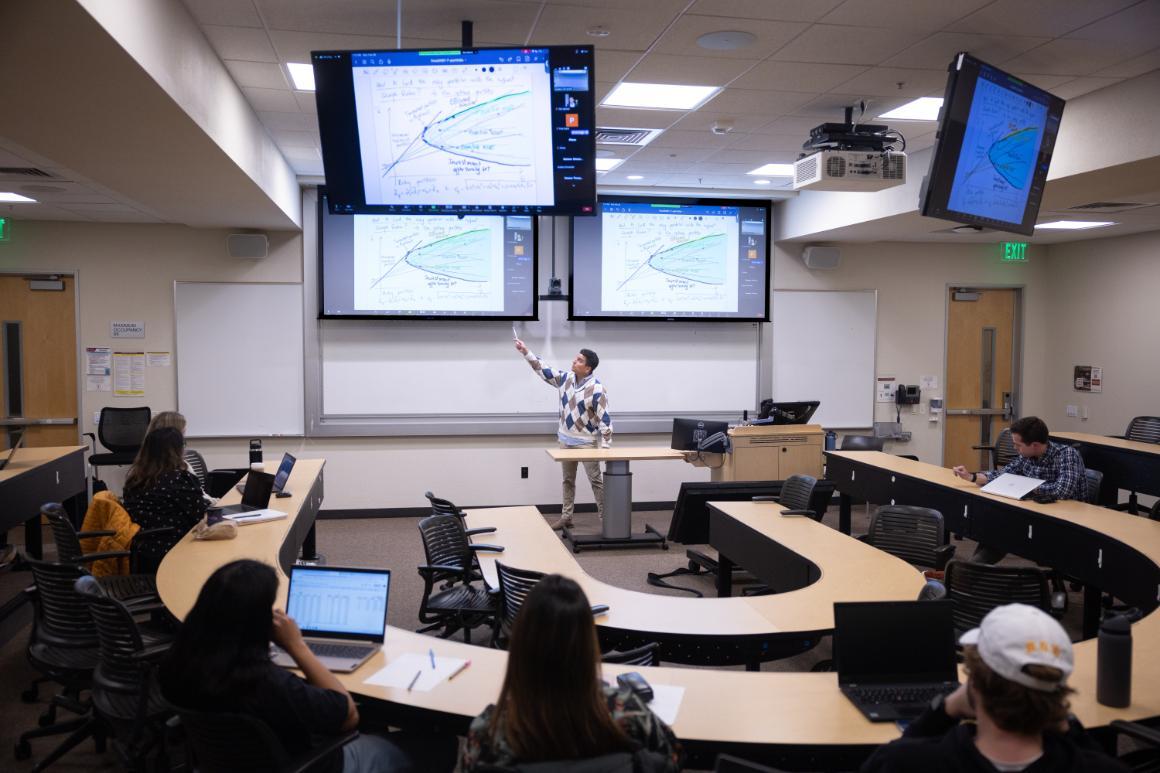
Part-time study is more common than many expect, particularly in professional programs designed for working adults. At Santa Clara University Leavey School of Business, for example, the Evening MBA follows a two-year structure built for part-time study, while the Executive MBA is designed as a shorter 18-month hybrid program. The Online MBA also allows students to complete the degree in roughly two years, depending on course load. More specialized programs can move faster; the MS in Finance & Analytics can be completed in as little as nine months full-time or around sixteen months part-time.
Program type and field of study
Different fields come with different expectations, which directly affect duration. Technical and quantitative programs, such as data analytics, finance, or engineering, often have more concentrated coursework and can be completed more quickly. Broader management or interdisciplinary programs may require more credits, group projects, or internships, which can extend the timeline.
Professional programs are also designed with application in mind. Many integrate real-world projects, case work, or industry collaboration into the curriculum, which can influence both pacing and workload, even if the overall duration remains similar.
Thesis vs. non-thesis tracks
Many master's programs offer both thesis and non-thesis options, and the choice between them can significantly affect how long you spend completing the degree. A thesis track requires original research under faculty supervision, which often adds one or two additional semesters.
Non-thesis tracks replace that requirement with coursework, a capstone project, or a practicum. In fields such as business, finance, and management, this is typically the standard path. At Leavey, for instance, MS students complete an experiential learning requirement that involves working with real data and real business problems, offering a more direct connection to industry than a traditional research thesis.
Transfer credits and prior learning

Previous academic work can sometimes shorten your timeline. Some programs accept transfer credits from prior graduate-level coursework, reducing the total number of credits required. A student entering with relevant coursework may be able to complete the degree more quickly as a result.
Policies vary widely, however. Not all programs accept transfer credits, and those that do often have strict limits. Reviewing these details early is important for planning.
Online vs. On-Campus Master's Programs
Online and on-campus master's programs typically require the same number of credits and carry the same degree since the format doesn't change the academic credential. What differs is scheduling flexibility and, in some cases, pace.
Online programs are structured for flexibility. You can complete coursework around a professional schedule, often asynchronously, which makes it easier to maintain full-time employment during the degree. Some online programs are explicitly designed for faster completion. Others run at the same semester pace as their on-campus equivalents, just without the commute.
How to Finish Your Master’s Degree Faster

If your goal is to move through a master's program quickly, the following strategies can help without cutting corners on the quality of the degree:
- Take summer courses. Many programs allow students to take classes in the summer term, which reduces the total number of academic years required. This is one of the most reliable ways to shave time off a program.
- Apply transfer credits early. If you have graduate-level coursework from a previous program, submit a transfer credit request before you enroll. Credits recognized upfront reduce your required coursework from day one.
- Choose an accelerated or cohort-based program. Some programs are explicitly structured for faster completion. Cohort models, where you move through the curriculum with the same group of peers, tend to have streamlined sequencing that keeps completion on track.
- Take the maximum allowed credits per term. If your schedule and program rules allow, taking the maximum each term compresses the overall timeline.
One important caution: check your program's rules on credit load before registering for an overloaded schedule. Many programs cap per-semester enrollment for academic reasons, and exceeding those limits isn't always possible. Speed is only useful if the program validates it.
Conclusion
What matters most is choosing a structure you can realistically sustain over time. If you are working full-time, a part-time or evening format may allow you to stay consistent without burning out. If you can step away and focus fully on your studies, an accelerated full-time program may help you complete your degree more quickly. The right timeline is not the shortest one, but the one you can follow through without disruption.
Explore master's programs at Santa Clara University Leavey School of Business and see how Santa Clara University's flexible formats can fit around your career and your timeline.
Frequently Asked Questions
Is a 1-year master's degree respected?
Yes, provided the program is accredited and meets standard credit-hour requirements, 1-year master's degrees are respected.
Can a master's degree take longer than 2 years?
Yes, particularly for part-time students, those on thesis tracks, or students who pause enrollment, part-time programs can run two to four years, and some research-intensive fields can take longer, even for full-time students.
Does a part-time master's degree count the same as a full-time one?
Certainly! The degree credential is identical regardless of whether you completed it part-time or full-time; employers evaluate the accreditation, the institution, and the program, not the enrollment pace.
Discover Your Next Step
This will only take a moment.