Top Stories
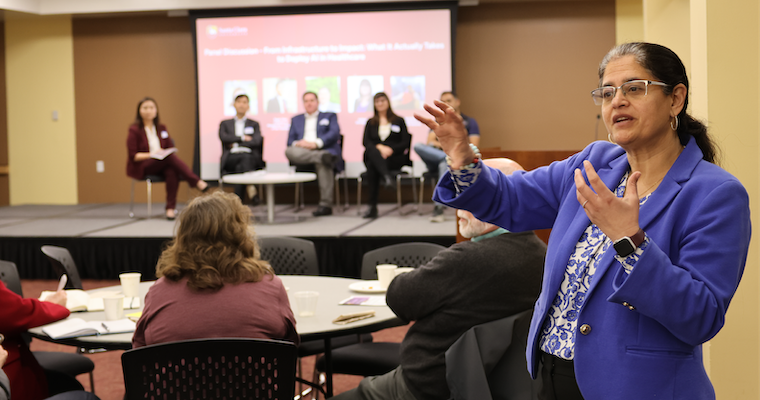
From Breakthroughs to Bedside: Inside Leavey’s AI Healthcare Workshop
On March 6, the Leavey School of Business brought together faculty, alumni, researchers, and industry leaders to tackle one of the most consequential challenges in modern innovation: how to translate the promise of artificial intelligence in healthcare into real-world impact.
Hosted by the AI and Healthcare Justice Lab, the workshop explored not only what AI can achieve - but what it takes to deploy it responsibly, equitably, and at scale.
Centering Humanity in an AI-Driven Future
Opening the event, Interim Dean Naren Agrawal framed the conversation with a reminder that AI in healthcare is no longer theoretical - it is already shaping diagnostics, clinical decision-making, and patient outcomes. But with that progress comes responsibility.
“Behind every data set, there is a person. Behind every model output, there is a human consequence,” he said, emphasizing that the human dimension of AI must remain central - not an afterthought.
This ethos reflects Leavey’s broader mission: advancing innovation that is not only technically sophisticated, but ethically grounded and socially impactful.
Innovation at the Cutting Edge
The workshop highlighted just how quickly AI is transforming healthcare - from operating rooms to research labs.
Neeta Mhatre, Vice President of Operations and Strategy at Intuitive and a Leavey alumna, offered a powerful look at AI-enabled robotic surgery. From real-time surgical guidance to predictive risk detection, she described a near future where AI enhances - not replaces - clinicians.
“AI is not here to replace surgeons… it’s here to amplify them,” she said.
Her examples illustrated a shift already underway: faster diagnoses, more precise procedures, and shorter recovery times - all driven by the integration of data, robotics, and machine learning. In many cases, what once sounded like science fiction is now clinical reality.
At the frontier of research, Stanford professor James Zou introduced a different kind of transformation: AI systems that can accelerate scientific discovery itself.
His team’s “virtual lab” - a network of AI agents simulating collaborative research teams - can generate and test hypotheses at unprecedented speed. Projects that might take human researchers weeks or months can now unfold in days.
“We don’t want to micromanage the AI scientist agents… we let them come up with their own research plans and execute,” Zou explained, highlighting a new model of human-AI collaboration.
From designing COVID-variant-binding proteins to predicting disease risk through sleep data, these systems point to a future where AI not only supports healthcare - but fundamentally reshapes how knowledge is created.
The Hard Part: From Innovation to Implementation
While the keynote talks showcased what’s possible, the workshop’s core focus was something more complex: implementation.
As Michele Samorani, director of the AI and Healthcare Justice Lab, noted, the central question is not whether AI can improve healthcare - but how to do so without deepening existing disparities.
“AI has the potential to improve healthcare outcomes for everyone… but there are dangers in deploying AI in the real world,” he said, pointing to risks like algorithmic bias and unequal access to advanced technologies.
Panelists echoed this tension, emphasizing that successful deployment requires far more than technical capability. It demands infrastructure, regulatory navigation, organizational alignment, and economic viability.
In healthcare, where stakes are high and systems are complex, innovation alone is insufficient. Impact depends on execution.
Equity, Access, and the Stakes of Scale
A recurring theme throughout the day was equity - who benefits from AI, and who might be left behind.
As new tools emerge, questions of cost, accessibility, and systemic inequality remain unresolved. If advanced AI systems are only available to well-resourced institutions, their benefits risk being unevenly distributed.
At the same time, speakers highlighted AI’s potential to do the opposite: to democratize expertise, standardize care, and expand access globally.
From AI-assisted surgery that enables consistent outcomes across geographies to diagnostic tools that detect disease earlier, the technology holds the power to both widen and close gaps - depending on how it is deployed.
Leavey’s Role: Bridging Technology and Impact
Across sessions, one theme remained clear: meaningful progress in AI and healthcare requires collaboration - between academia and industry, research and practice, technology and humanity.
That intersection is where Leavey is positioning itself.
Through initiatives like the AI and Healthcare Justice Lab, the school is advancing research that not only pushes technological boundaries, but also addresses real-world constraints - ethical, operational, and societal.
As the workshop made clear, the future of AI in healthcare will not be defined solely by breakthroughs, but by the ability to implement them thoughtfully and at scale.
And increasingly, that work is happening here.