Top Stories
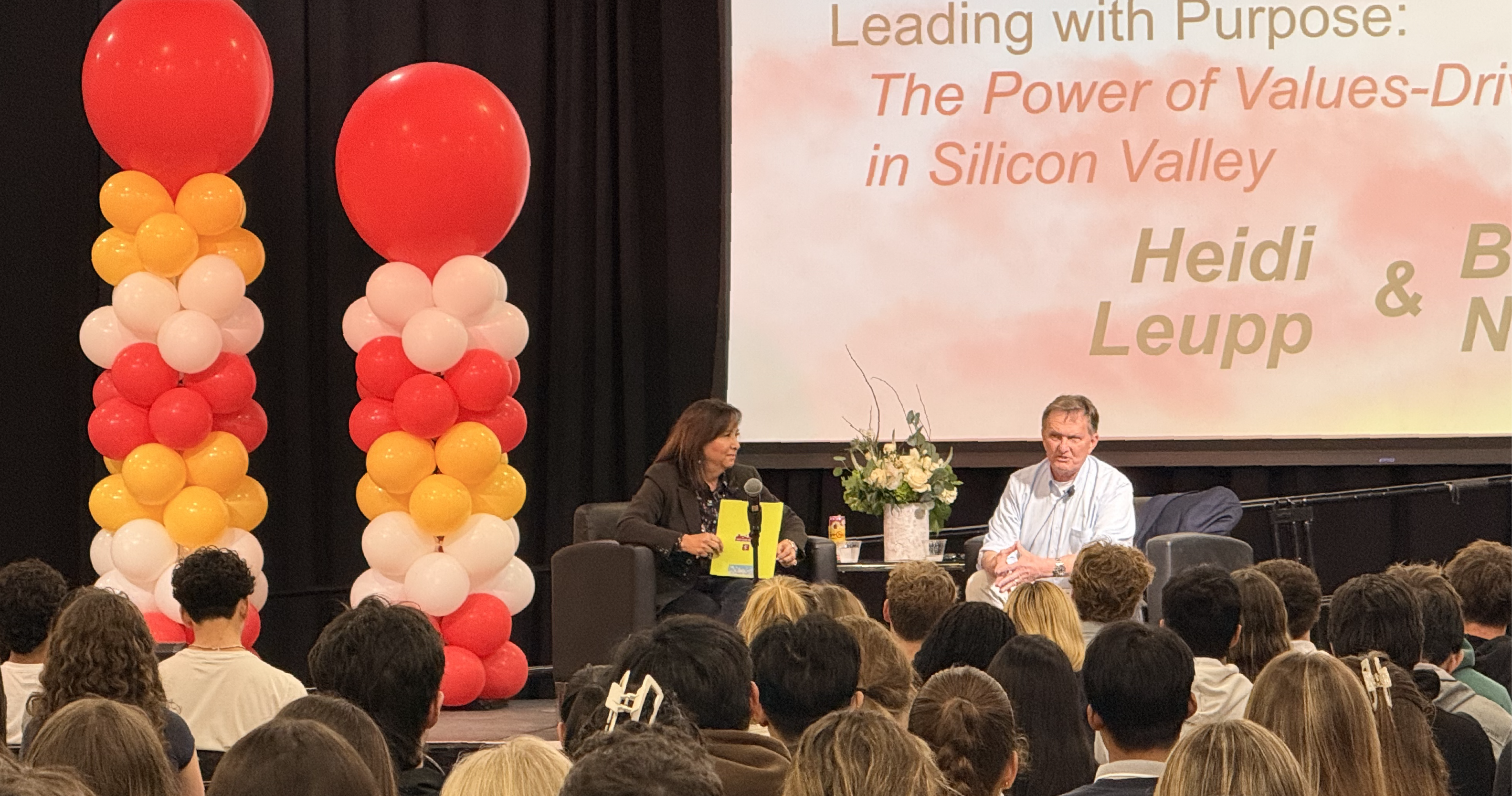
Leading with Purpose: Bryan Neider Shares a Values-Driven Leadership Playbook
Santa Clara University’s Leavey School of Business recently welcomed students to campus for Leading with Purpose: The Power of Values-Driven Leadership in Silicon Valley, a fireside chat featuring Santa Clara University alumni Bryan Neider ’78, CEO of AbilityPath and former Electronic Arts executive, and Heidi Leupp ’84, Santa Clara University Trustee.
Part of the Values-Driven Leadership in Silicon Valley Speaker Series, the event invited first-year Leavey students to examine what it means to lead with competence, conscience, and compassion - especially in high-pressure, fast-moving industries.
“Neider’s stories made ethical leadership concrete, illustrating how personal values shape real-world career and workplace decisions,” said Sarah Cabral, Dean’s Executive Professor in the Department of Management and Entrepreneurship, who oversees Leavey’s leadership curriculum. “One of the most consistent reactions from students centered on Neider’s story of refusing an opportunity that conflicted with his values. Students explicitly reflected on the importance of applying their values to their own future career decisions.”
Values as a real-world leadership test
Throughout the conversation, Neider emphasized that values-driven leadership becomes most visible not in theory, but in moments of tension and tradeoffs. Drawing on more than three decades of experience across the corporate and nonprofit sectors, he encouraged students to treat values as an active decision-making framework.
“Lean on your values,” Neider told students. “They will help you make the right decision.”
He shared a defining moment from his career when he declined a financially attractive opportunity that would have required undermining a colleague facing a family health crisis. Compromising in that moment, he explained, would have had lasting consequences.
“Once you go down the slippery slope of compromising your values, it’s really hard to go back,” he said.
Building inclusive, people-centered organizations
A second major theme of the evening focused on inclusion and community impact. Neider reflected on how his work at Electronic Arts exposed him early to the power of inclusive hiring and workplace culture - an experience that later shaped his transition to AbilityPath, where he now leads efforts to support children and adults with developmental disabilities.
“People from different backgrounds… it makes the whole community better,” he said.
At AbilityPath, that philosophy translates into programs intentionally designed to foster belonging and reduce stigma. For Neider, inclusion is not simply a policy initiative but a leadership mindset that strengthens teams, organizations, and communities alike.
Leadership starts earlier than you think
During an extended student Q&A, the conversation turned practical, with first-year students asking how to demonstrate leadership before holding formal authority.
Neider’s advice: start now.
He encouraged students to remain curious, ask thoughtful questions, and speak up when they see opportunities for improvement. Leadership, he stressed, is often demonstrated through everyday behaviors rather than formal titles.
“Don’t be afraid to make suggestions,” he said. “It shows you care.”
He also highlighted the importance of integrity, active listening, and being true to commitments - habits that build trust over time and distinguish strong early-career professionals.
Leading with humanity in the age of AI
Given the Silicon Valley context, the conversation also addressed how emerging technologies - particularly AI - are reshaping the leadership landscape.
Rather than viewing AI as a replacement for human connection, Neider framed it as a tool that, when used thoughtfully, can create more space for meaningful engagement. At AbilityPath, he explained, AI adoption is focused on reducing administrative burden so staff can spend more time serving families.
“It is always about being person-centered: how is it going to help us serve others better?” he said.
The message to students was clear: technical fluency will matter, but human-centered leadership will remain the differentiator.
A final word: joy
As the evening concluded, students asked Neider what single idea he hoped they would carry forward. His answer was both simple and memorable: joy.
“When you have an attitude of joy, it starts to affect others around you,” he said. “You have to be powered by joy versus anger.”
Cabral noted that the conversation ultimately reinforced leadership’s human dimension for students. “The event underscored leadership’s human dimension by highlighting listening, relationships, inclusion, and joy as essential leadership capacities,” she said.