Top Stories
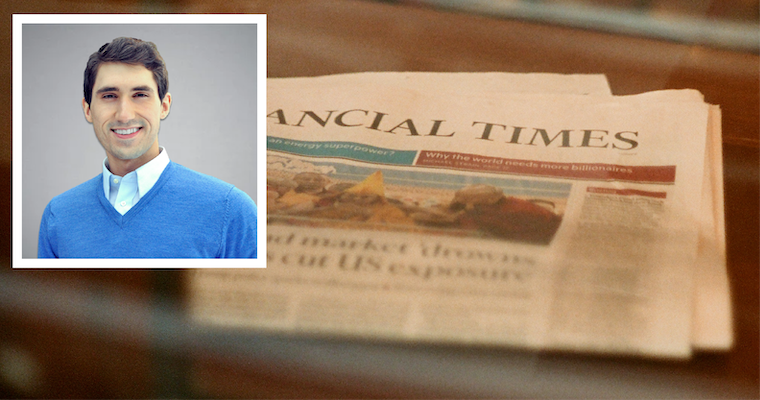
Leavey Professor Alexander Zentefis Unpacks 100 Years of Economic Storytelling
When we talk about inflation, we often think in numbers — rising prices, shifting interest rates, or changes in purchasing power. But for Professor Alexander Zentefis, an assistant professor of finance at the Leavey School of Business, the story of inflation is as much about words as it is about data. His working paper, A Century of Inflation Narratives, dives deep into the evolving ways Americans have talked about inflation for the past century and how those narratives shape what we believe about the economy.
Using a dataset of four million newspaper sentences containing the word “inflation” over the last hundred years, the study maps the shifting causes and effects attributed to inflation in public discourse. “We wanted to know not just what people thought caused inflation,” Zentefis explains, “but how that thinking changed over time, and how those stories influence our collective understanding of the economy.”
The research reveals distinct eras in how Americans have explained inflation. Up through the 1980s, newspapers overwhelmingly framed inflation as the result of fiscal policy, like government spending and tax choices. After that, monetary policy and supply-side factors, like oil shocks of global supply chains, became dominant. “You can actually trace the rise of the Federal Reserve as a public actor through the language of inflation coverage,” he notes. “In the 1980s, the Fed began to take on a much larger role in both controlling inflation and in the narrative around it.”
The study is meticulous in method: human coders first labeled sentences to identify causal and effect relationships, creating a “golden set” of examples. Then, a large language model was trained on those examples to detect similar patterns across the massive corpus — a hybrid of human insights and AI scalability that allows for nuanced, historically informed analysis.
“Inflation isn’t just an economic phenomenon, it’s a social narrative,” Zentefis says. “The stories we tell about why prices rise shape how people feel about their government, their future, and their own financial decisions.”
This work arrives at a moment when inflation, and the conversation around it, is once again dominating headlines. As the Federal Reserve balances inflation control with the risk of slowing growth, narratives about who or what is to “blame” for higher prices have become politically charged. In recent months, news outlets have focused heavily on “greedflation” — the idea that corporate profits, not macroeconomic forces, are driving price hikes.
This mirrors what Professor Zentefis’ data shows: new causal narratives emerge during periods of economic stress. The early 1980s saw similar shifts, when Americans debated whether inflation was a policy failure or an unavoidable global trend. Today’s debates echo that tension, underscoring how deeply intertwined economic storytelling is with public trust.
The next phase of the project plans to expand the analysis beyond the press. Zentefis and his research team are applying the same model to Federal Reserve transcripts and speeches dating back to the 1930s. The goal is to compare how policymakers and journalists have framed inflation, and to explore whether those narratives influence each other. “If we can understand how the Fed talks about inflation compared to how the media does, we might learn something profound about how policy messages are received or resisted,” Zentefis says.
Beyond its historical insights, the study poses important questions about communication and perception in the age of AI and data-driven news. Economic “facts” rarely speak for themselves; they’re filtered through language, metaphor, and institutional voice. By quantifying how these patterns shift, the research helps illuminate the mental models that drive not only market expectations but public confidence.
At a time when Americans’ trust in economic institutions remains fragile, this project highlights the power of words to shape reality. As Professor Zentefis puts it, “We can’t separate economics from storytelling. To understand inflation, we have to understand the narratives that make it meaningful.”