Top Stories
Zoom Veteran Nick Chong on Taking Risks, Managing Up, and Learning With AI
The former Zoom chief customer officer and Leavey MBA alumnus shared what Silicon Valley has taught him, and gave faculty and staff a first look at his new venture, Jolli AI.
Nick Chong’s first real job interview, at the oil and gas company Conoco, was for telecommunications work he knew little about. Fresh out of Kansas State University with an electrical engineering degree, he told the company the one thing he was sure of: he was willing to learn. “That was all I had to offer,” he said.
That willingness carried him far beyond Malaysia, where his story began. It took him to Cisco, through three startups, and to more than a decade at Zoom, where he started in product marketing and rose to chief customer officer. Now, as founder and CEO of Jolli AI, he is working on a question many educators face: how will students learn when AI can do much of the work for them.
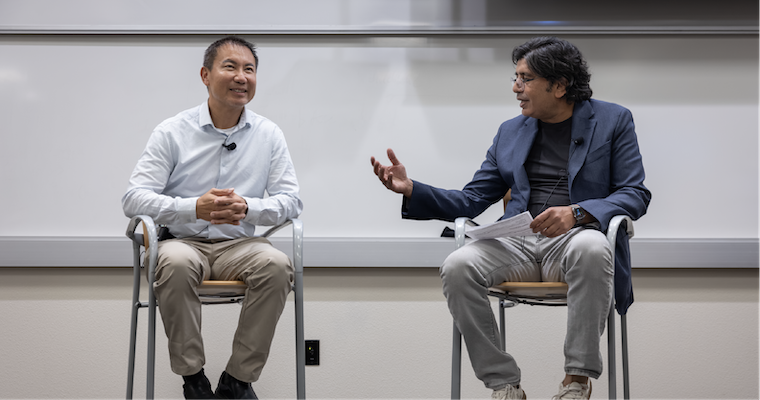
Chong, a 1996 MBA graduate of Santa Clara University’s Leavey School of Business, shared his story on Friday, Nov. 13, during a lunch conversation with Dean Ravi Bapna, the first event in a new dean’s speaker series that will feature fireside chats, book readings, and more conversations with people shaping Silicon Valley.
A Culture That Asks What’s Next
Chong came to California when Cisco offered him a job, after key executives had watched him build Conoco’s network. After seven years there, he joined a colleague’s optical networking startup, which collapsed when the dot-com boom ended. He found that in Silicon Valley, the failure didn’t count against him.
“A lot of places when they fail, they’re like, oh, okay,” he said. “But in California it’s like, what’s next?”
His next two startups, both in security, were acquired by McAfee and Cisco.
Filling the Gaps
Learning on the job had its limits. As a young director at Cisco, Chong was good at solving technical problems but shy in front of an audience and short on the business side: operations, strategy, data, and marketing. Many Cisco colleagues were enrolling at Santa Clara, and the part-time evening MBA fit his schedule.
What he took away went beyond the coursework: “the value of doing good, being good and caring.” Looking back, he said, the network has mattered most. “Ultimately, it’s really the connections.”
One skill he had to pick up later, on his own, was managing up. Chong noticed most people who leave a company are leaving their boss. “Managing up is a skill ... it’s something you need to learn.”
Zoom’s Classroom Start
Chong got to know Eric Yuan, who had come to Cisco from WebEx, while working on video products there. At the time, Cisco’s high-quality video systems cost around $100,000. When Yuan left to start his own company, built on the idea of high-quality video for everyone at a low cost, he asked Chong to join him. That company became Zoom, and Chong came on to lead product marketing.
The harder part was convincing people they wanted it. Years before the pandemic made video calls routine, the people Chong pitched kept asking the same question: “Why do I want to see my colleague?”
The answer came from a student. The team was handing out flyers around Santa Clara, Stanford, and San Jose State when a student who had brushed off the pitch circled back. “But I take an evening class,” Chong recalled the student saying. “It would be good if I could see my professor.”
That led him to Stanford’s online learning program. “Stanford became our first check-writing company,” he said. Santa Clara signed on early too, and those university customers helped Zoom win over startups with remote teams.
“Sometimes it’s not planned,” Chong said. You start with an idea, he said, and “learn along the way.”
Beyond the Founders
The conversation turned to entrepreneurship, already a strength at Leavey, which is ranked among the top-ten of national undergraduate programs for entrepreneurship by U.S. News & World Report.
For Bapna, the goal reaches beyond founders. “Not everybody’s going to be a founder,” he said, but he wants every student to come out of Leavey with an entrepreneurial mindset, which he described as “wearing multiple hats and learning how to take risks.”
Chong agreed, urging faculty to give students room to take risks. “Taking risks, even if they get bad grades, it’s okay. Do it again,” he said. His own example, from a marketing class at Santa Clara, was a business plan for a company called Buzz, which would let students share finished homework so classmates could skip class. He acknowledged the faculty in the room probably wouldn’t love it.
AI, Bapna said, cuts both ways. Beyond the worry about entry-level jobs, “the other side of this is that we could be building many, many more companies and solving many, many more problems which we haven’t solved yet.”
Chong agreed. “AI is just going to accelerate that and make it easier to build things,” he said. Building Zoom’s backend took six months.
If building gets easier, both suggested, the advantage shifts to judgment and relationships. Chong said the hard part now is understanding a customer’s real problem and earning trust, because people buy from “people you know, people you trust.”
“If GenAI has all the answers, the premium on asking the right questions actually goes up,” Bapna said. With AI-polished resumes flooding job openings, he added, “the role of the network in finding that job becomes really more and more important, I think. And I think our job here probably is to help the students build those networks.”
Chong said employers now expect new hires to arrive with “one to three years of real-life experience in college,” from projects and work they have actually built.
Back to the Classroom
Chong’s newest company takes him back to where Zoom found its footing. Jolli AI builds AI tools for developers and businesses, including a knowledge platform that records the reasoning behind AI-assisted code. Its education product, which the company calls “modern AI courseware with privacy and observability,” started at home, watching his two teenage sons paste homework into ChatGPT. When he raised it with Santa Clara professors and staff, he kept hearing that AI in the classroom was a problem. “Who’s solving the problem?” he asked.
Students are going to use AI either way, he said. “You need to at least provide them a way to use it that is somewhat safe and somewhat guided, and somehow they can learn from it.”
Chong then gave a demo in which a field assignment from a Santa Clara course ran entirely inside Jolli. Students upload photos from the sites they visit, write a short paragraph, and question AI personas playing a company CEO, a neighbor, a local government regulator, and an investor. When the demo student asked the AI to write the final paper, it declined. Professors can review every step, including the full AI conversation, and grade against their own rubric. A couple of Santa Clara professors are testing the platform informally in their courses.
Chong’s advice to educators was to lead. “We need to be the leaders here to drive this kind of change,” he said. “... We are in Silicon Valley; that’s my point.”