Press Releases
Santa Clara research develops advanced mathematical tools to understand the physics of terahertz wave propagation
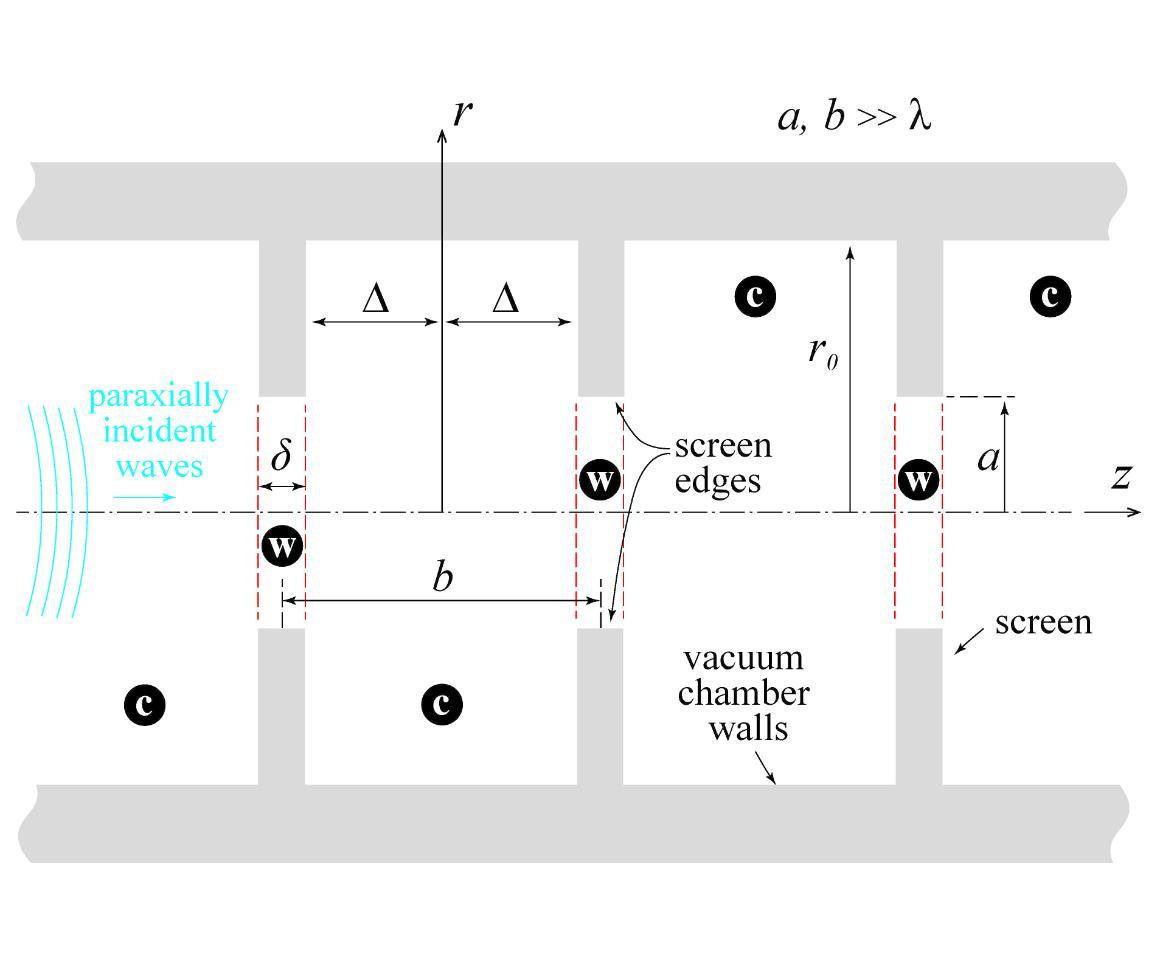
Researchers at Santa Clara University have developed a comprehensive mathematical framework to rigorously analyze and predict the behavior of terahertz (THz) radiation pulses when transported over long distances through a special type of waveguides named “overmoded iris lines.” The developed analysis deepens our understanding of key aspects of wave physics that underlie the challenges currently faced by advanced facilities seeking to transport and exploit THz radiation for new applications and scientific experiments. The published article summarizing the findings was recognized as “outstanding” by the Editors of Physical Review Accelerators and Beams, a leading journal on accelerator physics and advanced electrodynamics by the American Physical Society (APS), and was featured on the journal’s Highlights home page.
The research, led by Adham Naji, Ph.D., assistant professor of electrical and computer engineering and, by courtesy, of applied mathematics at Santa Clara University, represents an advancement in the analysis and modeling of scattering field phenomena within overmoded iris lines. It generalizes preexisting theories that describe these wave phenomena and includes back-scattered waves, which are often ignored in calculations. Accurate estimations of power loss that would be incurred by transporting such THz waves over distances of hundreds of meters are essential for pump-probe experiments at accelerator-based light sources at national labs, for example.
“THz electromagnetic radiation is a little tricky to transport over long distances because it is prone to losing its power to diffraction, mode competition, and to surface currents on the walls of the vacuum chamber surrounding the waveguide”, said Naji. “An iris-line waveguide, a promising technology for THz transport, can be thought of as cylindrical pipe whose interior is periodically loaded with metallic rings (irises) under vacuum.
“Ideally, sending the THz radiation in an iris line over 150 meters, for example, would incur as little loss as 15% in power, if we assume infinitely thin irises, simpler scattering models, or no ohmic losses. If we include the effect of finite iris thickness and a detailed vector field description of the scattering inside the iris line, however, a more nuanced picture emerges. We see that in some scenarios we cannot actually ignore ohmic loss and we have to be careful about the types of modes we excite in such waveguides. We also need to ascertain how a transient regime settles in after excitation from a THz source and whether that actually matches our model’s assumptions. Our recent work describes how we can analyze these phenomena and model their effects carefully.”
THz waves sit in a challenging spot, often called the “THz gap,” in the electromagnetic spectrum, just above typical electronic and microwave frequencies (in the GHz range) and just below the typical optical frequencies. They are generally difficult to generate and transport using today’s technology, even though they hold a special appeal for many sciences and applications interested in this region of the spectrum, such as spectroscopy for molecular and lattice dynamics outside the optical or microwave wavelengths, pump-probe experiments, accelerator physics, and even in ultra-high-speed next-generation wireless telecoms. Advanced projects at large national laboratories, such as the SLAC National Accelerator Laboratory in the US and the European X-ray Free-Electron Laser (European XFEL) in Germany, have recently explored efficient ways to transport THz radiation after it is generated by accelerator-based sources. The research led by Prof. Naji in this area at Santa Clara was originally motivated by these challenges and his collaboration with colleagues at these labs.
Key findings from the research include:
- Combining an enhanced-mode configuration in Lorentz’s reciprocity, uniqueness theorem, and a scattering source theorem by Schelkunoff, to analyze the field on nonuniform sections.
- Complete analytical expressions for all spectral field coefficients at structural discontinuities, including forward and backward scattering.
- Validation of the forward-scatter approximation and Vainstein benchmark for the high-frequency limit.
- Quantification of how screen thickness affects both diffraction and ohmic losses.
- Accurate modeling of the transient regime from the structure’s entrance.
Team members contributing to this research included Prof. Naji, Dr. Pawan Gupta, a former postdoctoral fellow in Prof. Naji’s group at Santa Clara University, and Dr. Gennady Stupakov, a long-term collaborator from SLAC National Accelerator Laboratory and xLight Inc., Palo Alto. The full paper, “Full-scatter vector field analysis of an overmoded and periodically loaded cylindrical structure for the transportation of THz radiation,” is now available on the website of Physical Review Accelerators and Beams journal.