Selling the Super Bowl
The Super Bowl isn’t just a game—it’s also the ultimate advertising showcase.
And it’s coming to the city of Santa Clara for 2026.
NBCUniversal Local’s Senior Vice President of Sales, Western Region, Jordan Knopf ’97, shares what goes into the broadcast, how the event changes when it’s hosted locally, and which Super Bowl ads deserve a championship trophy.
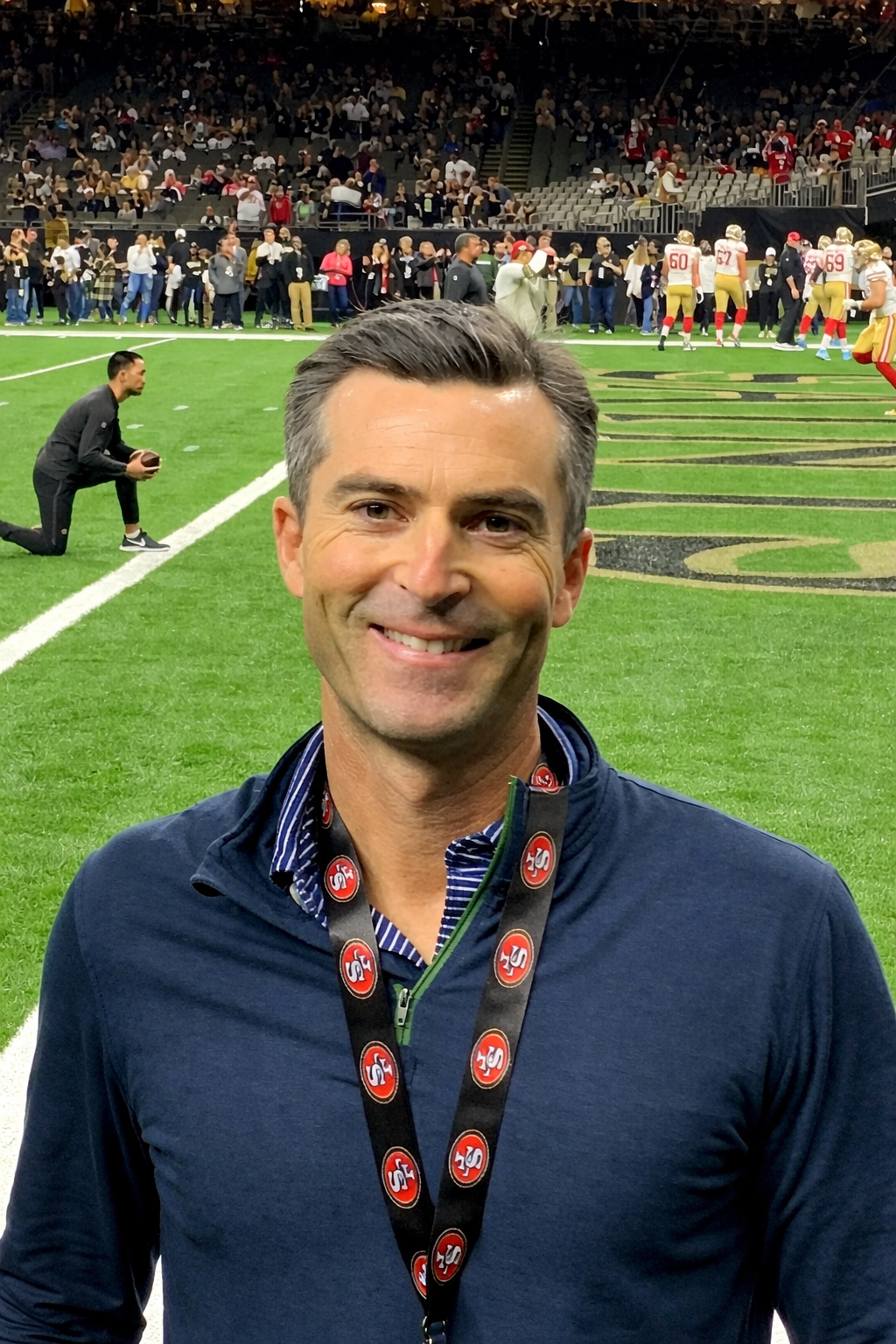
Jordan Knopf ’97 on the sidelines in New Orleans.
From SCU to Sales
When you look back on your time at SCU, Jordan, what’s one experience that still impacts your career today?
The importance of building meaningful relationships.
In an era of transactional, commodity-driven sales, the ability to establish trust and a deeper human connection remains critical.
The friendships I made at SCU remain among my closest to this day, and continue to shape how I build and maintain relationships throughout my career.
When did your career start to point toward media and advertising?
While at Santa Clara, I majored in communication, with an emphasis in television production, and interned at the local ABC affiliate.
I initially wanted to pursue a career on the production side, but my first roles were sales positions in the staffing industry. When an opportunity to join FOX Sports opened in 2001, I jumped at the chance to return to media ... and sales became the path.
How would you describe your role at NBC?
I provide sales strategy, support, and revenue growth across our owned NBC, Telemundo, and Regional Sports Networks—representing our entire portfolio across linear, digital, and streaming platforms, including Peacock.
A Super Game
What’s it like to play a role in a broadcast watched by hundreds of millions of people?
The Super Bowl is one of the rare moments when viewers actually look forward to the commercial breaks. From that standpoint, it’s a fun event to be associated with, especially when working with brands that have so much riding on how their creative is received.
It also gives you the ability to impress your friends by predicting which commercial is coming next.
What’s something happening behind the scenes during the Super Bowl broadcast that most viewers would never think about?
The orchestration around the halftime show is incredible.
Putting on a 12-minute concert in the middle of the Super Bowl requires more than 1,000 stagehands, a seven-minute set-up, and a six-minute tear-down.
When you’re in the stadium, it’s hard to fathom that a football game will resume momentarily.
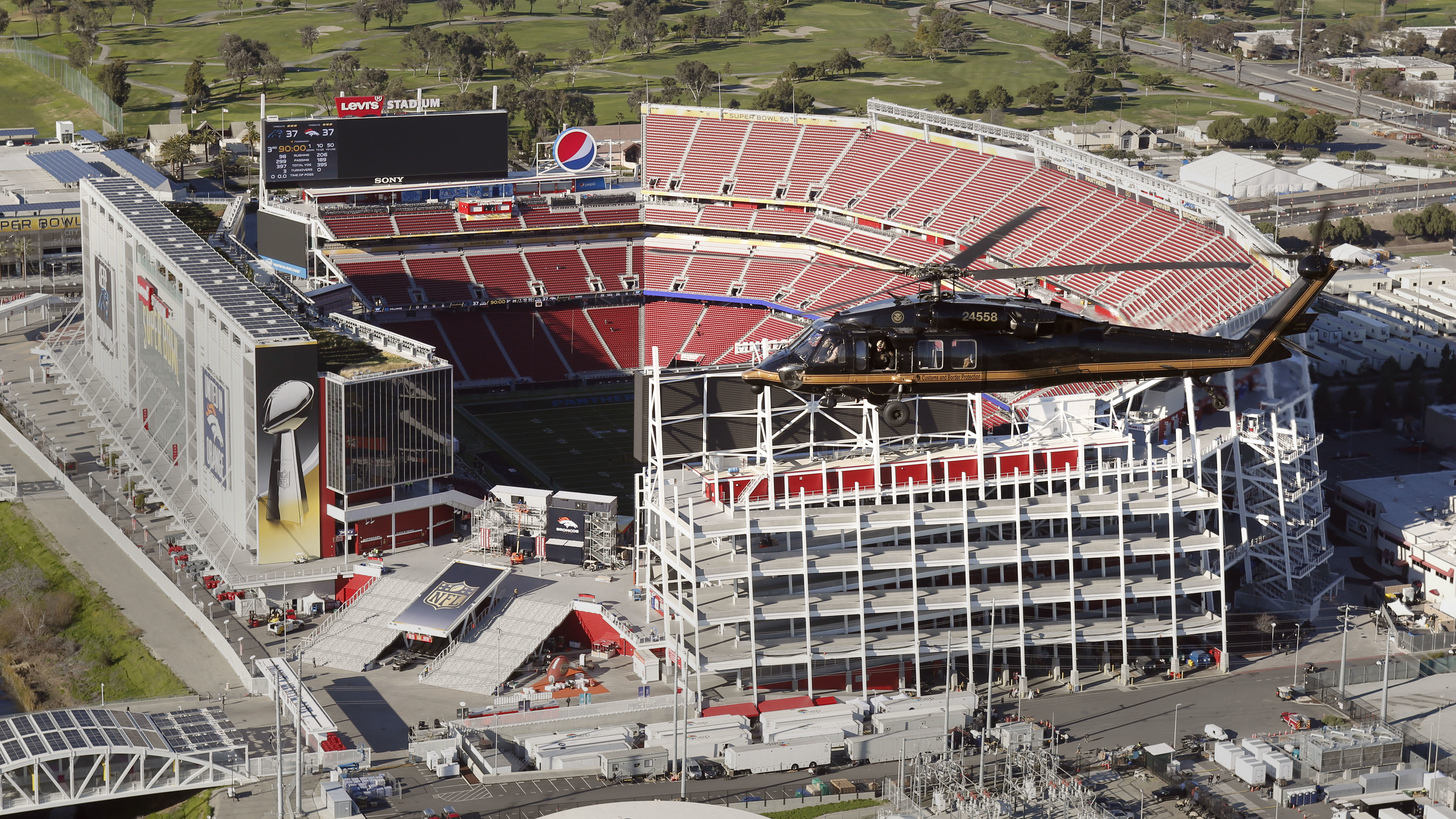
Super Bowl 50 in Santa Clara, CA, 2016.
How does your experience change when the Super Bowl is hosted in your local market?
Hosting the Super Bowl locally dramatically extends the experience beyond the game itself.
In the Bay Area, our station group established an exclusive media partnership with the Bay Area Host Committee (BAHC), serving as the regional marketing and promotional partner—telling stories tied to its mission (job creation, access to youth sports, economic development, etc.) and the regional businesses that have supported bringing the Super Bowl back to Levi’s.
The entire week leading up to the game is jam-packed with events featuring companies looking for ways to engage the flood of fans descending on the region.
It also means countless people coming out of the woodwork requesting tickets and hospitality.
NBC has the Super Bowl, the Winter Olympics, and the NBA All-Star Game in quick succession this month. How unique is this, and does this alignment shift how you look at ad sales?
This is a completely unique situation—it’s never happened before for any broadcaster or media company.
We’ve branded it “Legendary February,” and we began crafting our go-to-market strategy two years ago.
With a finite number of marketing dollars in play during this window, we needed to highlight the scale and value of the audiences we’ll deliver, to ensure we capture enough revenue to meet our targets and, just as importantly, deliver on our partners’ marketing objectives.
And once through this gauntlet, we’re in the final run-up to the World Cup on Telemundo!
The Super Bowl is one of the rare moments when viewers actually look forward to the commercial breaks.
It All “Ads” Up
What makes a Super Bowl ad great?
A great Super Bowl ad creates a memorable emotional connection (ideally a positive one) that lasts well beyond the moment.
The goal is to move the viewer toward a specific action: visiting a website, considering a vehicle, trying a service, making a purchase, casting a vote, etc.
What’s your all-time favorite Super Bowl commercial, and why does it still stand out to you?
It’s hard to pick a single favorite, but one that stands out is Volkswagen’s “The Force,” featuring a child dressed as Darth Vader trying to use the Force to power objects on and off.
After repeatedly failing, the child believes they’ve successfully activated the VW—with the reveal that the dad did it remotely.
When it aired during the 2011 Super Bowl, our son was eight years old and could easily have been “young Darth,” which made it especially relatable. I didn’t buy the car at the time, but I think that may have been the same model and year we purchased as the “kids’ car” nine years later, so the ad may have had a delayed effect on me.
Image Credits, Top to Bottom:
Football Balls, courtesy of Herbert Aust from Pixabay.
Jordan Knopf on the field, courtesy of Jordan Knopf.
Super Bowl 50 in Santa Clara, CA, 2016, U.S. Customs and Border Protection Photo by Glenn Fawcett (public domain image).