Stories
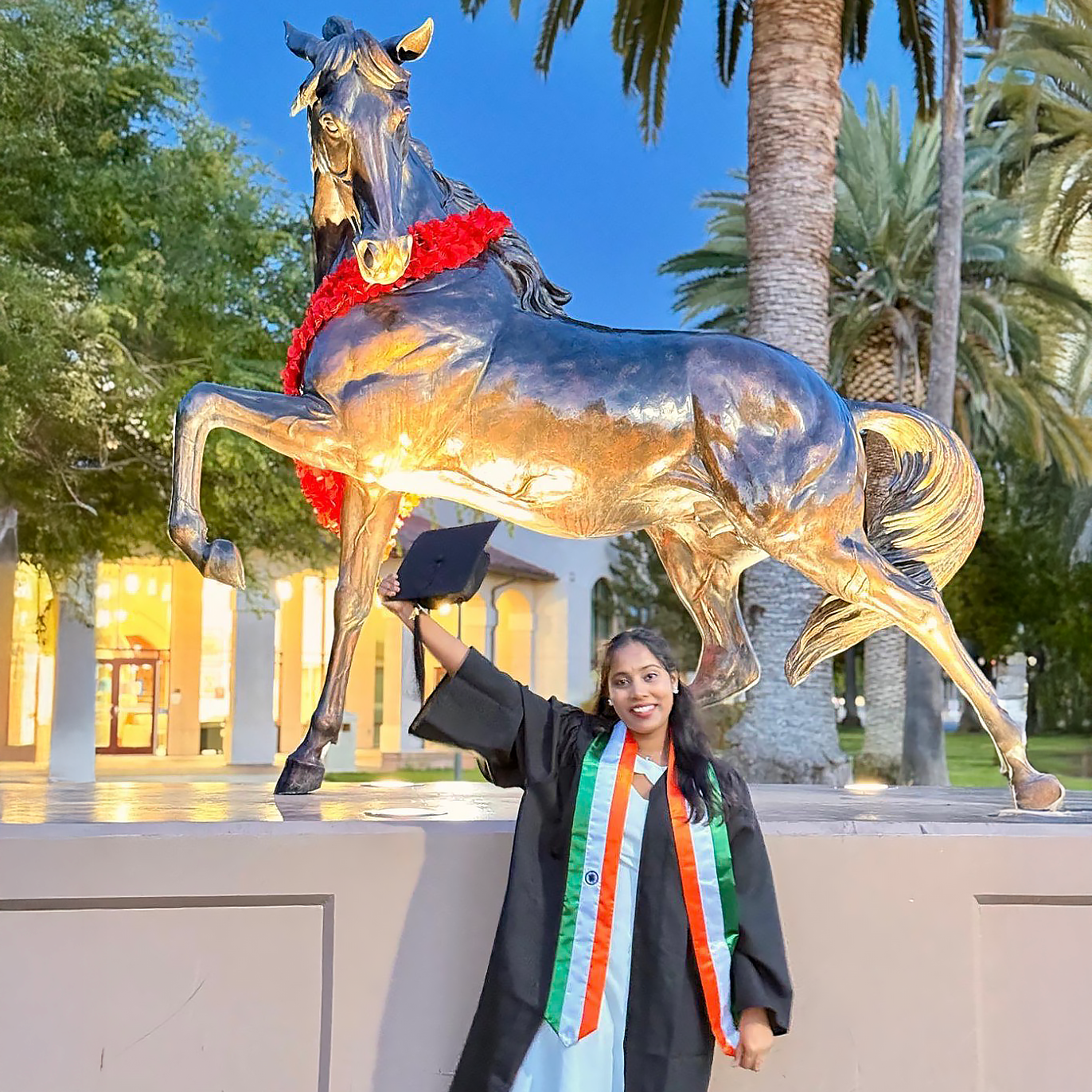
Alumni Spotlight: Nandini Kodipunzula
Meet Nandini Kodipunzula '24, a graduate of Santa Clara University’s School of Engineering, where she earned her M.S. in Computer Engineering. Coming from a non-CS undergraduate background and with industry experience at Freshworks, Nandini intentionally chose to pursue graduate school at SCU — driven by a desire to deeply understand the “why” behind architectural decisions. Today, she brings that foundation to Salesforce’s Service Mesh team, where she works on the critical infrastructure that enables reliable, secure communication between services at enterprise scale.
On Choosing SCU
“I chose Santa Clara University because of its academic rigor and powerful alumni network. When I spoke to alumni, what stood out wasn’t just their technical expertise, but their clarity of thinking and confidence. I wanted to be shaped by that environment.”
Her SCU Journey
You worked at Freshworks before coming to Santa Clara for your Master’s. What made you decide to pursue graduate school, and why SCU?
At Freshworks, I had a stable and rewarding role, working on products used by thousands of businesses. I learned how quickly decisions are made in a product-driven company and how critical reliability is at scale. But over time, I realized I wanted to understand the “why” behind architectural decisions — not just implement features, but design systems thoughtfully from the ground up. Coming from a non-CS undergraduate background, I knew there were foundational gaps I wanted to fill. I didn’t want to just work in tech — I wanted to deeply understand it. Graduate school felt like an intentional step toward building that strong technical core.
I chose Santa Clara University because of its academic rigor and powerful alumni network. When I spoke to alumni, what stood out wasn’t just their technical expertise, but their clarity of thinking and confidence. I wanted to be shaped by that environment. Courses like Operating Systems, Distributed Systems, and Web Architecture fundamentally changed how I think about building software. They bridged my non-CS background and gave me the theoretical depth I was missing. The smaller class sizes, accessible professors, and Silicon Valley location created an environment where I could grow intentionally — both technically and professionally. Choosing Santa Clara was about pushing myself toward growth — and it gave me the confidence and foundation I was looking for.
Beyond technical skills, what did SCU’s School of Engineering teach you?
Santa Clara pushed me to grow far beyond technical knowledge. It built my confidence. Coming from a non-CS background, I had to work harder in areas that didn’t come naturally at first. The culture at Santa Clara University encouraged consistency, discipline, and stepping into uncomfortable challenges instead of avoiding them. Over time, the hard things became strengths. What I’ll carry forward most is that growth mindset — showing up every day, doing the difficult work consistently, and improving incrementally. Santa Clara also fostered a friendly, collaborative, and bias-free environment where diverse perspectives were respected. That balance of confidence, humility, and persistence is something I’ll bring with me to Salesforce.
On Engineering for Impact
“Technology doesn’t have to be complex to be powerful. Thoughtful, small improvements can create real impact. No matter where we build — large systems or small platforms — the purpose of engineering is ultimately the same: to serve people in meaningful ways.”
Engineering for Social Good: NicaAgua
Tell us about your work with NicaAgua. What interested you in joining this project?
NicaAgua was a nonprofit-focused project I worked on during my time at Santa Clara University, and it gave me a very different perspective on engineering. I joined because I wanted to better understand impact beyond technical complexity. Through NicaAgua, I learned that sometimes even the simplest changes — adding a button, improving accessibility, organizing information more clearly — can meaningfully improve someone’s daily life. That experience grounded me and reinforced that the purpose of engineering is ultimately to serve people in meaningful ways.
Next Chapter: Salesforce
What are you most excited to work on at Salesforce, and what does “building something that matters” mean to you?
I’m excited to be part of the Service Mesh team at Salesforce — a part of the platform that plays a critical role in how services communicate reliably and securely behind the scenes. For me, building something that matters goes beyond writing elegant code. It means creating systems that are trustworthy, resilient, and dependable — technology people can rely on when it matters most. Ultimately, building something that matters means aligning technical excellence with real user impact — and knowing that what we build contributes to something larger than any one line of code.
Advice for First-Generation Students
“Believe in your potential, even before you fully see it yourself. Don’t let comfort limit your ambition. You don’t have to be perfect — you just have to be willing to learn and persist. If my journey can encourage even one person from the next generation to aim a little higher and trust their potential, that would mean a lot to me.”
The SCU Community
What’s your #1 piece of advice for first-generation students or those considering a graduate degree in engineering?
As a first-generation student, it can sometimes feel like you don’t have much room for mistakes. There’s financial pressure, family expectations, and the weight of wanting to make the “right” decisions. I felt that deeply when I chose to pursue my Master’s. I’m incredibly grateful to my family for their trust, encouragement, and sacrifices — their belief in education made my journey possible.
What I’ve learned is that growth often requires stepping into uncertainty — thoughtfully and intentionally. You don’t need to have everything figured out, but you do need to commit to your path once you choose it.
You don’t have to be perfect — you just have to be willing to learn and persist.
For me, success has always meant more than personal achievement. I hope that by continuing to challenge myself and grow, I can help make ambitious paths feel more possible for anyone who may be doubting themselves — especially students who come from modest or under-resourced backgrounds. Sometimes simply seeing what’s possible can expand how far someone believes they can go.
If my journey can encourage even one person from the next generation to aim a little higher and trust their potential, that would mean a lot to me.
Who or what at Santa Clara had the biggest impact on you?
Hands down, the alumni community and the peer group. Santa Clara has a strong culture of sharing and helping — whether it’s alumni offering guidance, professors making time outside class, or peers supporting each other through challenges. Hearing alumni talk about how SCU shaped their thinking — not just technically but professionally — encouraged me to set bigger goals for myself. Growing up, I was always taught the importance of helping others and lifting as you climb. Seeing that same value reflected in the Santa Clara community deeply resonated with me.
Favorite Santa Clara memory?
Some of my most vivid memories are from late nights preparing for interviews and coding challenges with friends — we struggled together, celebrated small wins together, and built confidence we didn’t have when we started. Those moments were more than preparation for interviews; they were transformation points in how I saw my own potential.