New Report Studies Data Center Development, Water Availability, and Environmental Justice In CA.
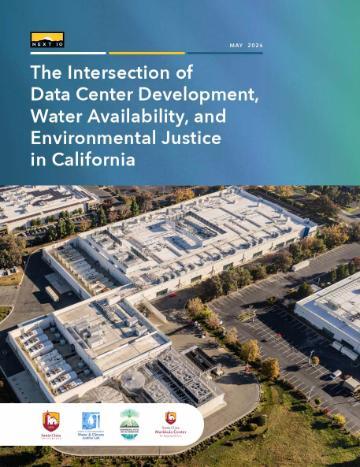
An aerial view of a large data center overlaid with the words The Intersection of Data Center Development, Water Availability, and Environmental Justice In California.Logos for Santa Clara University and supporting departments are present. Photo by Next10.org.
A new report from the nonprofit Next 10, The Intersection of Data Center Development, Water Availability, and Environmental Justice in California, co-authored by Santa Clara University researchers, asks a question that doesn't get posed enough: What could be done right now to make the planning and development of data centers in California both more sustainable and more equitable?
The short answer, it turns out, is “a lot.”
The research, led by Prof. Iris Stewart-Frey (who directs Santa Clara University’s Climate Justice Lab) and Irina Raicu (who directs the Internet Ethics Program at the Center), was published in May 2026. It is co-authored by several Santa Clara University students, and it’s the first effort to map every known operating and planned data center in California and review them through two key lenses: water access and environmental justice.
What the researchers found was troubling. Data centers, the massive facilities that host and process everything from ChatGPT to cloud storage, use massive amounts of water. And as the AI boom accelerates construction in the state, those facilities are increasingly being built in places that are already stretched thin on water and don't have much political muscle to push back.
The report has received substantial media coverage. The researchers spoke with CalMatters, for example: “We have this huge build-out, and we have very little data,” Raicu told them. Paired with California’s precarious water supplies, Raicu said, “it’s just not a good combination.”
The report takes a close look at five locations across California: Santa Clara, Los Angeles, Sacramento, Gilroy, and Imperial County. In Los Angeles County, about 93% of data centers had no publicly accessible environmental documentation. The pattern is consistent almost everywhere (the exception is Santa Clara, where more documentation exists–though not as much as the researchers had hoped).
Notably, larger facilities are increasingly being proposed in areas with higher social vulnerability and less reliable water supplies. Imperial County and Sacramento showed the starkest overlap between water scarcity and community vulnerability.
Raicu told The Desert Review that developers and policymakers should provide more information so that communities clearly understand the impacts for their own neighborhoods. “We do need data centers,” Raicu explained. “They’re really an important part of our lives. Our report here is not to say, ‘Don’t build data centers.’ The report [aims] to highlight California’s fragile water system and how it plays out in particular locations.”
In Gilroy, for example, where a major new facility is being built, the local water supply comes from a closed groundwater basin with limited ability to replenish itself and no backup source. In Imperial County, where one of the largest planned data centers in the country has been proposed, the region depends entirely on imported Colorado River water that is already subject to mandatory cutbacks.
The researchers also point out that water impacts don't stay contained to a single facility's property. When a data center draws from a shared groundwater basin or a regional water system, increased demand in one place can quietly drain resources from communities far away–communities that are often more vulnerable and less likely to have a seat at the table when decisions get made.
The report applies the Markkula Center for Applied Ethics’ Framework for Ethical Decision Making, looking at the issue of data center siting through the lenses of rights, justice, utilitarianism, common good, virtue ethics, and care ethics. It also includes an extensive list of the stakeholders impacted by data center siting decisions, highlighting the complexity of the trade-offs involved and the need for broad community engagement.
The conclusion of the report is a clear message: A lack of data doesn't just make good planning harder–it dismantles public trust. Without accurate information, communities can't meaningfully participate in decisions that shape their futures, and lawmakers can't craft effective policy.
The researchers call on state legislators to require standardized water use disclosure from data center operators, on developers to center environmental justice in siting decisions, and on researchers and communities to build the local capacity to push back when the data isn't there.
Iris Stewart-Frey and Irina Raicu will discuss their findings at a webinar hosted by the Next 10 and Santa Clara University at 11 a.m. PDT Thursday, June 11. Registration is free, and the public is encouraged to attend.
Diya Chaudhary, a sophomore studying communication, and a 2025-26 marketing and communications intern at the Markkula Center for Applied Ethics, contributed to this story.