SCU Students Earn National Honors for Work That Truly Matters
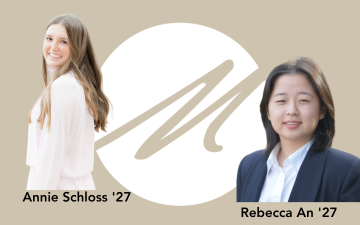
Santa Clara University Juniors, Annie Schloss and Rebecca An.
Annie Schloss had never heard of moral injury before she started researching veteran homelessness. Rebecca An was searching for a better way to get cancer-fighting drugs where they need to go. Two Santa Clara University juniors, each with a very different research question, both earned national recognition for the answers they’re working to find.
Schloss is a 2025-26 Hackworth Fellow, and An is a 2025-26 Health Care Ethics Intern at the Markkula Center for Applied Ethics.
An was named a recipient of the Barry Goldwater Scholarship, one of the nation’s highest honors for undergraduate students in science, mathematics, and engineering. Out of 1,485 nominees nationwide, only 454 students were selected this year.
Schloss, a junior, double-majoring in public health and biology with a minor in religious studies, is one of the nation's newest Strauss Scholars, and she's using a $15,000 award to bring trauma-informed yoga to veterans in the South Bay.
An is researching new ways to improve targeted cancer drug delivery, a field where precision matters the most. One of oncology’s most stubborn challenges is getting a drug to the right cell at the right time, without collateral damage to healthy tissue. An’s Goldwater-recognized research aims to solve that problem.
Schloss, a pre-med student from Tulsa, Oklahoma, was named to the 2026-27 cohort of the Donald A. Strauss Scholarship Foundation, a competitive program that funds community service projects led by California college juniors. She will carry out the project alongside fellow SCU student Gabrielle Gegel, who also received the scholarship. The two will partner with the Veterans Yoga Project to bring non-traditional mental health support to veterans in San Jose and Santa Clara, a community they say has been largely underserved when it comes to holistic care options.
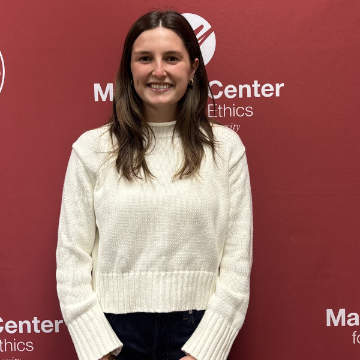
Photo: Santa Clara University Junior and 2025-26 Hackworth Fellow, Annie Schloss.)
The project grew directly out of Schloss's work this year as a Hackworth Fellow at the Markkula Center for Applied Ethics. Her fellowship originally centered on veteran homelessness and social determinants of health, but a book changed everything.
"I read 'Afterward' by Nancy Sherman, and she talks about this idea of moral injury," Schloss said. "It's like a third dimension, beyond physical trauma and psychological trauma. It's almost a spiritual wound."
Moral injury describes the distress that comes from acting against one's values, or from witnessing others do so. For veterans, it can mean carrying the weight of split loyalties, trust, and a sense of disconnection from the civilian world they return to. Schloss said the concept is gaining more attention, including among healthcare workers who faced impossible situations during the COVID-19 pandemic, but that it remains poorly addressed within the VA system.
Schloss pointed to a statistic that stopped her in her research: 17 veterans die by suicide every single day in the United States. While the VA receives roughly $400 billion in federal funding, Schloss said the majority of it goes toward traditional therapies, talk therapy, and prescription medication, leaving little room for alternatives that research shows can be just as effective.
Equine therapy, service animals, and yoga are all options that exist, but access is uneven, and cost is often preventative.
That's the gap Schloss and Gegel want to close in the South Bay. The Veterans Yoga Project trains instructors in trauma-informed methods specifically designed for veterans, but the nearest programming is in San Francisco. Through the Strauss project, the two plan to bring those classes south, covering transportation through Uber and Lyft vouchers for veterans who cannot get there on their own, and eliminating cost as a barrier to entry.
Their vision extends beyond the yoga classes. After each class, Schloss and Gegel want to create space for veterans to connect over breakfast, coffee, bagels, and conversation. They also want SCU students in the room.
"'Thank you for your service' isn't enough," Schloss said. "What veterans really want is to tell their story and have people listen. That's how we actually start to close the gap between the military and the civilian world."
The pair is exploring whether participation could count toward SCU's Civic Engagement learning requirement, which could bring a steady stream of student volunteers to each session. Their goal is to host around 30 veterans per class, meeting every other week with Santa Clara's Mission Gardens as one possible venue.
For Schloss, the work has also reshaped how she thinks about her own future in medicine. She came into college set on OBGYN, but now finds herself drawn to the VA system, maybe psychiatry, maybe rheumatology and chronic pain care, disciplines that map directly onto what veterans carry home from service.
"Healthcare is an honor and a privilege," she said. "Working with this community would take that to a whole other level."
Diya Chaudhary, a sophomore studying communication, and a 2025-26 marketing and communications intern at the Markkula Center for Applied Ethics, was a lead contributor to this story.