The Ethics of Prediction Markets and Wildfires
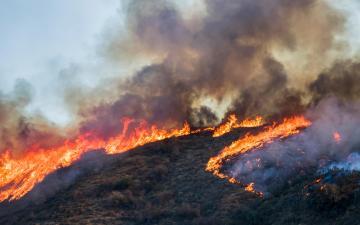
Brush and tree landscape burning with flames and smoke during California wildfire. Image by Erin via Adobe Stock.
While thousands of Southern California residents fled their homes during the 2025 wildfires, prediction market platforms racked up $1.2 million in trades. Traders bought and sold shares on questions like, “How many acres will the Palisades Fire burn by Friday, three days after it ignited on Tuesday? Will the Palisades Fire reach Santa Monica by Sunday? Will the Palisades and Eaton fires be contained before February?”
Critics and ethicists argue that prediction markets fail ethical and policy standards because offering contracts on active wildfires undermines public safety, creates insider trading concerns, and reduces community wellbeing to mere financial speculation.
Prediction markets create event contracts – the financial agreement tied to the outcome of a real-world event. Contracts with a financial incentive on human-influenced events create a moral hazard by giving people an incentive to influence or exaggerate physical disasters. Ed Nordskog, a retired L.A. County arson investigator and profiler, flagged a pattern. A number of arsonists set fires near the casinos they frequented. Online prediction markets create a similar incentive to set fires near the locations identified within the contracts.
Cases like these highlight the boundary where financial gain crosses into real-world danger. Ann Skeet, director of leadership ethics, spoke with High Country News and noted, “A market that might support that activity, I think, is a dangerous market.” Skeet continued, “When you start gambling on somebody’s potential death or harm, you’re really diminishing the value that you’re placing on human life.”
We are starting to see this play out in real-time. Oregon’s human-caused fire rate rose to 56% in 2026 (up from 52% in 2025). There are more instances of physical tampering to influence payouts. In April of 2026, there were recorded sudden temperature spikes at the Charles de Gaulle airport in Paris. The spikes were attributed to “airport sensor manipulation of weather-monitoring equipment,” according to Tech Times. An account turned a $119 stake into a $21,396 payout before the account was deleted. Skeet spoke with CBS News, saying, “the fabric of our society is fraying a little bit when we’re betting on the harm and demise of our neighbors.”
Skeet thinks that the federal government is failing to adhere to the common good of its people. “I look at the government failure here right now, the inaction that's happening, inertia from our government leaders,” she said. “And government leaders have a special responsibility to the common good, to set certain conditions that protect us all, and they’re not acting in this case.”
The federal government is facing pressure from nine U.S. senators who wrote a letter to the Commodity Futures Trading Commission (CFTC). The senators called for the enforcement of regulations on prediction market platforms, like Polymarket and Kalshi. In the letter, senators said, “These markets risk creating perverse incentives, undermining public trust, and commodifying human suffering in ways that warrant careful scrutiny.” In conversation with The Guardian, Skeet commends the Senators’ demands to the CFTC.
State leaders are stepping up where federal leaders have fallen behind. California Governor Gavin Newsom “strengthened a ban” on insider trading by state officials on prediction markets in March. Allowing bets on wildfire growth or containment risks corrupting institutional integrity and trust in the government if individuals with private access use that information for profit.
Despite prediction market supporters claiming that wildfire contracts allow for real-time probability signals, public agencies disagree. The U.S. Forest Service has stated that the agency does not use these markets for forecasting, and added that, “we do not rely on any system that treats wildfire as an event for speculation.”
Beyond public agencies, journalists can play a key role in how these markets are perceived and used. Subbu Vincent, director of journalism and media ethics at the Markkula Center, notes, “Where journalists can take responsibility is that they are creating the conditions to provide legitimacy to any and all bets of all types. Then that becomes a way for more people to get sucked into prediction markets without the necessary critical scrutiny on what these markets are actually doing, who has inside information, and how these bets are changing."
Vincent suggests that to cover this topic ethically, journalists should move away from using market bets as headlines since it adds legitimacy to the bets themselves. Instead, the focus on this topic should be geared towards the underlying issues of why these bets are occurring.
Reframing this coverage is critical given the atmosphere on these apps. User behavior reveals a stark detachment from the real-world destruction involved. Polymarket user comments showcase this, including comments like: “That was fun. Thanks everyone. Until the next time!” and, “For the next wildfire, I will hire some firefighters to manipulate the market.”
Ultimately, Skeet poses a question to prediction market leadership teams, “Is this what you want to be known for? Do you want to be known for allowing people to place bets on harms that come to other people or assassination, or acts of terror, or things that could motivate bad actors to create conditions in society that aren’t safe?”
For more insights into the ethical challenges associated with this new form of gambling, visit the Ethics Center recent Ethics Spotlight, The Ethics of Prediction Markets.
Riley Druhot, a junior studying communications and marketing and a 2026-27 marketing and communications intern at the Markkula Center for Applied Ethics, was the lead contributor to this story.