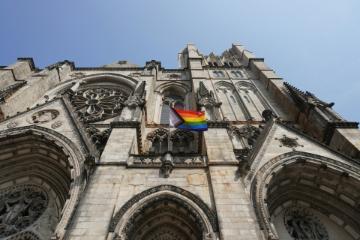
A rainbow flag is hanging on the side of a church building. Photo by Bertrand Colombo on Unsplash.
Grace Davis ’25 was a double major in political science and philosophy with a minor in gender & sexuality studies at Santa Clara University, a 2023-’24 Government Ethics Fellow and a 2024-’25 Hackworth Fellow both with the Markkula Center for Applied Ethics. Davis was also a student ambassador and served on the Associated Student Government (ASG).
Access audio of Grace sharing her essay via the links located in the sidebar to the right of this page, or access the full playlist via SoundCloud.
Introduction
This piece is dedicated to everyone who has longed for community. It is dedicated to those who feel permanently at a crossroads; this is for those who have felt like they don’t wholly belong anywhere. I see you, I honor you, and I hope that you can share in this story with me.
This project was born out of my own loneliness. This project came out of my own fears coming to terms with my queerness and my faith. In a moment of growing support for LGBTQ+ rights from religious leaders and simultaneous life-threatening attacks in the name of religious convictions, I felt existentially out of place. How could I, a lesbian Catholic, exist in a moment when those two core components of who I am were put against each other.
The queer part of my identity was not difficult to recognize. From as young as seven, I remember feeling love for all people, and it confused me why romantic love could only be expressed between men and women. It never felt wrong that I loved women; even when I didn’t feel supported by my family or when I saw all of the posts online condemning queer people, the thought that I could change this part of myself never crossed my mind.
It has been much harder to sit with the fact that I will always have faith. Faith meaning a belief in and a loyalty to God. This faith, which has connected me to my family, to my education and to my growth as a person, has been as fundamental to my life as queerness has. But I have wanted to turn away. I have wanted to turn away when I witnessed myself, my LGBTQ+ siblings, my friends, and my family isolated and hurt by our respective Christian churches. But there is a tie to the Divine that cannot be undone. I cried for weeks when I came to terms with the fact that I could not get married in the Catholic churches that my family has been married in. I changed out of my Catholic school uniform before going to hang out with friends at the local LGBT Community Center. For years, I have felt this tension: I could never be fully queer or fully Catholic anywhere, and yet I couldn’t let go of either.
In conversations about whether or not queer spaces and religious spaces can be one, there has been a glaring blind spot: actually hearing from queer and religious people. We’re not talking about, and more importantly listening to, the millions of queer religious people. Even when queer and religious people do share their stories, they are still a fraction of the voices in the conversation about the place of queer people in religions when they should be the focal point. So, when I was offered the opportunity to critically engage with the ethical challenges of belonging in both queer and Christian communities, I knew that I needed to highlight the stories of queer and religious people.
My case for the importance of valuing queerness and faith is nothing without their voices. Furthermore, I wanted to get more specific and highlight the stories of queer religious young people. Gen Z is shaping up to be less religious than the generations before them. Though the reasons cannot be adequately addressed here, it gives me all the more reason to focus on young people at a Jesuit university who want to continue in their relationship with God.
Though this work has been created and written by me, it is rooted in the stories of my participants. It is their vulnerability, kindness, and willingness to share their stories with me that makes this work possible. My greatest hope is that by uplifting more stories about the joys and struggles of these young queer religious folks, everyone can grow in their empathy and respect of the inherent human dignity in all people.
The language of ethics has to start from people’s stories. Human dignity necessitates a recognition that we are full members of a moral community. And clearly, queer and religious people have been excluded from this right. By sharing these stories, I hope to break down the walls of exclusion that prevent us from respecting and recognizing this dignity.
I include stories from other queer and religious people as the means of understanding and interacting with the ethical challenges of belonging. Doing ethics in this way connects with autotheory. Autotheory, as defined by writer Arianne Zwartjes, is “work that engages in thinking about the self, the body, and the particularities and peculiarities of one’s lived experiences, as processed through or juxtaposed against theory–or as the basis for theoretical thinking.” This is a deeply reflective practice that includes an understanding of oneself and how to connect your story to something bigger. I find that autotheory, a foundational practice in queer feminist theory, has parallels to Ignatian spirituality. In the Examen, we encourage ourselves to go through our day and use that story to connect with God. We are using our stories to connect with something bigger than us. By bringing in our personal experiences, we can further develop our own ethical theory and our relationship to God. This approach is how I weave the stories of my participants to create themes on human dignity in queer and religious communities.
This project is based on the ethics of dignity in belonging. Belonging is not just being welcomed and allowed into a community, but being an equal and valued member of that community. As articulated by many BIPOC feminist scholars, this belonging comes necessarily from a recognition and appreciation of every facet of someone’s identity. This means that you cannot truly recognize and appreciate someone if you claim to love them except for their queerness, something fundamental to their existence.=
I have found that, for myself, my identities as a queer woman and a Catholic has led to some disconnect in how I present myself and move through the world. And I recognize that systemic oppressions against other identities—race, gender identity, and nationality, especially—can warp that experience of disconnection even more.
Meet the Storytellers
I had profound conversations with four students from Santa Clara University who also struggle with being religious and queer. I want to briefly introduce you to each of them:
Cara (she/her) is a Black lesbian from California. She is out, but not heavily involved in queer spaces on campus. When she introduced herself in our conversation, she whispered “lesbian.” We were recording in a campus building, and when I asked why she whispered, she said, “in this building? Of course.” Cara was raised in a non-denominational Christian household. Her family goes to service every week and is very involved in their church community; Cara hopes to find a church community after college to invest herself in.
Shelly (she/her) is a lesbian from Washington. Her queer and religious journeys have both been on winding paths. It is only recently that she has identified as a lesbian; for a while she identified as pansexual (meaning that you are attracted to people regardless of their gender) before coming to terms with her lesbian identity. Similarly, her faith identity has shifted from different Christian denominations. Her parents are practicing Baptists, but were both raised Catholic. Shelly is still new to rediscovering Christianity as a part of her adult life.
D (he/they/she) is a Filipino nonbinary transmasc person from the greater San Jose area. In his words, “I am probably trans—as in if I were born a boy, I do not think I would be trans—but also, what is gender but a performance?” D lists he/they/she has his pronouns because he does not put as much value on pronouns as other queer people might. The pronouns used to describe them is more of a reflection on how we view D, less about how D views himself. D is a practicing Catholic who has been heavily involved in his Diocese, which has both provided community and led to doubts in their faith/queer journey.
Noah (he/him) tells me without a second thought that he doesn’t like labels. He wasn’t sure if this dislike for labels came from Catholic guilt or the obsession with labels our greater society has. For him, a box is greatly limiting for an individual human with a multitude of identities. But for us, Noah said he identifies as queer—because sexuality exists on a spectrum, so why limit it to one label—and as a Mexican Catholic. He specified that where you get your Catholicism from greatly influences the way that you experience, live, and learn about it. His family is also very involved in their Diocese in the San Francisco Bay Area, and Noah has been in Jesuit education for all of his life.
And then there’s me. My own stories have guided this process so it is only fitting that I briefly introduce myself here. My name is Grace (she/her) and I am a lesbian Catholic from Greater Cleveland, Ohio. My parents are both practicing Catholics, and religion has been foundational to our family’s creation: my parents met when my mom asked to play the flute with my dad, who was playing piano for Mass at Gonzaga University. I have been in Catholic education my whole life, and the values of service and work towards a greater good have driven my involvements throughout campus. I came out to my family when I was 14, and I am continuously inspired and fulfilled by my queer community. I have been known to shed a tear or two at my friends’ drag shows and at Pride events, because I feel so overwhelmed with joy when I am with other queer people.
Major Themes
I argue that there is a possibility for full recognition and appreciation of a person’s Christian and queer identity. These two do not need to be in conflict with one another. This can be best described from the individuals that have struggled to live out that harmony every day. My major themes include the similarities between the values of being queer and being religious, the definitions of what it means to belong as it relates to queerness and Christianity, and the understanding of what a community for a queer and Christian person looks like.
Similarities
When I asked Noah what similarities he saw in queerness and in faith, he started by saying he grew up feeling like they were polar opposites. He describes his life in boxes: in this box he was Catholic, in this a student, a son, and a queer person. Each box had moments where it opened, and others where it was closed and locked up. But as he grew into his queer identity, at the same time attending a Jesuit high school, he realized that there were no boxes. Being queer and being Catholic were not detached from each other; they were connected deeply to his inmost self.
“Cura personalis is an invitation for all of those different facets of your life to interact with one another so that you can best know how to care for yourself and how to care for others in a really holistic way…if you just understood me as a Catholic, you wouldn’t know how to best approach the queerness. If I was just a Catholic, you wouldn’t understand the Mexican part of me. Cura personalis really embodies the importance of understanding the whole person.”
With cura personalis, Noah learned that in order to truly take care of himself and develop into his best self, the boxes had to go. He had to allow these different facets of identity to interact with one another. This parallels intersectionality. Intersectionality, first named by legal scholar Kimberlé Crenshaw to describe the varied discriminations that Black women face, is the understanding that different social categories can interact to create unique experiences of privilege and oppression. In order to truly see and love someone, you have to be willing to recognize these identities and how they interact with one another.
Cura personalis and intersectionality share the same value: that to truly understand and support a person, you have to care for every part of their identity. I see this as three ethical ideas building up from each other. First, recognition requires the respect of the different dimensions of a person. From this, care can develop. Care requires the recognition and an appreciation of these identities. It is not just that you recognize someone is a Christian, but that you appreciate and care for that part of their identity. These are building blocks to love, which I understand to mean a deep affection and devotion that guides us to prioritize the care, respect, and livelihood of the beloved.
Love is a many splendored thing, and one of the challenges for queer and religious people is finding love in places where religions have said it cannot be found. But for Cara, the value of love is the primary similarity she sees between faith and queerness:
“[Love] is the sole thing that I get when I read the Bible. It’s about having a space where you are seen and you are loved more than you can possibly imagine. And that is a love that you can lean on, that is a love that is unconditional. And I think, very similarly, that’s so much of what the queer community is about, is love…respecting love and what love looks like and how that looks different for people, but also this formation of people that love each other because they’ve gone through a lot of similar experiences.”
Cara is connecting an important point here: that Christian and queer communities are rooted in the value of love. A community is built out of love: the love that you have for your family, friends, neighbors, and yourself. When we extend love to others, we can help them to love themselves too. The mission to love is actualized in the teachings to love thy neighbor, the Catholic preferential treatment of the poor, dedication to service and tithing in Christian traditions. In the queer community, the call to love has come out of pain. It has come out of necessity; to proclaim love so fiercely because it has been denied to us. That love is practiced in chosen families, caring for your siblings who are rejected from work or healthcare services, and celebrating queerness through Pride.
This core idea of love has been manipulated by religious institutions to change what it means to love another person, and what type of love is valuable. Because religious institutions have harshly condemned the love between queer people, these institutions have also driven a wedge between the love of God and the love of queer people. But for queer and religious people, the love they feel in their queer relationships is the same love that God teaches us to express. Here’s Cara on the love she feels with her partner:
“I always said that my biggest hope in life was that I would find a partner that reflected how much—that the way they loved me was— that I could just not even imagine how much more God loved me…Until I met her, I never truly knew what it was like to belong. She was the first person who saw me for all of the parts of who I was, loved me, and reflected God’s love in every way. I couldn’t ignore it. The way that she was able to be so intentional with the way that she loved me…it made me feel like I was seen fully.”
Cara’s relationship is evidence that the love between queer people is a reflection of God’s love. Similarly, Shelly has found herself reopening to faith because of her queer relationship. It is through the love shared between her and her partner that she feels like she can explore a relationship with God:
“My girlfriend is Christian, and that’s what really inspired me to reopen my faith…I hadn’t heard of the intersection of being queer and religious before…”
Another overlap that Shelly found between being queer and being religious is the idea of chosen families. I agree with her completely; my community growing up was our church community. In the Catholic church, godparents are your chosen family. Through the Sacrament of Baptism, you are making a covenant between the child, the godparents, and God that the godparents will be a core part of the child’s life. I felt community in the choir my parents sang in and in spending weekends with my godparents. Shelly’s parents also found a chosen family in their church:
“In the church, my family has been able to get a chosen family…those Christian spaces were our family. And that’s within the queer community too, you kind of find your chosen people, especially when your own family doesn’t necessarily support. It’s nice to have that reaffirming space so you don’t feel like such an outcast.”
Love as it pertains to family has many dimensions. We are all born into a family, which may be an occasion of love or sorrow. Other kinds of families are voluntary. They are families that we are not born into, but ones we treasure all the same. Many families make up our communities. Community is where we move into our discussion on what it means to belong.
The Challenges of Belonging
I asked everyone what belonging meant to them, and to describe a moment when they did not feel like they belonged.
D wanted to define belonging as it related to their Catholic identity, but that has become harder and harder. Despite his extensive involvement in the Catholic Church and his local diocese, he has never felt like he belonged.
“It’s something that’s been on my mind recently. It’s just…every time I’m in the Catholic Church or in that space it is with people who I think are my friends. But I end up feeling lonely. We’re not really friends, we are just in the same place.”
D is describing a loneliness that is not easily washed away by being in the presence of other people. It doesn’t go away just because you are allowed to participate in the Church or hang out with your friends. Cara speaks to a similar phenomenon, a loneliness even when in community with others:
“I think that because of my intersectional identities, it has made me feel like I don’t really belong anywhere. Even when I’m in spaces that are predominantly Black, a lot of Black people don’t like gay people…And conversely, there have been experiences that I’ve had at this school where I’ve been in queer spaces, even queer religious spaces, that I still didn’t feel fully comfortable either because, again, they didn’t recognize the fact that I was Black or I was the only Black person and maybe my experiences as a person of color and also being queer were not reflective of their experiences.”
Beyond accepting someone’s social identities, belonging also includes the feeling of being able to come into your community on good and bad days. Shelly focused on a time where she really felt like she did belong. She described the dynamic on her high school cross country team as …
“Constantly supportive of who I was and what I did, my work ethic…a lot of the time you’re just proving yourself and that you’re working hard enough. I was surprised that everybody was so accepting and patient with me even when I didn’t have my good days. I think that’s a big part, who is supporting you when you’re having hard days, when you’re not the best person.”
Shelly is parsing out a critical part of belonging and recognizing someone’s dignity. Dignity necessitates that we recognize the value of someone even when they’re not performing their best, not meeting expectations, or when they’re hurting. All too often, we care about queer people conditionally. I remember being told, “I’m so glad you’re not that kind of gay,” “I can’t be around people who are too gay, if you know what I mean.”
It is setting a conditional where queer people are only worthy of respect when they meet a certain expectation. Or, in Christian spaces, I remember feeling ashamed if I wasn’t meeting the expectations of being the perfect Catholic. D shared my sentiment; they expressed worry or fear when they got distracted during Mass or when they weren’t meeting the expectation of what they thought a perfect Catholic was supposed to be. I felt the same; I remembered being a young kid, no older than eight, and crying because I fell asleep before I could pray every night.
This shame around failure became internalized. I started to believe that I was never going to belong because of who I was. This shame, this feeling that your fullest self—the good and the bad—is the reason why you can never belong, takes a toll on you. In order to move towards a reality where queer religious people truly belong, there must be a full appreciation and acceptance of every part of themselves. This applies to everyone; we all deserve to come into community on our best days, our worst days, and always as our truest selves.
Fostering Community
What would it take for queer and Christian communities to come together, to live cohesively and even thrive together? Community itself is so difficult to come by these days. Noah says that, “Our generation has been crying out for community.” We spent the formative years of our social development isolated from each other, and the boom of social media and partisan politics compounds this loneliness.
As our generation enters the working world after our time at Santa Clara University, we are faced with the question of how we are going to create our own communities, and whether or not we are equipped to do so. Still, the values of community embedded in queerness and in Christianity call on us to be leaders. If queer and religious people are at the forefront—having their stories told, being heard, being valued as leaders—we could build a community where Christians and queer people can develop a respect and appreciation for one another. What if we could foster a community that truly made us feel like we belonged? Cara says …
“I have to believe that that community can exist. I have to hope that it’s going to exist one day. It starts with an acknowledgement of a lot of the ways the church has—not by God, but by man—turned away people that God loves. There needs to be a real recognition and confrontation of that.”
Noah specifies that we have to start with Christian communities, not the institution at large. He emphasizes the need for full recognition of the pain and suffering queer people have faced in the name of religious conviction. From there, a more inclusive and loving community can start to develop. For Cara, this may include a recentering of priorities:
“Maybe the church needs to not be so involved in what’s being taught in the school sex ed class and focusing and redirecting those efforts and monetary contributions to doing real work in the community, because they can really make some difference. A lot of queer kids are thrown out by their family members, they could benefit from a home and a community in a church. But the church needs to be prepared to not try and change that individual. Just as God loves them for who they are, they need to love them for who they are and be a reflection of God’s love.”
There also needs to be work done from the queer community. For a lot of us queer religious people, it feels just as isolating to enter into the queer community. The hostility against religion is understandable, but any movement forward has to come with acceptance for those who want to maintain a religious life. To move forward, D asks the queer community to not …
“Bat down those who want to stay Catholic or stay faithful to a God. There are times where I’m in the queer community and I don’t necessarily want to wear my crosses because I feel like they often look down on you and they’re like, ‘Why are you even supporting that faith when they don’t support you?’ I think from a queer perspective, just being a little bit more accepting of those who still want to have faith or still want to believe in the same faith that may have hurt them.”
When I think about building a shared community, I am reminded by Fr. James Martin’s book Building a Bridge, which calls for respect, compassion, and sensitivity from both the Catholic Church and the LGBTQ+ Community. I find these to be helpful when encouraging reflection and action from both Christian communities and the LGBTQ+ community. Respect can include extending ministries to LGBTQ+ Christians, and an openness to understanding the way faith is intimately connected with a person’s queerness.
To be compassionate is to “experience with,” to strive to understand. This has been the bedrock of this entire project; by sharing stories and being willing to listen to them, we are striving to understand one another. Noah, Cara, Shelly, and D described sensitivity. Sensitivity asks that Christians be sensitive to the pains and traumas that queer people have faced in religious communities. And sensitivity asks the LGBTQ+ community to be sensitive to the importance of faith in a person’s life. These three practices are building blocks on a longer journey of cultivating belonging.
Conclusion
Though this project includes various Christian denominations, I want to return to the Catholic identity. “Catholic” (little “c”) means universal; it is essentially for all people. This parallels the core of what it means to be queer. Queerness, in its most fundamental sense, is about rejecting the status quo. Queerness is its own version of universal because it is open to everything beyond the walls of what society calls “acceptable.”
The LGBTQ+ community is also built on standing in solidarity with those everyone else wishes to cast out. This can be applied to other Christian denominations; in Christianity, we are called to be Christ-like. Jesus Christ extended love to all people, stood with the marginalized, and built community everywhere he went. To be Christ-like and to be queer calls for the same practice of acceptance, respect, and love.
Noah, Cara, Shelly, D, and I are examples of people who want to build up a community for queer religious people. We are the stories that can be weaved together to create a strong foundation for such a community. We deserve full respect and appreciation for who we are. We deserve the care and love that can develop from this appreciation. We deserve to nurture and celebrate our queerness and our faith. Our dignity demands it.