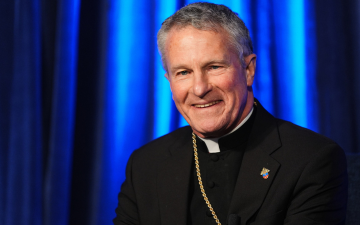
Military Services Archbishop Timothy Broglio, president of the United States Conference of Catholic Bishops, speaks during a press conference at a plenary assembly in Baltimore, Tuesday, Nov. 11, 2025. (Stephanie Scarbrough/AP Photo)
David DeCosse is the director of religious and Catholic ethics at the Markkula Center for Applied Ethics. Views are his own. "Archbishop Broglio's Comments on Conscience Exemplify Catholic Morality" is reprinted by permission of NCR Publishing Company www.NCROnline.org.
On Jan. 18 on the BBC's "Sunday" program, American Archbishop Timothy P. Broglio said of Catholic personnel in the United States military who could be ordered to attack Greenland: "Within the realm of their own conscience, it would be morally acceptable to disobey that order."
Broglio's comment was a brave intervention in the ludicrous-if-it-were-not-so-catastrophic Trumpian drive to conquer the land of a longtime ally. But the archbishop's appeal to conscience is also a prophetic moment in the development of Catholic moral teaching on war and peace and in signaling the relevance of such teaching for Catholic opposition to the authoritarian political rule now besetting this country.
Broglio is the archbishop for the "1.8 million Catholics serving in the United States Armed Forces, their family members, students at the Military Academies, patients in VA medical centers and US governmental personnel serving abroad." Catholics constitute about 20% of active duty personnel. At a time when Secretary of Defense Pete Hegseth can't stop going after politicians who say that troops are required to disobey illegal orders, the archbishop spoke up to say the same thing to a huge swath of the U.S. military.
And he did so for the second time in the last weeks. On Dec. 3, Broglio issued a statement on the morally problematic naval attacks on alleged drug smuggling boats in the Caribbean and eastern Pacific:
No one can ever be ordered to commit an immoral act, and even those suspected of committing a crime are entitled to due process under the law. As the moral principle forbidding the intentional killing of noncombatants is inviolable, it would be an illegal and immoral order to kill deliberately survivors on a vessel who pose no immediate lethal threat to our armed forces.
Broglio's statements may seem a surprise to many Catholics and to the broader American public. A recent past president of the United States Conference of Catholic Bishops, he is widely considered allied with the conservative wing of the American episcopacy. But in fact his appeals to conscience and to just war theory are not only a powerful reflection of Catholic moral and social teaching. They are also a timely demonstration that Catholic teaching is grounded in values that transcend the interests of any political party. Broglio has shown us the way. Now if only Bishop Robert Barron of Winona-Rochester, Minnesota, would follow his lead.
But it's important also to consider Broglio's statements as a prophetic teaching moment in the development of Catholic moral thought on war and peace. To be sure, Catholic opposition to any participation in war goes back to the early church. But that opposition lessened in the face of the demands of political rule (as Christians themselves became emperors) and under the influence of just war theory.
For centuries, the theory stated that only a legitimate political authority was morally permitted to initiate a war. Along with that requirement also came the presumption that a soldier was bound by obedience to accept the moral judgment about war made by a legitimate authority and was freed in conscience from any guilt associated with an unjust war. Shakespeare in Henry V famously articulated this view: "We know enough if we know we are the King's subjects. If his cause be wrong, our obedience to the king wipes the crime of it out of us."
But the Second Vatican Council shifted the responsibility for evaluating the morality of war toward the conscience of a citizen-soldier. The council fathers who first gathered in 1962 did so amid the agonizing memory of World War II and the visceral fear of a nuclear arms race. Moreover, as Jesuit moral theologian James Keenan has argued, the fathers also confronted the reality that "Catholicism had created an obediential, minimalist passivity" that left the laity vulnerable and even clamoring for the war-mongering authoritarianism of Nazis and allied fascists.
The famous affirmation of conscience in Gaudium et Spes — "Conscience is the most secret core and sanctuary of a man. There he is alone with God" — was in ways a response to the challenge of finding a better balance between the authority of conscience and political authority in the context of war. Moreover, the council for the first time at such a high level of teaching authority declared the moral acceptability of the conscientious rejection of all war when it said: "It seems right that laws make humane provisions for the case of those who for reasons of conscience refuse to bear arms."
Then in 2007 Pope Benedict XVI beatified Franz Jägerstätter, an Austrian husband, father, and farmer who in 1943 was executed by the Nazis for his conscientious refusal to serve in the German military. Jägerstätter did not reject all war but thought that Germany's war was patently unjust. "I do not agree with the view that an individual soldier bears no responsibility for the whole [war] and that this responsibility belongs to only one individual [i.e., Hitler]," he said.
To be sure, these are complex matters. Any soldier facing a possibly immoral order also faces a host of other hard questions. And any country under attack faces pressing moral questions about the defense of the common good that may attenuate appeals to individual conscience. Nevertheless, Broglio's statements represent a welcome and unambiguous affirmation of the direction set by the Second Vatican Council on matters of war and peace: The individual Catholic conscience has an inalienable role in such matters.
Moreover, his comments point toward the ultimate basis of the conflict between Catholic thought and authoritarian rule. Wrapped in the flag and in a parade of lies, authoritarian rule tries everything to conceal that at bottom it depends on violence to compel submission. However much over the centuries the Catholic Church participated in such authoritarian rule, the Second Vatican Council made clear that conscience properly understood as a reflection of our freedom and responsibility and of our duties to God and neighbor can never finally submit to such pretension.