At Santa Clara University’s Digital Dignity Day in 2025, the Markkula Center for Applied Ethics held a panel discussion on Human Dignity Framing. We talked about how grassroots leaders and ethicists frame dignity in their efforts to remove indignities that people and communities at the margins experience.
On the panel, we had three speakers representing three different vantage points. Jane Pak, Co-ED of Refugee & Immigrant Transitions, Greg Eskridge, Leadership Fellow from the award winning podcast Uncuffed, and Irina Raicu, director of Internet Ethics at Markkula Center for Applied Ethics. Subbu Vincent, director of Journalism and Media Ethics was the moderator.
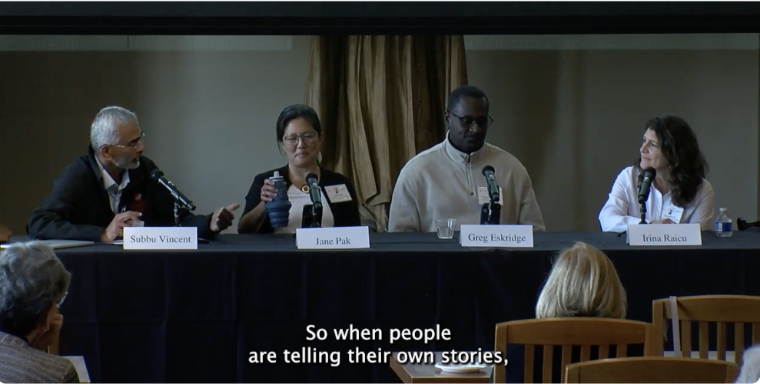 Panel on Human Dignity Framing at Digital Dignity Day held at SCU on May 2, 2025. Moderator: From left to right: Panel moderator Subbu Vincent, director of Journalism and Media Ethics. Panelists: Jane Pak, Co-ED of Refugee & Immigrant Transitions, Greg Eskridge, Leadership Fellow from Uncuffed Podcast, and Irina Raicu, director of Internet Ethics at Markkula Center for Applied Ethics.
This article elevates an exchange on the connection between dignity and journalistic reporting between Eskridge and Vincent. Eskridge was formerly incarcerated at San Quentin prison in California, is a founding member of the Uncuffed podcast team. Vincent asked Eskridge to talk in detail about dignity as a value. He then asked Eskridge to explain why KALW, the San Francisco newsroom hosting the Uncuffed radio program and podcast, decided to facilitate incarcerated people at San Quentin telling their own stories instead of sending in a reporter and doing a conventional journalistic series.
Eskridge was uniquely suited to respond to this question. Prison is a system “that's geared to really strip you of your dignity”, he noted. He then added in his deep and moving voice: “Storytelling is a way to reclaim that dignity.” For over a decade in San Quentin, Eskridge fostered an atmosphere of professionalism and dedication which led to the program winning numerous awards. On July 23, 2024, Greg was released from San Quentin prison after serving 30 years and 25 days. A few months later, Greg began working full-time as Uncuffed’s first Leadership Fellow, preparing him for leadership roles in the program. In January 2026, Eskridge was promoted as Co-Director of Uncuffed at KALW.
You can see the full exchange on YouTube starting at time code 7:50. The transcript here is edited for clarity.
Subbu Vincent: The word dignity comes up in the context of freedom, storytelling, work, etc. Why is the word dignity always used in conjunction with all of these other things? There must be something special about the word.
Greg Eskridge: So, for me it's thinking about, in terms of storytelling, owning our own stories, being inside of San Quentin for so many years. Like I talked about, just being in this system that's geared to really strip you of your dignity and get the opportunity to be on the radio and tell our own stories was a way of reclaiming that dignity.
It was a way of basically fighting back against this system because there is one system that says we are this particular group of individuals who do not deserve to be um treated as human beings. But then you have an opportunity to say no this is who I am as a person. This is my struggle. This is my triumph. This is my resiliency. This is who Greg is. This is who other incarcerated people are of these systems. And for me, the storytelling gave me the opportunity and other folks opportunity to be able to say to the world, no, see us for who we truly are, not for the narrative that's already been painted for us.
And being home now for the past eight months, I've been working with KALW and I continue to do this important work of giving folks a platform, giving folks a microphone to be able to tell their own stories and share with the world and reclaim their own dignity.
Subbu Vincent: So, how did you manage to convince the people at San Quentin, given the oppressive system that prison is? Can you talk us through the journey there? They actually did facilitate this kind of podcast, and so at least they didn't stand in the way.
Greg Eskridge: Yes. I don't think they really truly knew what was coming.
I think it was an opportunity. I mean, and so one thing I would just say given this opportunity to share um to share our stories, there was particular staff that had a progressive mindset that said that we wanted to give you all the opportunity to be able to show what change truly looks like. And so we were given this opportunity by staff that were forward-thinking. And so all of the stories we tell are about humanity. We're not talking about bashing the system. We can sit here all day and talk about how horrible these systems are. We all know this, right? But that's not what it's about. We're not talking about the system itself. We're talking about the people, the people who are inside of this place.
And so, yes, they helped to facilitate us starting the program. And also, I would say our stories are filtered. Like, they're censored. We get a chance to put a story together and send it out. They do have to listen to it and approve it. And so keeping that in mind, we have to make sure that we're always staying on point, staying on topic with just showing our humanity and showing our true rehabilitation. And as long as we've continued to do that, we have not had any hiccups.
Subbu Vincent: In journalism, the assumption has always been that reporters will come in and tell the stories of the people in the reality they're actually covering. So, they'll interview people, they talk to a bunch of people, they dig up a bunch of documents, and then they'll report out a story. So, in a way, it's an indirect story. You chose, you're in a media organization (KALW) that actually could have gone into San Quentin and said we'll report out the story of how incarcerated people are rehabilitating themselves, how they're going to transition out, what are they doing after transition. It could have been a classic journalistic series, but no, you are actually the people telling your own stories inside and also as you come outside. How did you take that decision? That is not a common decision to take.
Greg Eskridge: Not at all. Thank you for that question. And so it's so interesting you say because that's exactly what happened in around 2012 when journalists wanted to come inside of San Quentin. They wanted to just come in like you say interview a few people go back out and tell the stories that they wanted to shape. And so a lot of individuals said we're tired of that skewed view, that negative narrative that was only causing harm to people. We said to them, "No, we want to tell our own stories. How about you come into the prison, give us the computers, and teach us how to edit, to tell stories, and how to produce, and we'll produce our own stories." It's like Irina (co-panelist, Irina Raicu) alluded to, like, who can tell Greg's story better than Greg?
Nobody, right? And so given that opportunity, we took it because there were so many instances where you would see the media come in and they would portray prisoners as these horrible monsters. Right now, I know some amazing people inside of these places that committed crimes during horrible times of their lives. I make no excuses for it. I take full responsibility for the uh crime I committed and for others as well. However, does a five second bad decision determine Greg's entire 51 years on this planet? It should not.
And so get an opportunity to tell that story and to tell the story of how Greg got to a point to where he committed a crime in the first place and how Greg changed his life and became a rehabilitated human being that was ready to get back out in society and be productive. This is what we wanted to do and we were not going to go for anything less than that because we know the power of the truth and there's truth inside of the people but you have to let the people tell their own stories.
Vincent then broadened the conversation into the use of the term dignity itself. Is there a risk of it being overused or should it not be brought up in some cases.
Subbu Vincent: Do you see any limits to using the word dignity in your conversations? Have you felt hesitant that I shouldn't bring up the concept of dignity up here because it doesn't apply?
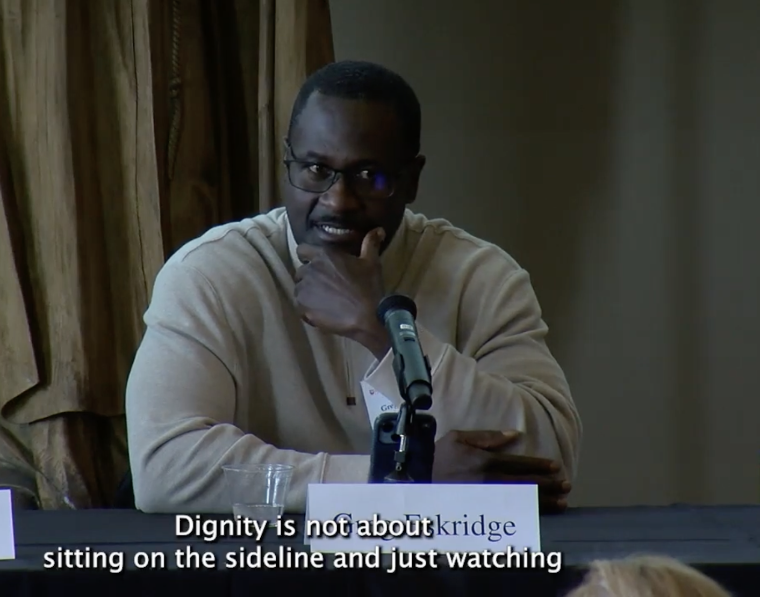 Greg Eskridge speaking at Human Dignity Framing Panel, Digital Dignity Day, May 2025, Santa Clara University.
Greg Eskridge: I love the word. I love what it means because I've been on both sides of it. I've experienced a lack of dignity and I've experienced having dignity shown to me. And I've also had dignity within myself. So, going back to the term, the buzzword, you know, I think the word has to be used not as a shortcut, but actually it has to be applied when you see someone whose moral standing is at stake. It's about getting involved.
Dignity is not about sitting on the sidelines and just watching some atrocity take place to other people. Dignity is about being intentional. It's about putting yourself in a situation where you're uncomfortable because atrocities are taking place not just in prison, but all across this world. And dignity is the opposite of complacency. And I think the state of this country is in the place we're in because of complacency. Because folks have looked and saw things and normalized certain behaviors. A lack of dignity in this society and coming from someone that was in a place where dignity was not shown. Dignity was the last word that you would ever think that you would experience inside of a prison cell. And then to come out into a world where I'm still fighting for dignity.