Consent and Consequences: An AI ethics case study
An AI Ethics Case Study
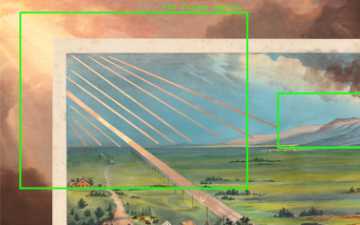
A highly-contrasted digital landscape of a train going West with settlements in the bottom left. (cropped). Framed by green box symbolizing computer vision. Hanna Barakat & Archival Images of AI + AIxDESIGN / Better Images of AI/. Licenced by CC-BY 4.0.
The well-known cartoonist and podcaster Scott Adams, creator of the “Dilbert” cartoon and of the podcast “Coffee with Scott Adams,” died in January 2026. Not long after, two brothers who describe themselves as fans of his work launched a podcast series featuring an “AI Scott Adams.” In response, Scott Adams’ family members said that they found those new podcasts “deeply disturbing,” and asked their creators to stop.
An article titled “The Battle Over Scott Adams’ AI Afterlife” notes that in a 2021 podcast Adams had “granted ‘explicit permission’ for anyone to make a posthumous AI based on him, arguing that his public thoughts and words are ‘so pervasive on the internet’ that he'd be ‘a good candidate to turn into AI.’”
In a subsequent Business Insider interview, one of the creators of “AI Coffee with Scott Adams” added that the model developed for the new series was trained on transcripts of Adams’ original podcasts. He also claimed that each of the new episodes costs $1,000, but said that the developers have no plans to monetize it. And he argued that they are not claiming that “this is Scott” or a replacement for him.
Nonetheless, Adams’ family expressed their opposition to the new series; his brother posted on X that Adams "never would have approved an AI version of him that wasn't authorized by himself or his estate,” adding, “Do you truly believe Scott didn’t know a rogue AI version of himself could be used for persuasion and propaganda he would find abhorrent?”
In the Business Insider interview, the series’ creator explained that at “each stage there's a little bit of art versus science — we check that something feels in line with what Scott would have chosen.” He added that the project “is far from perfect,” but that “Scott used to say it's better to take action now than to wait until something is 100% ready. So we launched knowing it would improve. After every episode, we feed comments back into the model to keep refining it. The tone and cadence have already evolved significantly.”
He also said that he and his brother had started working on the project as soon as they heard about Adams’ cancer diagnosis, with the intent to “preserve at least some essence of how someone thought.”
“The goal,” he said, “is permanence—not profit.”
The Adams family calls it a “violation, not a tribute.”
Discussion Questions
- Who are the stakeholders involved in this case?
- Consider the case through the lenses of rights, justice, utilitarianism, the common good, virtue, and care ethics; what ethical issues does each of them highlight?
- The responses from the developers of the new podcast series also reflect particular values and ethical claims; which are those?
- Should the creators of the new podcast series accede to the request of Scott Adams’ family? Why, or why not? Are there additional facts you would want to know before making that determination? If so, which?
Image credit: Frontier Models 1 by Hanna Barakat & Archival Images of AI + AIxDESIGN (cropped) Better Images of AI/ Licenced by CC-BY 4.0.