Breaking the Cycle: Media Representation and MENA Women’s Democratic Participation
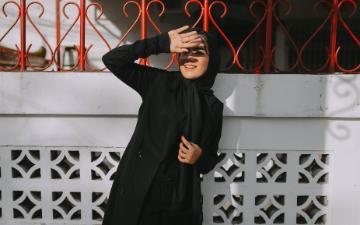
A woman wearing a hijab standing against a white wall with red iron fencing uses her hand to block sunlight from her eyes. Image by Amrullah Ab via Pixabay.
Tara Khan was a 2025-26 Hackworth Fellow with the Markkula Center for Applied Ethics at Santa Clara University. Views are her own.
Introduction: The Georgetown Post and the Question of Belonging
In March of this year (2026), a Georgetown University student organization posted on social media: "Let's be honest: Muslims have no place in American society. Their religion is incompatible with our Christian nation." This statement, emerging from a Jesuit institution founded on principles of interfaith dialogue, is not merely an isolated incident of bigotry. It is a symptom of deeper structural failures in how American society understands and represents Middle Eastern and North African communities. These are failures that have profound consequences for democratic participation.
As a Pakistani-Bosnian Muslim American woman at a Jesuit university, I have navigated what Virginia Lieutenant Governor Ghazala Hashmi describes as living in "two spaces": Muslim at home, American in community, never quite fully belonging in either. This lived experience shapes my research question: How does media representation of Middle Eastern and North African (MENA) women affect their democratic participation? More specifically, what are the mechanisms by which representation either enables or forecloses participation, and how can the negative cycle be broken? I looked into some factual research on how the demographics of Muslim voters look. I found that data from the Institute for Social Policy and Understanding shows that 85% of legally eligible Muslims are registered to vote, aligning closely with the 84% registration rate of the general U.S. public. However, registration rates differ significantly by gender. According to the American Muslim Poll 2025: Full Report, 92% of legally eligible Muslim men are registered to vote, compared to 76% of eligible Muslim women. When registered, Muslims vote at rates comparable to other religious groups and the general population. However, when taking into account the total number of eligible adults (including unregistered individuals), overall participation can sometimes appear lower in certain cycles. In recent elections, the community has seen a shift toward third-party candidates or a reluctance to vote at the top of the ticket due to dissatisfaction with foreign policy (such as the situation in Gaza) and domestic issues.
My specific question emerged from a conversation with Hana Baba, a Sudanese-American journalist at KALW public radio. She posed what became the framing puzzle for this entire project: "It's like the chicken or the egg. The narrative comes from ignorance. But there's less women telling their own stories, but the women are afraid to go into the media because of the images. Like, which one do you solve first? Like, where do you break the cycle?"
Her question captures a fundamental paradox: Bad media representation discourages MENA women from entering media and politics, which perpetuates bad representation because there are fewer MENA voices to complicate narratives, which further discourages participation. This is a negative feedback loop where each stage reinforces the next. Understanding how this cycle operates, and how it can be broken, is essential to understanding barriers to democratic participation and to fulfilling democracy's promise of equal citizenship.
To answer these questions, I conducted qualitative interviews with four women positioned at the intersection of MENA identity, media or advocacy, and ethical reflection: Hana Baba (Sudanese-American journalist, KALW public radio), Shereen Adel (Egyptian-American journalist, KALW public radio), Jeannie Kahwajy (Lebanese-American communication scholar and CEO of Effective Interactions), and Zahra Billoo (Pakistani-American civil rights attorney, executive director of the Council on American-Islamic Relations in the San Francisco Bay Area). I analyzed their insights through the Markkula Center for Applied Ethics' framework of six ethical lenses—Rights, Justice, Care Ethics, Common Good, Virtue, and Utilitarian perspectives—and examined the case of Ghazala Hashmi, who recently became the first Muslim woman elected to statewide office in U.S. history.
What emerged was a comprehensive analysis of how media representation creates participation barriers through four systematic failures, how these failures violate multiple ethical principles simultaneously, and how solutions must operate at three levels—individual, institutional, and structural—to break the cycle. This paper synthesizes those findings.
PART I: THE DIAGNOSIS - FOUR MECHANISMS OF MEDIA FAILURE
The Flattening: From Complexity to Binary
The first and most pervasive failure is what Shereen Adel calls "the flattening." I would describe it as the process by which complex, contested, multidimensional debates within communities get reduced to simple, external, binary frameworks imposed by outsiders.
Shereen's paradigmatic example involves hijab. In Egypt, where she lived from age eight through college, debates about hijab are rich and contested. They involve theological questions (does Islam actually require it?), feminist questions (is it empowering or patriarchal?), class questions (what does its increasing popularity mean for social mobility?), and generational questions (why are young women choosing it when their grandmothers didn't?). These debates are not simple, and people hold diverse positions grounded in different frameworks such as Islamic jurisprudence, secular feminism, cultural nationalism, and economic analysis.
When these debates cross into American media and public discourse, they collapse. The rich, multidimensional conversation flattens into a binary: oppression or freedom. Either hijab is patriarchal control of women (oppression narrative) or its empowered choice (freedom narrative). The actual debates happening in Muslim communities, which are debates that don't fit this Western liberal framework, become invisible.
Shereen describes her frustration: "I came to the States and I felt like the conversation was so flat. There's no room for a conversation about what it means to be Muslim and not think this is a representation of our religion." When she tried to explain the complexity to American friends, they were confused or dismissive. Her friend eventually told her: "Too bad. That's the reality we live in now." The flattening has already occurred. It's too late to unflatten it. MENA women must accept being systematically misrepresented.
This flattening operates across multiple dimensions. The media treats the idea of a "Muslim woman" as a monolithic category despite enormous diversity across religious practice, national origin, class, sectarian identity, and relationship to Islam. The media reduces entire regions to crisis narratives including war and terrorism, while erasing culture, ordinary life, joy, and complexity. The media even creates categories like "culturally Muslim" that don't exist in home countries but racialize religion in the American context.
The ethical analysis reveals that flattening violates multiple principles. From the Rights perspective, it violates MENA women's right to be understood in complexity, to have their own debates reported on their own terms, to define their own identity categories. From the Justice perspective, it concentrates power in the hands of those who decide what frameworks are used. By account, they are overwhelmingly white, non-Muslim editors and journalists who impose Western categories on non-Western debates. From the Care Ethics perspective, it fails to listen to what people actually say, judging instead whether they fit expected categories. From the Common Good perspective, it prevents the cross-community understanding necessary for democratic deliberation.
The participation consequence is severe: MENA women cannot meaningfully participate in discourse that fundamentally misrepresents the terms of debate. They are forced to constantly correct, educate, and translate before they can even begin to make their actual arguments. This exhausting labor discourages participation. I reasonably conclude that engaging in public discourse that doesn't make room for their actual positions is futile.
The Normalization Pipeline: From Lies to Violence
The second mechanism is what Zahra Billoo, drawing on sixteen years of civil rights work with CAIR, calls the "normalization pipeline." This is the process by which deliberate lies about Muslim communities become normalized truth, leading to government action and community violence.
The pipeline has four predictable stages. First, right-wing activists with explicit anti-Muslim agendas create false narratives. These can be things like filming Muslim businesses with cell phone cameras, posting inflammatory claims about welfare fraud or terrorism connections, or creating the appearance of investigation without journalistic verification. Second, the right-wing media echo chamber amplifies these narratives. The first outlet covers the activists' claims, others cite the first as a "source," and each repetition adds legitimacy through sheer volume. Third, mainstream legacy media legitimizes the narrative by covering it as a "controversy" or "debate." They present both sides as equally valid without independently verifying which claims are true. Fourth, government acts based on the now-normalized false narrative. Federal agencies investigate, ICE conducts raids, violence follows.
Zahra describes the result: "Somali communities are under attack by the federal government. They're under attack by right-wing extremists." The consequences are material and devastating: businesses lost and families deported. The normalization pipeline doesn't just produce symbolic harm, it produces deportations, economic devastation, violence, and potentially death.
Why does the mainstream media participate in legitimizing lies? Zahra's answer is direct: "If that echo chamber is loud enough, then mainstream media picks it up because it's interesting and it's selling." Commercial media needs engagement to sell advertising. Controversy drives engagement. So even false controversies get covered because they're profitable. The profit motive overrides the journalistic responsibility to verify before amplifying.
The ethical analysis shows that the normalization pipeline fails on every dimension. It violates rights (due process, safety, freedom from discrimination). It perpetuates gross injustice (vulnerable communities bear all burdens while powerful actors reap all benefits). From a utilitarian perspective, it produces massive concentrated harm for minimal diffused benefit. It undermines the common good by poisoning democratic deliberation with lies. It exhibits vices (greed, dishonesty, cowardice, opportunism) and lacks virtues (courage, integrity, compassion). And it completely fails care ethics by treating communities as objects to extract controversy from rather than people to care about.
The participation consequence is that communities under attack cannot participate in civic life. When you're facing deportation, when your business has been destroyed, when you're living in fear of violence, or when your children are traumatized, you're in survival mode. Civic engagement is foreclosed. And the chilling effect extends beyond the directly targeted community. Other Muslim communities watch and withdraw preemptively, knowing they could be next.
Parachute Journalism: Extraction Without Relationship
The third mechanism is parachute journalism, which is when journalists fly into crisis zones, extract stories, and fly out without ongoing relationships, accountability, or context.
Shereen witnessed this during the Arab Spring. Western journalists descended on Cairo when Tahrir Square erupted, stayed in hotels, went to protests with cameras and interpreters, interviewed English-speaking elites, filed dramatic stories about democracy versus dictatorship, and then left. The aftermath (the military consolidation, the brief Muslim Brotherhood government, the coup, the imprisonment of activists) got much less coverage because it wasn't dramatic enough.
She describes her visceral reaction: "I felt like my impression of journalists was they're parasites or they're opportunists and they're parachuting in and they're telling the story of this place when it's in crisis." The parasites metaphor is precise; they are organisms that extract nutrients from a host, provide nothing beneficial in return, and don't care about the host's wellbeing beyond keeping it alive enough to continue extraction.
Shereen herself lived in Egypt from age eight through college, yet felt she lacked "permission" to tell Egyptian stories because her Arabic wasn't fluent enough, because she went to English-speaking schools, and because she felt like an outsider despite living there. Meanwhile, Western journalists with no Arabic, no lived experience in Egypt, no understanding of context felt entirely entitled to parachute in and tell stories. Permission comes from structural power (working for Western media outlets), not from knowledge or relationship.
The ethical failures are clear. Parachute journalism violates care ethics completely. There is no relationship, no listening, no accountability. It violates rights by denying communities the right to participate in how they're represented. It perpetuates injustice because journalists extract value (stories converted into career advancement and awards) while communities bear burdens (misrepresentation, sensationalization). It undermines the common good by preventing genuine understanding. Americans learn crisis narratives but not cultural complexity, making solidarity and informed policy impossible. And it exhibits the vice of opportunism rather than the virtue of integrity.
The consequences are sensationalized, decontextualized, and extractive coverage. Egypt becomes only Tahrir Square protests and violence, not the complex society with diverse political factions, economic structures, cultural richness, and ordinary life. Americans think they're learning about Egypt, but they're learning Western narratives about Egypt. When policy is made based on these simplified narratives, like Iraq-War justifications about "liberating" Iraqis, the results are disastrous.
Corporate Consolidation: Killing Stories for Politics
The fourth mechanism operates at a different level. Even when individual journalists want to practice ethical journalism, corporate consolidation creates structural barriers they cannot overcome through individual virtue alone.
Zahra describes the case of CBS pulling a 60 Minutes report on Trump deportations. The story was fully vetted, fact-checked, and ready to air. But suddenly it was pulled from the schedule. After public pressure and reporting on the decision, CBS eventually aired the story with the body unchanged. According to reporting, the initial decision to pull the story came from corporate pressure. Barry Weiss had enough corporate influence to delay the story and attempt to control when it aired. CBS correspondents and journalism critics were furious, calling it a political decision instead of an editorial one.
This reveals the problem: "Journalists are required to report to people who don't have journalistic integrity," as Zahra puts it. Corporate owners prioritize political and business interests over journalism. They impose editorial restrictions like: you can use this word but not that word, you can report on this but not that. For MENA journalists and stories about MENA communities, this is devastating because many of the most important stories conflict with corporate owners' political preferences.
The ethical analysis outlined through the Markkula framework's ten-step decision-making process shows that killing the story fails every test. All six ethical lenses condemn it. It violates the public's right to information and journalists' right to editorial independence. It's unjust—a powerful benefit while the public is burdened. It produces more harm than good (utilitarian failure). It undermines conditions for democracy (common good failure). It exhibits vices (cowardice, dishonesty) and lacks virtues (courage, integrity). And it violates care for all stakeholders except corporate owners.
The participation consequence is severe: Why enter journalism if, even when you succeed professionally and follow all standards, your most important work can be killed by corporate owners for political reasons? This creates brain drain. Talented MENA women who could complicate narratives choose other fields—law, medicine, business—where professional standards matter more than owners' political preferences.
PART II: THE SOLUTIONS - THREE LEVELS OF INTERVENTION
Individual Strategies: Going First and Behaving Into Belief Change
Jeannie Kahwajy's research on communication and perception offers frameworks for individual action. Her core insight: "We behave our way into belief change. We do not believe our way into behavior change." Don't wait for people's beliefs about Muslims to change before acting. Act first, and then the behavior can shift beliefs.
She offers three key concepts. First, "receiving" rather than judging. Prepare to catch whatever someone offers rather than evaluating whether it meets your expectations. Second, "invitation" rather than "announcement." Approach as "here's my perspective, what do you think?" rather than, "this is the truth, believe me." Third, "going first." Don't wait for conditions to be perfect. "There's only one person who has to go first and that person can always be me."
Examples from the interviews show this in action. Hana chooses regularly to cover Muslim and Sudanese stories despite fear, despite being the only one, despite the burden of being a "reference point" for everything. She goes first, and her presence shifts her colleagues' stereotypes—they learn to save her shawarma during Ramadan, they see that "she can talk" and "she's not oppressed." Zahra uses her privilege (citizenship, economic security) to be "loud and unfiltered" in ways undocumented people cannot risk. Stories like Moina Shaiq chasing down someone who hated Muslims to invite relationships show individual encounters shifting person-by-person bias.
But the limits are crucial. Individual strategies require privilege and safety that not everyone has. They place enormous emotional labor burdens on MENA women. And they don't work when institutions are structurally hostile. Individual virtue cannot overcome corporate consolidation or the normalization pipeline. The strategies work in receptive contexts (KALW) but fail in hostile ones (Fox News, corporate consolidated media).
Institutional Media Models: KALW and the Caring Culture
Both Hana and Shereen use the same word for KALW: "home." After years of feeling like outsiders, they found an institution where they could be themselves.
What makes KALW different? Its public media structure creates different incentives: mission over profit, listener loyalty over click maximization, community accountability over corporate interests. Its "disproportionate Middle Eastern representation" creates critical mass rather than tokenism; Hana and Shereen can be individuals rather than representatives of entire regions. Its caring culture means colleagues attend to each other's needs without being asked. Its commitment to storytelling "with" communities rather than "about" them creates partnership rather than extraction.
When Shereen was asked, "Should journalists move from storytelling about communities to storytelling with communities?" her response was immediate: "100%. Yes." This is care ethics translated into journalism practice. Communities as partners, ongoing relationships, accountability, giving back not just taking.
The limitations are significant. KALW is small enough to maintain a caring culture through personal relationships, so this might not scale to New York Times size. It operates in the progressive, diverse, wealthy Bay Area, so that might not work in rural conservative areas. It depends on precarious nonprofit funding. And it benefits from self-selection; people work there because they share the mission.
But the lessons are generalizable: Hire for critical mass, not tokenism. Cultivate culture intentionally through leadership commitment. Clarify mission and use it to filter decisions. Practice relationship-based accountability. Support public media structurally because its incentives enable ethical journalism better than commercial models.
Structural Alternatives: When Institutions Cannot Be Reformed
When mainstream institutions are structurally captured, when corporate consolidation means owners override journalists, when profit motives guarantee sensationalism, and when the parachute model is cheaper than maintaining relationships, working within them is futile. That's when structural alternatives become necessary.
Zahra's analysis points to the ecosystem of alternative media emerging over the past few years. Twenty years ago, independent media meant Democracy Now and Counterpunch. Now there's media that operate on different business models (subscriptions, with some ads, but not reliant on ads alone), different ownership (journalists, not corporations), and different accountability (audiences, not owners).
This is the "exit" strategy. When voice within captured institutions is futile, build alternatives outside them. Justice sometimes requires exit rather than voice because working within unjust systems legitimizes them. Building alternatives challenges their monopoly on power and demonstrates what's possible.
Political power is another form of structural solution. Muslim women in elected office—Rashida Tlaib, Ilhan Omar, Mamouna Wahab, Aisha Wahab, Ghazala Hashmi—hold actual power to make policy, not just advocate for others to use power well. Their visibility models possibility for others and their substantive work serves communities.
Zahra's most important insight is about coordination: "We're not just solving individual legal problems. We're confronting systemic ways people are targeted and applying holistic solutions—law, media pressure, community empowerment, political organizing." Legal defense + media accountability + community organizing + political advocacy working together creates effects no single arena can achieve. This holistic strategy recognizes that structural problems require structural solutions across multiple domains simultaneously.
PART III: THE SYNTHESIS - BREAKING THE CYCLE
Ghazala Hashmi: When Everything Aligns
Ghazala Hashmi's trajectory from community college professor to Virginia Lieutenant Governor-Elect demonstrates that the representation-participation cycle can break. Her story validates the theoretical framework while also revealing what breaking the cycle requires.
She lived the "two spaces" isolation that Hana also described. The 2017 Muslim Ban became her catalyst; she realized "it wasn't fair to rely solely on others to speak for her community" and decided to "reclaim agency." This validates Jeannie's "going first" framework. Her family initially resisted. Her father, a political science professor, was "quite angry" and "terrified" for her safety, validating the immigrant parents' fear that Hana identified. She reframed her 20 years teaching community college (which her dissertation advisor called the "death of her professional career") as her greatest political asset: her grassroots base and policy expertise. This validates Jeannie's "behaving into belief change." She overcame Democratic Party establishment gatekeeping (they deemed her an "unnecessary primary") through grassroots organizing.
Her election to State Senate in 2019 created representation where none existed before. This enabled belonging because Muslim women in Virginia could see themselves in office. That belonging potentially enabled more participation. And her 2025 election to Lieutenant Governor shows the positive feedback loop accelerating.
But the alignment required was extraordinary: individual courage + family transformation + 20 years preparation + grassroots support + establishment rejection overcome + 2017 political catalyst + favorable political moment in Virginia. Remove any element and she might not have succeeded.
Democracy Should Not Require Heroism
This is the ethical problem at the heart of the thesis. Hashmi's success required heroism; it needed exceptional courage, resources, circumstances, and preparation. But democratic participation should require only citizenship, not heroism.
White men can run for office or enter journalism with ordinary courage and ordinary resources. If MENA women need to be heroes to do what others do ordinarily, the burdens of democratic leadership are unjustly distributed. This violates rights (MENA women have a right to participate without needing exceptional circumstances), justice (unequal burdens), care (a caring democracy would support participation), common good (democracy cannot flourish when most people are excluded unless exceptional), and virtue (we should build institutions enabling ordinary participation, not just celebrate extraordinary individuals).
The goal is not identifying more heroes to celebrate. The goal is removing barriers so participation doesn't require heroism.
Multi-Level Interventions Working Together
Hana's question—"which one do you solve first?"—has become answerable. You don't solve one first. You work at all three levels simultaneously.
Individual level: Enough people going first that "first" becomes "normal." Individual courage sustained over time, using privilege strategically, practicing receiving and invitation. But recognizing that individual strategies work only in receptive contexts and require resources not everyone has.
Institutional level: Creating more KALW-type cultures through diverse hiring for critical mass, cultivating care intentionally, clarifying mission, practicing "with" not "about" storytelling, maintaining accountability to communities. Supporting public media structurally because its incentives enable what commercial media prevents.
Structural level: Building alternative media when mainstream is captured, organizing political power from grassroots, coordinating across domains (legal + media + organizing + politics), creating infrastructure that enables others. Recognizing that justice sometimes requires exit from unjust systems, not just voice within them.
All three must work together because each alone hits limits. Individual courage without institutional support leads to burnout. Institutional reform without addressing corporate consolidation hits structural ceilings. Structural alternatives without individuals to build them cannot emerge. The ecosystem needs all three operating simultaneously and reinforcing each other.
Context determines which strategy to prioritize. In receptive institutions like KALW, individual and institutional strategies work—invest there, improve them, stay. In hostile institutions captured by corporate interests, structural alternatives become necessary—exit, build new platforms, create competition. In mixed contexts, do both—work within where possible, build alternatives simultaneously, coordinate across both.
Conclusion: From the Georgetown Post to Belonging
Return to where we started: the Georgetown post declaring Muslims have "no place in American society." This statement doesn't emerge in a vacuum. It emerges from the systematic failures this thesis has documented: the flattening that reduces Muslims to simple stereotypes, the normalization pipeline that amplifies lies about Muslim communities, the parachute journalism that shows only crisis and never humanity, the corporate consolidation that prevents nuanced coverage even when journalists try to provide it.
These failures create what Zahra Billoo identifies as the absence of belonging. She distinguishes between tolerance and belonging: "We all tolerate DMV lines, but they're not enjoyable. We want to actually belong with each other and aspire to be with each other." Tolerance is putting up with someone's presence. Belonging is wanting them there, valuing their contribution, aspiring to be together.
Media representation creates or destroys belonging. When media flattens, extracts, amplifies lies, and serves corporate interests, it creates conditions for mere tolerance at best, active exclusion at worst. When media preserves complexity, builds relationships, maintains independence, and serves communities, it creates conditions for belonging.
And belonging is the precondition for democratic participation. The representation-participation cycle operates through belonging as the mediating variable. Bad representation destroys belonging, which discourages participation, which perpetuates bad representation. Good representation creates belonging, which enables participation, which creates more representation.
The cycle can break. Hashmi proves it. KALW proves it. Alternative media proves it. But breaking it currently requires extraordinary alignment of favorable circumstances. The ethical imperative is making participation accessible to ordinary people with ordinary courage, not just exceptional heroes.
This requires recognizing ethical media representation as a democratic necessity, not optional improvement. Rights demand it: MENA women's rights to dignity, self-representation, participation. Justice demands it: fair distribution of narrative power, accountability for harms. Care demands it: relationships, listening, "with" not "about." Common good demands it: informed citizens, free press, conditions for all to flourish. Virtue demands it: courage, integrity, compassion cultivated in individuals and institutions.
The work ahead is removing barriers so that posts like Georgetown's become unthinkable, and that’s not because we've silenced bigotry, but because we've built the media systems and democratic culture where everyone genuinely belongs. Where MENA women can participate fully not as heroes overcoming impossible odds, but as ordinary citizens exercising ordinary rights. Where the media serves democracy by creating conditions for belonging rather than destroying them through systematic misrepresentation.
From tolerance to belonging. From heroism to participation. From exclusion to democracy, as it promises to be.
Disclosure: The author used Artificial Intelligence to help identify useful quotes within the interviews. Taara Khan worked with Subbu Vincent, director of Journalism and Media Ethics at the Markkula Center for Applied Ethics. Vincent is a board member at KALW Public Media. Two of Khan's interview subjects are KALW employees."
References:
- Interview with Zahra Billoo, 12/8/2025
- Interview with Jeannie Kahwajy, 1/8/2026
- Interview with Shereen Adel, 1/13/2026
- Interview with Hana Baba, 3/10/2026