The Markkula Center’s Journalism and Media Ethics program has a focus on journalistic and information sourcing as it studies and advises diverse stakeholders: news producers – publishers, journalists, content creators, and distributors – search, social media, and AI technology companies. The program conducts convenings, research, software prototyping, industry training, student engagement/teaching and more, with a specialization on sourcing ethics and implications for accurate coverage, distribution, and decision making. These are some examples of applied media ethics at work.
Whether you are a media studies academic, or an industry product or policy manager (news, trust and safety, etc.), or a student interested in the latest intersections of ethics, news, and technology, this list of projects and outputs might interest you.
Benchmarking LLMs for Journalistic Sourcing
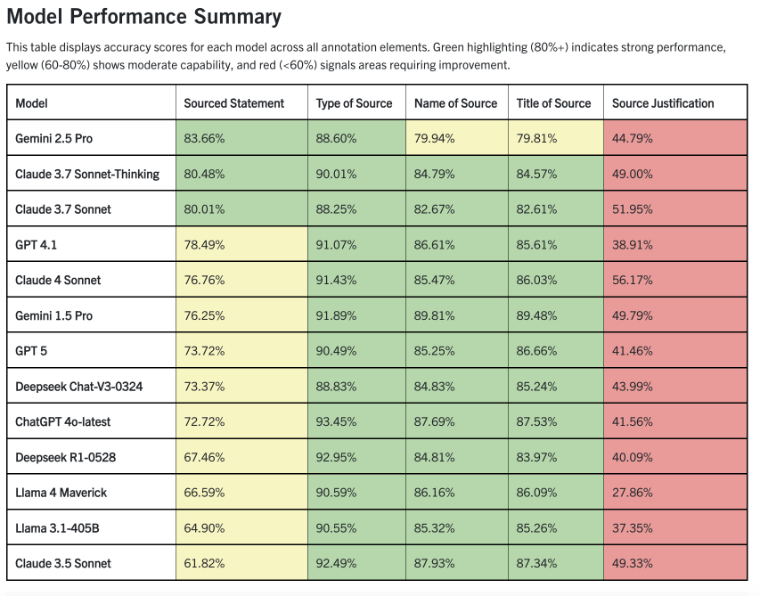
We benchmarked 13 leading LLMs—from Anthropic, OpenAI, Google, Meta, and Deepseek—on their ability to identify and categorize 646 source attributions from 43 professionally published news articles. Using a ground truth dataset built by trained student annotators, we measured accuracy across five sourcing elements: sourced statements, type of source, name of source, title, and source justification. Only two models reached an 80% accuracy threshold for identifying sourced statements.
Teaching Media Sourcing Literacy Through Annotations
But how might college students–undergraduate or graduate–systematically observe the use of sourcing and attribution that are present in everyday news? One way is to annotate all the sources and attributions in news reports, using a vocabulary (terms and definitions) and a datasheet. This initiative includes the COMM 198 internship course at SCU where students come to the Markkula Center to learn annotations.
Journalism Source Diversity Dashboard and Monitor
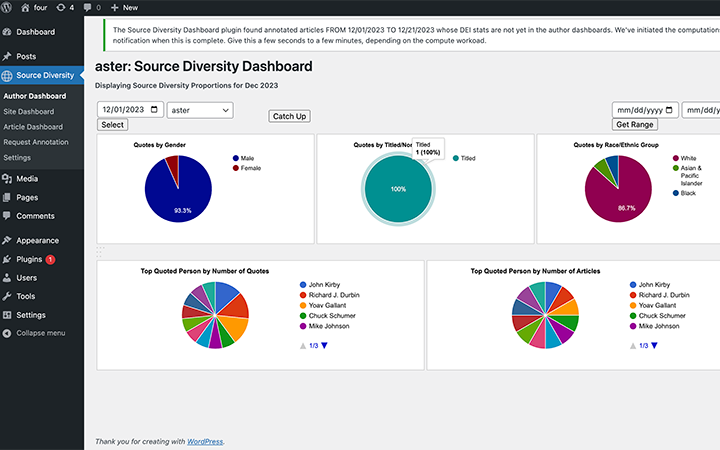
Santa Clara University’s source diversity audit technology for news articles consists of a front-end WordPress dashboard plugin supported by a DEI annotation API (application programming interface) service at the back-end. The plugin helps annotate news articles on demand from within WordPress, and works for all stories, both drafts and published.
The Ethical Distribution of News: Roundtable Use Cases
The Markkula Center’s News Distribution Ethics Roundtable (2022-2024) discussed the ethics of news distribution over several meetings. In Jan 2024, we published this set of use cases on how diverse voices, perspectives, and formats in journalism may or may not enter a news feed, and the ethical concerns that arise.