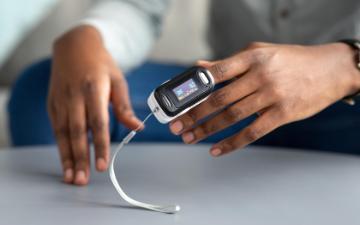
A close-up of a Black individual using a pulse oximeter on their fingertip. Prostock-studio/Adobe Stock.
Tiffany Kinyua is a psychology major with a minor in biology and she is a 2025-26 health care ethics intern at the Markkula Center for Applied Ethics at Santa Clara University. Views are her own.
Pulse oximeters are among the most trusted monitoring tools in modern medicine. In hospitals and homes alike, the small clip placed on a fingertip quietly determines who needs oxygen, who qualifies for medication, and who can safely remain at home. For most patients, it is a routine part of care.
For Ryan Jolly, a nurse and mother in Kansas City, it is something more. The red glow of the pulse oximeter is the only thing standing between her children and death. Her daughter, who is nonverbal and relies on a tracheostomy tube to breathe, has darker skin than her son. While her son’s oxygen readings are consistent, her daughter’s monitor alarms multiple times a week for no clinical reason. Some nights, Jolly turns the device off and sleeps with her hand on her daughter’s chest to make sure she is still breathing. “I don’t trust the machine,” she explains.
Her story exposes a troubling reality. While pulse oximeters guide life-or-death decisions in every hospital, they are not equally reliable for everyone. A 2020 study found that Black patients were nearly three times as likely as white patients to experience undetected hypoxemia despite normal readings. During the COVID-19 pandemic, these devices became gatekeepers for life-saving treatments tied to strict oxygen thresholds.
If a tool improves overall outcomes but systematically fails certain patients, is its continued use ethically justified?
Why is a Standard Medical Tool Less Accurate for Some Patients?
Pulse oximeters function by sending beams of red and infrared light through tissues in the fingertip, such as the skin and blood. The device’s sensor identifies how much oxygen is in the blood based on how the light is absorbed, providing an indirect estimate known as SpO2 rather than a direct measurement. Current FDA standards require these prescription devices to have a minimum average accuracy within 2% to 3% of arterial blood gas values. In emergency and COVID-19 care, clinicians rely on this number to meet specific clinical thresholds (usually between 90% and 94%) to trigger life-saving interventions.
Because the device relies on light transmission, skin pigmentation can affect how accurately it reads oxygen levels. Melanin absorbs light beams and can interfere with the device’s ability to calculate an accurate estimate. This is a technical error which leads to a dangerous clinical state known as “occult hypoxemia,” where a patient's true arterial oxygen level is critically low (below 88%), but the pulse oximeter displays a safe reading between 92% and 96%.
Large clinical studies demonstrate the scale of this problem. In a cohort of more than 7,000 hospitalized COVID-19 patients, occult hypoxemia occurred in 6.1% of Black patients compared to 4.9% of White patients. A 2022 systematic review further identified a pooled mean bias of 1.52%, showing that pulse oximeters systematically overestimate oxygen saturation in Black patients. As noted above, Black patients were nearly three times as likely as White patients to experience undetected hypoxemia despite normal pulse oximeter readings.
Do Pulse Oximeters Save More Lives Than They Harm?
Given this documented disparity, why do hospitals continue to rely so heavily on pulse oximeters? From a utilitarian perspective, the moral worth of a medical tool is judged by its outcomes, specifically, its ability to maximize "the greatest good for the greatest number." Pulse oximeters, despite their documented flaws, remain one of the most widely used monitoring tools in modern medicine for achieving this goal. These devices have become the global standard in primary and intensive care because they improve survival at scale. By enabling early recognition of clinical deterioration outside the hospital, pulse oximeters helped direct limited medical resources to patients most in need, thereby improving outcomes at the population level.
The utility of these devices is found in their unmatched accessibility and efficiency. Pulse oximeters are inexpensive, portable, and non-invasive, allowing for rapid, population-level triage. They enable clinicians to monitor thousands of patients simultaneously without the need for invasive and painful arterial blood draws, which are slower and more costly to process. A utilitarian would argue that removing these devices from clinical use due to uneven error rates would likely increase overall harm, leading to dangerous bottlenecks in critical care and leaving many patients without any real-time monitoring. From this viewpoint, while the uneven error rates are a significant concern, they are a tolerable trade-off when measured against the millions of lives preserved through the device’s speed and safety.
Who Bears the Risk When the Device Fails?
A utilitarian defense asks whether pulse oximeters save more lives than they harm. Justice asks a different question: who bears the risk when the device fails?
Patients of color face a higher likelihood of undetected hypoxemia and delayed escalation of care. Frontline clinicians rely on pulse oximeter readings in good faith, often unaware that the device may be less accurate for certain patients. Device manufacturers and regulators determine testing standards, while health care systems decide whether safeguards are implemented once disparities are known.
For patients, these structural decisions are invisible. What they experience is delay–
more time before intervention, more progression of illness. For clinicians, the discovery carries its own moral weight. Critical care physician Tom Valley described the “shock” and “guilt” he felt upon realizing that pulse oximeters in his ICU were systematically misclassifying Black patients. He later reflected that he thought of “the patients that I’ve potentially caused harm to.” This highlights a core failure of justice: the burden of technology’s "hidden" flaws falls on both the patient and the clinicians who are unknowingly forced to provide lower-quality care to patients of color.
The data reveal how this burden is distributed. In a cohort of over 7,000 COVID-19 patients, pulse-oximeter readings frequently failed to identify Black patients who met criteria for treatment based on arterial oxygen levels, contributing to delayed therapy. Among patients whose eligibility for COVID-19 treatment was never recognized by the medical team, 54.8% were Black. The device did not simply delay care; it failed to signal eligibility altogether.
The risk does not end with COVID-19. Research shows that these inaccuracies can begin at birth, with dark-skinned preterm infants receiving falsely elevated oxygen readings that mask respiratory distress. As these patients age, the bias compounds.
Justice as fairness rejects the idea that one group’s safety can serve as a trade-off for collective efficiency. Once an unequal risk is visible and documented, maintaining the status quo is a choice to allow preventable, unequal harm.
The Ethical Choice Ahead
These disparities risk reinforcing patterns of health inequity. Communities already experiencing disproportionate morbidity and mortality may question whether the tools guiding their care are equally reliable. Trust in health care depends not only on innovation, but on fairness.
Given these ethical concerns, health care institutions cannot treat unequal pulse oximeter accuracy as a technical flaw. When a tool used in nearly every hospital room carries documented disparities, responsibility shifts from awareness to action. Institutions must implement safeguards that ensure unequal measurement does not translate into unequal care.
Regulators have already begun to respond. In January 2025, the FDA published draft guidance that significantly strengthens how pulse oximeters must be tested across skin tones. The previous 2013 standard required that only 15% of a study population, or as few as two individuals, be classified as “darkly pigmented.” The FDA’s updated draft guidance recommends substantially larger and more diverse clinical studies, using standardized tools such as the Monk Skin Tone Scale to ensure evaluation across a broad range of skin pigmentation.
The FDA’s draft guidance calls for manufacturers to demonstrate comparable accuracy across the full range of skin pigmentation, supported by diverse clinical data. This shift moves towards an enforceable benchmark of equity. A device can no longer be considered safe and effective if it performs reliably for some patients but not others.
Manufacturers must also adopt transparent labeling that clearly communicates device performance across diverse skin pigmentations, allowing clinicians to interpret readings responsibly. At the clinical level, providers can implement additional precautions, such as confirming oxygen levels with arterial blood gas testing when symptoms do not align with pulse oximeter readings.
Without structural reform, disparities in measurement risk becoming disparities in treatment. If health care systems continue relying on a device that performs less accurately for certain populations without meaningful safeguards, they tacitly accept unequal vulnerability as the cost of efficiency.
The issue is not whether pulse oximeters save lives. They do. The issue is whether a health care system committed to equity is willing to ensure that life-saving technology works reliably for everyone. When unequal risk becomes visible, justice demands more than acknowledgment. It demands change.