Crossing Neural Boundaries: Ethical Challenges of Human Brain Organoid Transplantation in Animals
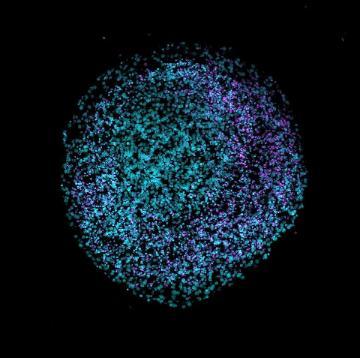
A fluorescent microscopy image of a brain organoid, a three-dimensional cluster of neural cells grown from stem cells in a dish. Image from Wikimedia Commons, CC BY-SA 4.0.
Andrew Kai ’27 is a neuroscience & biology major and he is a 2025-26 health care ethics intern at the Markkula Center for Applied Ethics at Santa Clara University. Views are his own.
What if we could restore the lost memories of a child blowing out candles on their first birthday? Or a wounded veteran who has trouble expressing their pain with speech? There are 69 million people suffering from a traumatic brain injury yearly. The brain is one of the few organs in the human body that does not regenerate. So, what if we could regrow the brain?
Human brain organoids are no longer science fiction. Transplanting lab-grown brain tissue to restore lost function could become feasible in the future. Progress in the field has allowed researchers to gain a better understanding of how the brain develops, functions, and goes awry. Nevertheless, it has raised ethical concerns. Could these clumps of human neurons develop human-like consciousness and challenge what it means to be human upon transplantation in animals?
Our ethical and legal frameworks have not kept up with growing innovation. This article highlights the need for a universal ethical framework that addresses the unique challenges of human brain organoid transplantation, including consciousness and the moral status of animals. This must be done, both ethically and responsibly, without limiting the progress made in organoid research.
What are Human Brain Organoids?
Human brain organoids (hBOs) are small, self-organizing, three-dimensional tissue models derived from induced pluripotent stem cells. This allows scientists to study patient-specific cells, which advance the development of targeted treatment options. In 2013, organoid research transitioned from in vitro (in a dish) to in vivo (in a living organism) studies, giving rise to human-animal chimeras (organisms containing cells from different species). Brain organoids produce scaffolding that mimics normal brain function and models severe psychiatric and neurological diseases. It has provided a powerful new platform for testing new therapies.
In September 2025, the National Institute of Health announced $87 million in initial contracts to establish a new center dedicated to standardizing organoid research. The field's growing popularity and the increasing complexity of hBO models have raised ethical concerns. However, despite their ability to reflect brain development, they have clear limitations, including hypoxia, limited maturation, and circuit formation.
Human-like consciousness refers to the capacity to experience and process emotions. An animal is thought to reach consciousness when they can experience sensations and feel emotions, arising from a tangible nervous system. Human dignity is the idea that humans possess inherent worth regardless of their contributions, intelligence, or productivity. These two ideas arise when considering hBO transplantation in animals.
The Pasca Experiment: A Landmark with Unanswered Questions
This experiment addresses two qualities that distinguish humans from animals—consciousness and human dignity. In a transplantation study by Sergiu Pasca (2022), human cortical organoids were transplanted into the somatosensory cortex of neonatal rats. Over several months, they integrated themselves into the rat’s sensory and motivation-related circuits. These results were demonstrated through whisker stimulation (sensory input) and optogenetic stimulation (a technique that uses light to activate/inhibit specific cells), activating the transplanted human neurons and altering the rat's behavioral response. The human neurons were able to integrate into the rat’s brain circuits, demonstrating the potential for human tissues to drive animal behavior.
This raised the question posed by Insoo Hyun, “What does it mean if human cells are causing gains in animals’ abilities?” Concerns grow as researchers look to move from experiments involving rodents to those involving non-human primates and larger tissue samples. More neural integration could lead to unexpected characteristics emerging, such as sentience, sensation, and feeling.
Do the Benefits Outweigh the Cost?
The ethical dilemma of brain organoid research lies in the tension between utilitarian justifications and deontological concerns. Alzheimer’s disease affects an estimated 51.6 million people. Individuals affected by Alzheimer’s decline in daily functional activities and their families carry a significant emotional burden. There is no cure for Alzheimer’s.
Imagine a 45-year-old woman is diagnosed with early-onset Alzheimer’s. She is a mother, daughter, and friend. Treatment exists that could limit the progression of her Alzheimer’s and return her to an independent lifestyle. The treatment would benefit her and her loved ones. However, this treatment would directly harm many research animals. Is this treatment justifiable?
A utilitarian perspective supports hBO research because the potential to cure devastating neurological disorders outweighs the harm caused to research animals. While this will not completely eliminate it, using in-vivo models will reduce animal reliance in research. Additionally, the benefit is shared by the individual with Alzheimer’s and her loved ones, as her life would be extended.
Animals are frequently used in research to ensure a treatment is safe and effective before it is used in humans. In 1959, the 3Rs framework was introduced in The Principles of Humane Experimental Technique by scientists W.M.S. Russell and R.L. Burch. They proposed the three principles of replacement (use non-animal models when possible), reduction (minimize animal use), and refinement (minimize harm) in animal models.
Animal activists and society would be opposed to the inhumane treatment of animals. The tension lies between the researchers seeking innovation and the biological humanization of animals. A utilitarian perspective would support the continuation of hBO transplantation in animals, in the hope that the benefits outweigh the costs.
The Consciousness Question–A Deontological Perspective
The core debate in brain organoid research centers on the moral status of chimeric animals and the emergence of consciousness. The human brain is the organ most closely tied to consciousness and moral status. Therefore, their integration into animals carries moral implications.
From a deontological standpoint, a rational being is capable of moral reasoning, decision making, and goal-oriented behavior. Humans are rational beings with moral status because they have an inherent human dignity. When animals with transplanted human brain cells gain human-like consciousness, they should be granted the same privileges and rights. There is a need for greater protection against experiments that cause suffering to animals if animals reach a higher moral status.
According to Kant, people should not be treated as a means, but rather as ends in themselves. Implanting hBOs into animals raises two distinct Kantian concerns. The first concern is that the original cell donor’s dignity would be violated if their consent for chimeric transplantation was not granted. Donating cells for one purpose does not automatically grant permission for other uses. Doing so is a direct violation of the donor’s autonomy, treating the donor as an instrument of scientific progress rather than a rational being.
The second concern is that creating a new being with ambiguous moral status violates Kantian principles around the treatment of rational nature. Researchers currently cannot predict the level of consciousness of human-animal chimeras they create. What happens when human-animal chimeras with rudimentary levels of consciousness are produced? Kant’s framework offers no clear category for these beings because they do not reach the level of human consciousness. Could we universalize a maxim that permits creating beings with uncertain consciousness for research purposes? If we cannot will this as a universal law without treating rational nature merely as a means, the research violates the categorical imperative. This raises concern over whether scientists should experiment with cells capable of producing unintended consequences. Is ethical science built on following structured guidelines or through pure experimentation?
Since scientists today are far from evoking consciousness in animals, I would favor the utilitarian view of continued transplantation of hBOs into animals. If the animals were to one day show signs of consciousness, I would reconsider and align with a deontological perspective that this research needs to be stopped.
Understanding the Stakes
The real-world impacts of these ethical questions are significant. There is a risk for abuse of experimentation without a universal standard for hBO transplantation. For example, an experiment led by Pasca (2024) recreated and stimulated a human pain pathway in mice. This raises concerns over the welfare of animals in these types of experiments.
Additionally, this cutting-edge technology raises concerns about equity. This technology is expensive because it offers personalized medicine. hBOs have the potential to widen existing health disparities rather than reduce them. Organoid-based therapies should include equitable access provisions to prevent the technology from excluding lower-income populations. A regulatory framework could include a tiered pricing model, public funding requirements to prevent proprietary monopolies on organoid therapies, and requirements that clinical trials recruit diverse patient populations.
Recommendations to Move Forward Responsibly
To address these concerns, a comprehensive ethical framework should be created to address the unique challenges of hBO transplantation. No widely accepted benchmark of consciousness exists due to the lack of a formal definition and the difficulties of measurement.
The International Society for Stem Cell Research provides an initial framework, but lacks specific guidelines regarding the transplantation of human brain cells. This leaves room for concrete guidelines to be set in order to mitigate the unexpected consequences of brain cell transplantation. Two proposed benchmarks include the fetal development proxy (the 20-week mark of human fetal development before consciousness arises) and the functional substrates for pain (the appearance of neural substrates required for the experience of pain). A combination of these benchmarks, in conjunction with EEG measurements and a mirror self-recognition test, should be included in these evaluations.
It is important to acknowledge the difficulties of assessing consciousness in animals and humans alike. Even if animals are able to pass every behavioral and cognitive test, it is not possible to directly assess an animal’s consciousness. However, we can assess neural processes, behavioral responses, and brain structures to determine where an animal falls on the spectrum of consciousness. Regulations should be consciousness-dependent—the level of animal protection increases in proportion to the chimeric animal’s acquired mental capacities. Guidelines should be updated every 5 years or upon a predetermined significant breakthrough, as the field is rapidly advancing. We should apply a precautionary principle if unsure of an animal’s level of consciousness.
Call To Action
This research holds incredible promise and carries tremendous ethical implications. While chimeric animals are currently unable to achieve consciousness, this may be possible in the future. There are pressing concerns over transplantation in animals because of the lack of regulations in brain organoid research. It is crucial to establish universal guidelines to ensure ethical research is being conducted.