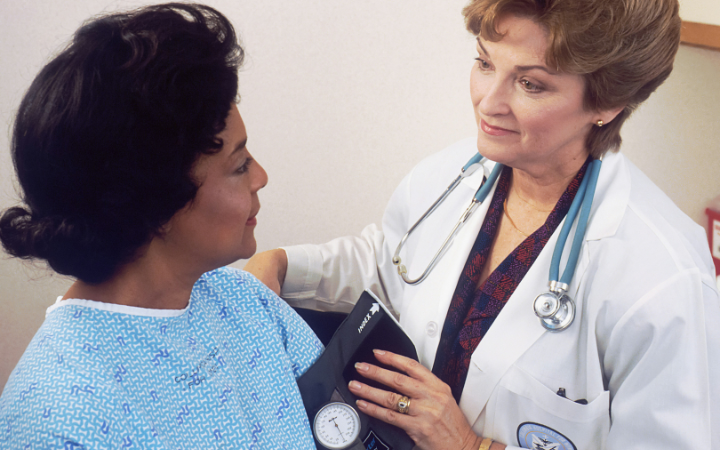
A woman with a stethoscope and wearing a medical coat talking to another woman wearing a patient's gown. Image by National Cancer Institute on UnSplash.
Cassandra Blake is a double major in biology and public health science and she is a 2024-25 health care ethics intern at the Markkula Center for Applied Ethics at Santa Clara University. Views are her own.
If you were asked to define the term “menopause,” would you be able to? Would you be able to list any menopause symptoms and treatment options? According to an article in the American Journal of Managed Care, 80% of medical residents feel “barely comfortable discussing or treating menopause,” even though menopause is increasingly becoming more openly discussed and less taboo of a topic. A survey conducted by the American Association of Retired Persons revealed that only 20% of obstetrics and gynecology residency programs provide their students with menopause-related training, and 42% of women aged 50 to 59 years old had never discussed menopause with a health care provider. Thus, inadequate knowledge about menopause is prevalent among both medical professionals and the general public.
What is Menopause?
In order to understand the severity of this issue, it is crucial to understand what menopause is and what symptoms are associated with menopause. The term “menopause” refers to the time when a menstrual period has stopped for at least 12 consecutive months. Once a woman reaches menopause, she no longer has the ability to reproduce.
The symptoms of menopause can be debilitating and cause prominent disruptions in women’s daily lives. One symptom of menopause that we hear talked about more regularly is hot flashes. Women with hot flashes experience heat to the upper body and face for up to several minutes and up to several times per day. Hot flashes can cause women to wake up in the middle of the night and thus become sleep-deprived. It is important to know that hot flashes are just one of over 30 symptoms of menopause.
Other symptoms include, but are not limited to, heart palpitations, brain fog, impaired short-term memory, joint pain, urinary incontinence, low motivation or energy, and sleep issues. These symptoms can affect women’s mental health and quality of life. So why are so many women not receiving information about links between their symptoms and menopause?
Funding
An extreme lack of prioritization of women’s health research exists in the United States, which is evidenced by the small amount of funding toward women’s health research initiatives each year. In 2013, the National Institute of Health (NIH) dedicated 9.7% of its total spending on research grants to women’s health research. In 2023, that percentage dropped to 7.9 percent, despite the fact that the NIH’s total spending on research grants increased from $26.3 billion to $43.7 billion over that 10-year period. In 2024, the NIH spent only $56 million in funding on menopause as a research/condition/disease category.
Ethical Implications
Several ethical implications result from the lack of prioritization of menopause. First, if health care providers fail to recognize menopause as the root cause of patients’ health concerns, patients may not be able to provide fully informed consent. Patients will not be made aware of all of the possible treatment options for their symptoms, and thus their autonomy will suffer as informed decision making is a key aspect of patient autonomy in bioethics. For example, envision a 51-year-old woman who visits the doctor for complaints of joint pain. Her doctor has not had adequate menopause-related training or knowledge, and thus the patient is diagnosed with arthritis and prescribed medication to treat her joint pain.
Since her doctor did not mention menopause to her and thus she is not made aware that joint pain is a common symptom of menopause, she will not be informed that menopausal hormone therapy (MHT) or hormone replacement therapy (HRT) – a menopause treatment that replaces the hormone estrogen, or both estrogen and progesterone, which the body produces much less of during menopause – could also be treatment options for her joint pain. This woman thus experiences a lack of fully informed consent to her treatment plan, diminished autonomy, misdiagnosis, and potentially inadequate treatment.
Along with informed consent, autonomy, misdiagnosis, and inadequate treatment, the bioethical principle of justice and health inequities in access to comprehensive care are also concerns associated with the lack of knowledge of and attention paid to menopause. If not all doctors are adequately informed about menopause and discussing menopause with their patients, some women will receive different education and treatment than others solely based upon the doctor with whom they have an appointment.
Additionally, systemic inequities in educational attainment level and socioeconomic status can lead to differences in the ability to seek and receive treatment for menopause. According to an article published in Cell Reports Medicine, “Addressing Sociodemographic, Socioeconomic, and Gendered Disparities for Equity in Menopause Care,” higher educational attainment levels have been associated with decreased severity of menopausal vasomotor symptoms (such as hot flashes and night sweats). On the other hand, “marginalized groups [...] often report knowledge gaps in understanding menopause symptoms and treatment options”.
A study investigating perimenopausal and menopausal women, as well as general practitioners and gynecologists, links socioeconomic status and educational attainment when discussing menopause. This study found that groups of lower socioeconomic status were associated with “being less educated about [...] menopause.” On top of this, “gynecologists [...] felt that the majority of women seeking help for menopause and requesting HRT were white, [...] well-educated women. This was even more apparent in private clinics.”
Conclusion
What should be done to ensure that more people are adequately informed about menopause? First, more funding should be allocated to women’s health research more broadly, and menopause research more specifically. The more we understand about menopause, the more education we will be able to provide about menopause. There should be a module in health profession curriculums dedicated to menopause, in order to equip our future health professionals to properly educate women about their health and address their health concerns.
Raising awareness about the need to prioritize menopause research and education about menopause will reduce the stigma surrounding this important transition period in women’s lives, and will provide women with knowledge to make fully informed, autonomous decisions that can impact their health and quality of life.