Naloxone: The Drug That Saves Lives for the Common Good
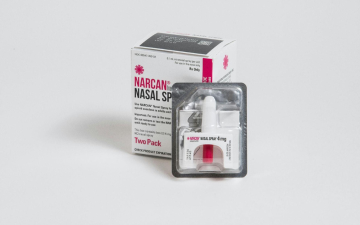
A package of Narcan sitting on top of a white table. Image by nextdistro/unsplash.
Gabby is a neuroscience major with minors in biology and public health and she is a 2025-26 health care ethics intern at the Markkula Center for Applied Ethics at Santa Clara University. Views are her own.
There seems to be a common misconception that opioid overdoses only happen to people addicted to illicit substances. I beg to differ.
Charlie Ternan was a student at Santa Clara University who was three weeks away from graduating when he died from fentanyl poisoning. He ordered online what he thought was a Percocet for back pain. He never had a substance abuse issue, yet this one laced pill took his life within thirty minutes after consumption.
About 29% of counterfeit pills containing fentanyl have a potentially lethal dose of about 2 mg of fentanyl. There is, however, a 4mg nasal spray that can reverse the effects of an overdose; it's called naloxone, commonly known as Narcan. Unfortunately, society tends to frame addiction and self-medication as a personal weakness. Under the ethical framework of the Common Good, this common misconception is a moral failure.
We have the power to help in ways that could save countless lives, yet stigma and racial disparities prevent us from protecting some of the most vulnerable people in our society. The opioid crisis does not discriminate, but the way we respond to it does. Therefore, carrying and distributing naloxone is a moral responsibility that we owe each other to help our communities flourish for the Common Good.
Anyone Could Be Affected and Anyone Can Take Action
For every 100,000 people, 25-30 people die from an opioid overdose with approximately 54,045 opioid overdose deaths across the United States in 2024. Some examples of such opioids include illegal substances like fentanyl and heroin, and commonly prescribed pain medications like morphine and oxycodone. Fentanyl, in particular, is 50-100 times more potent than legal opioids, and it is because of its potency and affordability that it is pressed into fake pills. Such pills are hardly distinguishable from regular prescription medications, and anyone, regardless of a history of substance use, could be at risk. Minors and young adults who are experimenting with substances, as well as regular substance users, have access to social media and e-commerce platforms where counterfeit prescription pills are sold.
Naloxone is just one form of harm reduction–a public health strategy focused on lessening the negative effects of drug use. The CDC explains that harm reduction is a type of care that focuses on holistically helping those struggling with substance abuse as well as preventing drug overdoses in a way that is free of stigma. They do this by focusing on keeping people safe and alive rather than solely abstinent.
Knowing these facts and resources could potentially save lives. This life-saving knowledge, however, is not widely discussed as much as it arguably should. College students like Charlie are among the most vulnerable and least prepared populations targeted by illegal counterfeit pill companies. In a survey conducted among college students at West Virginia University, only 15.9% of students knew how to respond to an opioid overdose. What a majority of these students may not know is just how important a $40-50 device like naloxone is. According to the CDC, it can reverse an overdose and restore normal breathing in as short as a few minutes. Even if the person is overdosing on something other than opioids, or not overdosing at all, administering it to a person has no adverse effect at all. Anyone can carry it. Anyone could need it.
Why Doesn’t Everyone Carry Naloxone?
One prevalent barrier has to do with racial disparities in the U.S. overdose epidemic. A study conducted by the CDC found that overdose death rates among Black and indigenous Americans vs. white Americans between 2019 and 2022 showed that Black Americans saw a 249.3% increase in mortality. Native Americans experienced a 166.3% increase. Hispanic/Latino Americans reported a 171.8% increase, and white Americans saw a 57.1% increase.
In Massachusetts, a simulation model was used to measure naloxone availability using naloxone kits per opioid overdose death (OOD) to evaluate naloxone availability. The results found that in municipalities with more Black residents, naloxone distribution rates (kits per 100,000 people) for Black individuals in these areas were lower than for white residents. Systemic barriers that limit naloxone access and effectiveness include low naloxone availability at pharmacies in low-income or predominantly racial and ethnic minority communities. Other barriers include concerns that carrying naloxone could lead to familial, social, or legal tensions, especially since Black and Hispanic/Latinx individuals are more likely to be subject to criminalization if found in possession of naloxone.
Stigma is another significant barrier to harm-reduction efforts, which is fueled by political and community prejudice, misinformation, and socio-economic conditions. Not only do the people who would carry naloxone fear judgment, but naloxone providers face prominent challenges as well. In a qualitative study on community-based organizations providing harm reduction services in San Francisco, harm reduction workers faced trauma and burnout because of public hostility as well as insufficient public funding. Ultimately, this led to these community-based organizations going through self-censorship and limiting service availability.
How Do We Protect Each Other? The Common Good of Naloxone
It seems that the root of the problem lies within what society has chosen to believe about naloxone and the people who carry it when it has the power to save lives. Under the Common Good framework, this may offer a solution when viewing how we can make our communities safer. The Common Good is defined as, “the sum of those conditions of social life which allow social groups and their individual members relatively thorough and ready access to their own fulfillment.” When looking at harm reduction through this lens, it is clear that it is necessary for individuals, institutions, and communities to cooperate in a collective effort to help the community flourish. When systemic, racial, or social barriers interfere with each individual’s duty to keep the community healthy, everyone pays the price in deaths by overdose.
What seems to be holding many of us back, regardless of circumstance, is called the free-rider problem. This is the tendency for people to benefit from a common good without contributing to its maintenance. This means that a select few people within the society are equipped with the knowledge to respond to an opioid overdose, which protects the rest of the community, but the rest of the community does not do the same to extend that protection to people who use drugs or unknowingly buy counterfeit pills.
This lack of action not only leaves the most vulnerable at risk and may put you in danger, but it also erodes the trust in the institutions that were designed to protect all of us. When schools do not educate students about overdose responses, trust in the school’s ability to prepare students for real-world problems wavers. Pharmacies that don’t stock naloxone in the most at-risk neighborhoods may not be trusted to help where it matters most. Even public health institutions whose funds for harm reduction are cut due to stigma may lose the trust of the community because it communicates that those who use drugs are not worth protecting. Eventually, this may lead to even more dangerous problems. People may stop calling 911 during overdose crises because they fear the legal consequences. College students may hesitate to call for help for a friend who may have taken a laced pill. All individuals of the community must play their part for the sake of protecting the whole.
Putting Our Collective Responsibility Into Practice
The first crucial recommendation to ensure the flourishing of our communities in accordance with the Common Good is to foster understanding, solidarity, and empathy by educating the facts about opioid overdoses and prevention within schools, workplaces, and other institutions. A study published in the Journal of Addictive Medicine found that out of all choices for public funding, harm reduction always received the lowest allocations. However, when participants were educated on the evidence-based benefits of harm reduction, they increased their funding for these initiatives. This is just one example of how stigma, misinformation, and inequitable resource allocation can be improved by the spreading of public support and education.
This second recommendation could potentially save a life. Whether a stranger or your loved one. Someone in a high-risk neighborhood or on a college campus. This action could have saved Charlie if just one person had known how important it is and knew how to use it.
Carry naloxone.