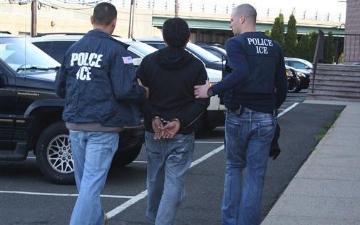
U.S. Immigration and Customs Enforcement agents taking a person into custody during operation Cross Check III in 2012. (AP Photo/U.S. Immigration and Customs Enforcement)
Jesse Vargas is a biology major with a minor in philosophy and he is a 2024-25 health care ethics intern at the Markkula Center for Applied Ethics at Santa Clara University. Views are his own.
Sunnyvale has always felt like home, a safe place where neighbors look out for each other, and where essential services, like health care, should be available to all without the sense of fear. However, for undocumented immigrants, this sense of safety has been shattered. I had seen news and posts about ICE activity around border cities but never imagined it would happen here. The recent change toward protections that once prevented U.S. Immigration and Customs Enforcement (ICE) and U.S. Customs and Border Protection (CBP) officers from entering protected areas like hospitals, has devastating consequences, as seen in the case of Ulises Peña López.
On February 21, 2025, ICE agents violently arrested Ulises in Sunnyvale, disregarding his legal rights. As he remained inside his vehicle and invoked his right to silence and legal counsel, ICE agents shattered his car window, forcibly dragged him out, and assaulted him. According to a public statement from Ulises’ family that was released by Santa Clara County’s Rapid Response Network, the brutality of this encounter, alongside various pre-existing medical conditions, including a blood clot in his neck, a heart condition, and a spinal disorder, caused him to collapse to the floor where he struggled to breathe. He was rushed to the emergency room. Yet even within the hospital, Ulises found no relief. He was shackled to his bed, denied food, water, necessary medications, and was prevented from speaking confidentially with his attorney. Before fully recovering, ICE transferred him to a detention center overnight, disregarding his medical needs and failing to inform his family. Ulises’ case exemplifies how the recent policy change has compromised health care access and patient safety for undocumented individuals.
From Protection to Risk: The Policy Change
Previously, ICE operated under guidelines designed to prevent enforcement actions in “protected areas.” These policies, outlined in a memorandum issued by the former Secretary of the Department of Homeland Security (DHS) Alejandro N. Mayorkas in October of 2021, aimed to ensure that individuals could access essential services such as medical care, education, and religious institutions without fear of immigration enforcement. Mayorkas understood that it was their responsibility as public servants to maintain peace within these important areas. Mayorkas’ guidelines established restrictions, recognizing that the mere presence of immigration officers in these spaces could disrupt them entirely by deterring people from seeking critical care and other essential services.
However, on January 20, 2025, acting DHS Secretary Benjamine C. Huffman issued a new memorandum that rescinded these protections. Rather than upholding the restrictions in place, Huffman’s memorandum shifts these restrictions to a case-by-case approach, placing the burden on individual officers’ judgement. Huffman claims that it is up to their officers’ “common sense” to determine when these areas should be breached. Under this new policy, ICE and CBP officers now have ambiguous discretion to conduct enforcement actions in or near these once protected spaces. This policy change not only undermines the intent of Mayorkas’ directive but also creates an environment where undocumented individuals might avoid medical care out of fear, ultimately jeopardizing public health.
Ethical Violations: Justice and Nonmaleficence
The removal of protections for sensitive areas raises bioethical concerns regarding the principles of justice and nonmaleficence. Distributive justice demands that health care resources be allocated fairly, particularly to vulnerable populations. Yet, by making these spaces unsafe for them, the new policy change perpetuates systemic inequities in healthcare access. Undocumented individuals already face numerous barriers to receiving medical care, including financial obstacles and fear of deportation. A study conducted between 2017 and 2018, during the current president’s first term, found that 24% of undocumented Latino immigrants avoided emergency care due to fear of being discovered as undocumented. The added threat of ICE or CBP officers being allowed to enter hospitals may exacerbate these disparities, effectively denying them the right to health care.
Some might argue that the principle of justice also requires that individuals receive only what they are due, and since undocumented immigrants are not citizens, they are not entitled to the same access to health care as those with legal status. However, denying medical care based on immigration status contradicts the ethical and moral duty of medical professionals and institutions to provide treatment without discrimination. This obligation is already recognized within the U.S. health care system through the Emergency Medical Treatment and Labor Act (EMTALA), which requires that all Medicare-participating hospitals stabilize or treat all patients with an emergency medical condition regardless of their ability to pay, insurance status, immigration status, or race.
If justice means giving people what they are due, then under this precedent, it follows that undocumented immigrants are entitled to at least the same basic level of care that protects life. However, the new policy creates fear, discouraging undocumented individuals from seeking medical treatment, even when facing life-threatening situations. Justice is not merely about citizenship; it is about ensuring that all individuals, regardless of their background, receive the care necessary to maintain their dignity and well-being.
The principle of nonmaleficence is also similarly violated by this policy change. Health care professionals have an ethical duty to prioritize patient well-being, avoiding unnecessary harm when possible. However, the presence of immigration enforcement in hospitals directly contradicts this commitment. In cases like that of Ulises, ICE enforcement deliberately interfered with patient care by restricting his access to necessities and transferring him before he fully recovered. Denying or delaying these necessary treatments violates the duty of health care providers to prioritize their patients’ well-being. Interactions like these instill fear in undocumented immigrants, causing individuals to avoid care due to the fear of deportation, worsening health outcomes, and potentially leading to a loss of life. Ultimately, patients should not have to weigh the risk of deportation against the need for medical care. Yet, this policy forces them to choose between possibly facing deportation or avoiding medical care and risking their health, undermining the fundamental purpose of health care.
The Need for Institutional Protections
Given these ethical concerns, it is important for health care institutions to establish their own protective measures to protect undocumented patients. Health care facilities should implement sanctuary policies that deter cooperation with ICE enforcement to ensure that all patients can seek care without fear. For example, Santa Clara County Medical Center has publicly reaffirmed its commitment to treat all patients, regardless of immigration status, and has pledged not to ask about immigration status or share patient records with federal authorities. By taking this stance, Santa Clara County Medical Center helps ensure that undocumented individuals can seek medical care without fear of detention or deportation.
Other examples of potential policies could include staff education on applicable laws and rights, as well as training on how to interact with ICE or CBP officers. Without such protective measures, trust in health care institutions will continue to deteriorate, putting lives at risk.
Ulises Peña López’s case is not an anomaly; it is a warning. If hospitals cease to be safe spaces, the very foundation of health care is under threat. It is the responsibility of policymakers, health care providers, and communities to ensure that people are not forced to choose between their health and their freedom.