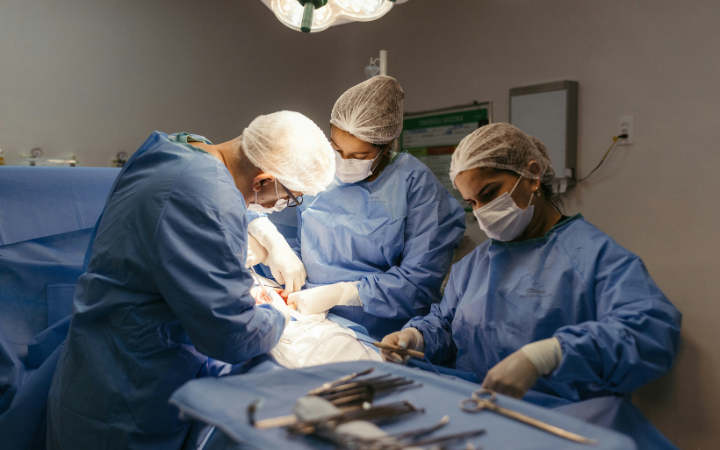
A group of doctors performing surgery in a hospital. Image by Jonathan Borba/Pexels.
Harpreet Bhasin is a biology major with minors in Biotechnology and Public Health and he is a 2024-25 health care ethics intern at the Markkula Center for Applied Ethics at Santa Clara University. Views are his own.
Meet David Powell, a 35-year-old man from San Diego who faced daily difficulty in walking upstairs and exercising. Doctors could not diagnose David, making it difficult for him to complete his daily activities. Determined to find a solution to his problems, David turned to the internet and found that his symptoms were consistent with phrenic nerve damage. These vital cranial nerves send signals from the brain to the diaphragm, telling the body to inhale. After the diagnosis, David was able to receive a successful nerve transplant and was no longer impaired in his daily activities, restoring his health and ability to complete daily tasks. However, he is not alone as many other patients “suffer tremendously and yet have very few options.”
Why Do These Transplants Matter?
Skin, nerve, and vascular transplants play a crucial role in restoring function and appearance in certain individuals subjected to physical injuries, medical conditions, and surgeries. Skin grafts help individuals heal from burns, tumors, infections, and other wounds. Nerve transplants aim to repair damaged nerves in order to restore function to limbs or alleviate pain for patients diagnosed with degenerative diseases. Blood vessel transplantations can be utilized to restore blood flow from damage or vascular diseases. These transplants are important for mitigating further physical and emotional harm to patients.
In certain cases, surgeons can take autografts from the patient’s own body to fix the damaged areas. While this method has some benefits, it can lead to additional complications, a prolonged recovery time, and may cause further nerve pain. Some individuals are ineligible for autografts, and this problem lingers as donor numbers remain low. Establishing a system for compensating donors can help to increase the supply of tissues and help alleviate pain in injured individuals.
How Can We Evolve From the Outstanding Ban on Transplantation for Compensation?
In general, most countries prohibit compensation for organ donations to ensure equitable access, facilitate donation, and prevent exploitation. This act was first regulated under the Uniform Anatomical Gift Act of 1968, which provided the primary legal framework that governs organ donation. One major flaw of this act includes multiple interpretations it had for special conditions. This act was further refined in 1984 when Congress passed the National Organ Transplant Act, which created the framework for organ allocation and placement, and banned the exchange of organs for “valuable consideration.” This act aimed at preventing payment for organs to avoid disparities in health and patient exploitation, which created a system that prioritizes needs over the socioeconomic status of the patient. The fear that a market could emerge, pressuring the poor to donate their body parts due to financial hardship, led Congress to pass this act to prevent such exploitation. However, skin, nerve, and vascular transplants differ from traditional organ transplants, and this warrants an exemption from the law. Simple supply and demand economics state that there must be a supply to meet the demand of the consumer. While organs like lungs and hearts are limited in the human body and are necessary for life, skin, blood vessels, and nerves are of a higher supply in the human body. Therefore, they have a lower dependence on life, allowing patients to donate these parts without major risk and meeting the same demand as other low-supply transplantable organs.
Tissues do not require the same conditions as organs to survive, which means that tissue donation is possible after the heart and lungs have stopped working. They must be removed within 24 hours of a person's death to be eligible for transplant, but the donor does not need to be placed on a ventilator during this period. Furthermore, donated tissues can be stored for an extended period in comparison to organs, and people can be considered tissue donors at the time of death.
Additionally, skin, nerves, and blood vessels have regenerative properties that enable transplanted body parts to restore and heal to some extent. If these body parts were to be transplanted into a new body, the donor would be able to grow new neural pathways and blood vessels to support the physiological functions of the human body.
Successful models for a compensation system exist as some countries have allowed for the compensation for regenerative body parts such as plasma, bone marrow, hair, leukocyte packs, etc. If plasma and bone marrow can be compensated with ethical safeguards, why not skin, nerve, and vascular transplants if they carry similar risks?
Currently, people are in desperate need of a transplant, as a recent study found that 44% of patients needing these transplants died before they could receive a transplant. In response to this, desperate patients refer to illegal markets, which have their risks. Posing a danger to both the donor and patient, there have been many problems, including misinforming the patient of the procedure details and potential risks, limited donor screening, and no substantial post-operative care, including medical observation and prescribing immunosuppressants. While the public originally rejected the notion of a compensated system, current surveys have shown support for compensation and argue incentives would increase the likelihood of donation without affecting the risks. Implementing a legalized compensation system will help increase donor motivation and allow the donor to use said compensation for themselves or their loved ones.
Ethical Perspectives of a Transplant Compensation System for Skin, Nerves, and Blood Vessels
From a utilitarian perspective, creating a compensation system is moral as it aims to maximize the welfare of humanity by increasing the number of available donors if treated under the right circumstances without exploitation.
Altruism plays an important role in organ donation because understanding motives influences the nature of an organ donation. Altruistic donations are often viewed as a generous act, but neglect to highlight the decisions made with inherent incentives and disincentives. This is supported by the notion that families often receive secondary compensation on an emotional or psychological level by donating to loved ones instead of those in deeper need of such transplants. Their loved ones will benefit from this donation rather than from donating on a needs-based basis. On a global perspective, extrinsic factors such as social connections, economic status of the family and region, and current donation resources often influence donor and recipient decisions, which suggests that organ donation is not a purely altruistic act.
Kantian ethics argues that people should not be used as a means to an end. Therefore, compensating for body parts violates these moral practices. However, justice and autonomy should also be upheld to give people the authority to be compensated for their body parts without threatening vulnerable populations through coercion and fraud. This questions how we view society and whether individualistic beliefs should overtake collectivist ideals and goals.
Virtue ethics plays an important role in the evolution of society as it challenges us to question how our society will develop if we were to permit the sale of such organs. Will we thrive as a society, or will we uphold profits over the sanctity of human life?
Future Scenarios
If a compensation model were to be implemented, these transplants would have numerous benefits. However, the future is unpredictable and can have multiple outcomes that can influence the ethical considerations behind organ transplants. Ensuring the safety and autonomy of both the patient and donor, we can develop a regulated market for donations that is strictly controlled. If compensation remains illegal for these procedures, we can predict a rise in emerging underground transplant markets, as seen in many countries with kidney and liver transplants. This rise could lead to the exploitation of patients due to a lack of autonomy for the patient, proper medical oversight, and receiving the necessary follow-up care from the procedure. Additionally, we could see a future where a middle ground is reached between legality and illegality, where donors are compensated in the form of benefits. This might include medical benefits, federal tax credits, loan forgiveness, etc. Providing a non-monetary incentive for donors would influence participation in donation programs while preventing money from being used for unethical purposes.
How can we implement safeguards?
To ensure that financial incentives for skin, nerve, and vascular transplants are ethical, we need to implement safeguards to ensure that both parties are protected. Creating an independent agency to provide oversight, regulation, and support to transplant centers will improve communication in procurement, inefficient matching programs, and quality standards in current transplant centers. Our current system has a central system for procurement and allocation; however, it has little influence on the local level due to the role of Organ Procurement Organizations operating regionally, leaving the current system vulnerable to a lack of access to transplants and the quality of care. Simple guidelines for the new organization can include:
- Conduct comprehensive medical screenings to ensure safe and ethical transplants to minimize harm.
- Inform patients thoroughly of all risks to ensure the autonomy of the donor and patient.
- Utilize a predefined algorithm to ensure equitable allocation of all donated body parts for a fixed form of compensation.
- Make sure both patient and donor receive comprehensive post-donation care to ensure no long-term harm.
- Treat the donor with dignity and appreciation for providing a lifesaving transplant.
- Ensure transparency by opening up operational procedures and guidelines to the public and government. Establish an ethical review board for constant feedback on the legal and regulatory frameworks.
Conclusion
Overall, we as a society must work together to improve patient outcomes and provide life-changing transplants to those who need them. By applying our current models, creating transparent regulations, and promoting the betterment of human suffering, we can eventually create a safe and effective system that aims to alleviate suffering and increase donor motivation by compensating individuals for donating skin, nerves, and blood vessels. Creating a monetary compensation system, or settling for a non-monetary system based on concerns, is essential in creating a new future of organ donation and advancing global health for all humans.