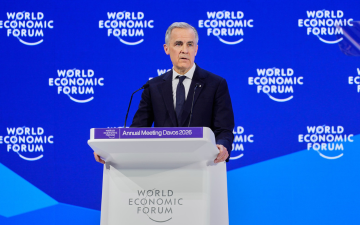
Canada's Prime Minister Mark Carney speaks during the Annual Meeting of the World Economic Forum in Davos, Switzerland, Tuesday, Jan. 20, 2026. (AP Photo/Markus Schreiber)
Ann Skeet is the senior director of leadership ethics at the Markkula Center for Applied Ethics at Santa Clara University. Views are her own.
A hallmark of ethical leadership is a leader’s ability to prioritize the interests he or she is charged with consistently upholding, and especially when there are risks to doing so. Canadian Prime Minister Mark Carney offered a master class in principled leadership at the 2026 World Economic Forum, commonly referred to as Davos, delivering a set of comments that evaluated the global circumstances he and other leaders are facing in a clear-eyed, forward-looking manner.
Though Carney identified a “rupture” in the world order, he did not dwell on the state of play between global powers, emphasizing instead the path he is charting to protect and advance the interests of Canadians now. He told a compelling story, drawing on other storytellers before him. Canada would no longer be “living within a lie,” he said, referencing a Vaclav Havel essay, “The Power of the Powerless,” to argue that “middle powers” countries could no longer rely on relationships and conditions that had preserved stability in the face of a disintegrating global framework in which economic integration is weaponized. Nostalgia, he noted, is not a strategy. Effective leaders help people make sense of situations through the stories they tell about what is happening to them. Carney connected the reality Canadians and others in middle powers countries face to the stories of people who had faced similar realities.
Through his remarks, Carney forged community amongst Canadians, standing up for their collective interests, and those of the middle powers countries he believes must work together in the face of changes on the global stage. His ability to build a sense of community is a superpower ethical leaders deploy, reminding people they are in relationship with others. When people have a sense of kinship, they do not want to let others down, to act unethically, or without prudence. The network of alliances Carney laid out pointed to his belief that stable relationships with other countries will serve the common good.
And government leaders have a special responsibility to the common good, to make decisions that serve a community as a whole and not just some members. Carney defined a global community and outlined steps his country could take to meet the interests of Canadians and also the rest of the world, so we do not otherwise face a “world of fortresses.” He spoke passionately about values and principles, doubling down on ethical rhetoric, and his message was received around the world. For example, Australia’s Treasurer Jim Chalmers stated, “the point that Prime Minister Carney was making is that our interests are best served by co-operation and by managing our differences within international law and international institutions.”
Though Carney never named President Trump, Trump received the message also, as noted by his direct comments to Carney when Trump spoke at Davos the next day. In sharp contrast to Carney’s emphasis on principles, collaboration, and courage, conveyed in a tightly scripted 16-minute commentary, Trump rambled for over an hour and a half, choosing to emphasize the shortcomings of other countries and the leverage the U.S. has over various nations, reinforcing his image as the world’s biggest bully. Carney spoke to the value of NATO; Trump derided the alliance as unreliable. Carney emphasized finding partners with common ground. Trump repeatedly referenced “our hemisphere” as if the United States owns all the other countries in its geographic proximity. While Carney committed his country’s allegiance to Greenland, Trump said everyone should be grateful he wasn’t going to capture it forcefully.
The press has relentlessly reported the various ethical norms the Trump administration has shattered, advancing Trump Organization business interests in ways that compromise U.S. foreign policy goals and inserting rare government control over American companies. Trump’s remarks at Davos reinforced his disdain for ethical leadership and stood in sharp contrast to the comments Carney and other leaders in Davos made about the need to work together to create a world we all want to inhabit. Leaders’ various speeches over the course of the week revealed that trust in the United States has been lost.
Trust is a vital component of the common good. It helps society to function. Mark Carney’s speech reminds us that principled, ethical leaders can command attention on the global stage and he offered Canada as a partner worthy of trust. Let’s hope U.S. leaders and followers join others in responding to Carney’s call to recognize our interconnectedness and value international relationships. Countries with strong, trusting alliances will prevail in the 21st century.