The Faustian Bargain of Prediction: Are We Gambling Away our Souls?
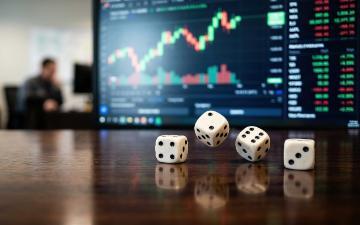
Dice. Computer screen showing risk, chance, investment, speculation trading. Blurred background with person sitting at desk with computer. Generated with AI by Chopang.studio via Adobe Stock.
Deidre Frontczak is a faculty scholar with the Markkula Center for Applied Ethics and an associate teaching professor in management and entrepreneurship at Santa Clara University’s Leavy School of Business. Views are her own.
With prediction markets a worldwide rage, gamers are “having a moment.” After all, who needs market analysts or old-fashioned polls, when everyday bets can offer superior forecasting tools – with entertainment and hopefully profits thrown in for good measure?
Prediction defenders (and winners) are many: Tech leaders tout them as reliable windows onto real-time choices, accessible profits at the grassroots level. Our leaders, they say, can shape policy around the shifting priorities of actual voters, not just what the “experts” – economists, health professionals, demographers, analysts – might propose. But then, even (especially?) “experts” can leverage the markets: What are the prospects, say, of a selloff in commodity futures in a particular region of Asia? How are midwestern farmers feeling about the chances of a disastrous heat wave by fall? How might geopolitical conflict in, say, the Mideast affect sales of our favorite sneakers or home appliances? Might a pandemic dramatically alter travel or recreational plans, worldwide?
Of course, students -- especially those in fields like economics, data science, or politics -- may find them irresistible. After all, what’s the difference between prediction and stock markets; aren’t they both just legalized gambling? Wall Street too wants in on the action: Kalshi and Polymarket are now two of the fastest-growing startups, valued at $9B and $11B respectively (Forbes, 4.14.26) and trading apps such as Robinhood, Coinbase, and Crypto.com offering prediction markets to capture new customers and edge out competition.
But before embracing prediction markets as harmless fun or a socially beneficial trend, we might pause to raise a deeper question: What habits are we learning, and fostering, in betting on our collective future? And what kind of people do these markets lead us to become?
A Moral Vision Behind Prediction Markets
Prediction markets work by turning events — not just sports but elections, natural disasters, policy decisions, celebrity unions or scandals — into everyday opportunities for profit. Participants buy and sell shares tied to the likelihood of X or Y outcome. If they are right, they win money (and someone else loses). Unlike licensed casinos, prediction markets do not define the odds: gamblers are not betting against the house but against each other, with the value of each bet increasing as its chances appear more remote.
Supporters, including some very smart people, find the markets a clever way to collect information across a widespread field. Prediction, we read, helps individuals, institutions, and countries make better decisions, based not just on theories but on other people’s real-time expectations and intent. This may be justified in a world where the ends are what count, where each individual’s free choices -- and investments -- open the door to increasing practical success.
There is, however, another perspective. From Aristotle through Aquinas and into the fabric of Catholic social teaching over centuries -- ethicists ask us to look beyond outcomes and consider who we are: What intellectual virtues, and what habits of the heart, does a zeal for prediction markets cultivate in us -- as individuals and as a collective, as people together seeking our common good? Who are prediction markets training us to become?
Prizing the Tools of Success: When Everything Becomes a Means
As Aristotle tells us, virtue starts from the awareness that character -- who we really are -- is shaped by how we see the world, and by the ideals, values and practices that we admire. Those practices, reinforced in everyday habit, direct our attention toward a vision of our future that gradually shapes us, for better or worse, into the people we become.
Prediction markets subtly train a particular kind of vision: all events are simply the means to personal gain, rather than moments of shared moral significance, moments that call us to raise provocative questions about our shared future. A hurricane is no longer a call to compassion; it’s a volatility event. An election is not a civic responsibility; it’s a price signal. A public health crisis is no longer a summons to protect the vulnerable; it’s a betting opportunity. A violent conflict is not an occasion for solidarity; it’s a disruption to global supply chains. And so on.
This shift in perception matters. It accustoms us to view the world -- and the people in it -- as instruments of gain, rather than as our neighbors.
More than three centuries before Christ, Aristotle warned about this. He distinguished cleverness (the ability to achieve any end) from practical wisdom (phronesis; the ability to discern good ends). Prediction markets reward cleverness, not wisdom. They cultivate calculation, not moral discernment. They celebrate a gospel not just of prosperity, but of greed.
Indifference as a Learned Habit
No one joins a prediction market intending to become indifferent to human suffering. In fact, most bettors would deny such indifference; they’re just having fun and after all, it’s only money. But virtue ethics teaches that over time, habits form us regardless of our intentions.
Prediction markets reward emotional distance. Caring too much about lives affected, about the human stakes, just gets in the way. The ideal gamer is detached, unruffled, and uninvested in anything except the accuracy of the prediction. Over time, this stance becomes ordinary practice. Everyday practice becomes habit. And habits become character. Not because of our intention, but in spite of it.
The result is a subtle but real moral erosion: we learn to watch events as detached observers, rather than respond to them. We learn to be impervious to the weaknesses of compassion or care, to ignore the experience of solidarity in favor of a gospel of individual success.
This stance is the opposite of solidarity: a willingness to recognize that we are responsible for one another. Prediction markets cultivate a posture where others’ misfortunes are financially advantageous -- or at least morally irrelevant. Even if we never explicitly wish someone harm, the structure of the activity normalizes a stance of practiced indifference. And, like it or not, this indifference seeps into not only our financial or political transactions, but our souls.
Indifference is not just a private vice. It corrodes the very conditions that make a shared social and moral life possible. Aristotle described civic friendship -- the sense that citizens are partners in a shared project -- as the foundation of political community. Catholic social teaching echoes this with its emphasis on the common good. But prediction markets highlight incentives that undermine this shared horizon. If I profit from political instability, institutional failure, individual tragedy, or social unrest, I am no longer a co‑participant in a project of shaping the common good. I become a spectator with a financial stake in the “game.”
This is not just a personal moral problem; it is a collective one. A society that trains its members to view events primarily through the lens of profit cannot sustain the trust, goodwill, and shared purpose that moral communities require. Indeed, a 2025 survey by the Pew Research Center, conducted among 3605 U.S. adults, found that 53% of Americans view the morality and ethics of their fellow citizens as bad, while 47% say they are somewhat or very good. (Note, the U.S. is the only country in a 25-nation comparison where more people saw their fellow citizens in a negative, rather than positive, light.) How do we work toward a shared society that seeks and embodies our common good, when we fail to trust our compatriots in that endeavor?
The Collapse of a Shared Moral Horizon
The deepest danger of prediction markets is not that they are inaccurate or unfair. It is that they subtly reshape our moral imagination. When we learn to see events primarily as opportunities for gain, we lose the ability to see them as occasions for direct moral response. When we learn to detach from the human impact of events, we lose the capacity for compassion. When we learn to treat the world as a series of bets, we lose the sense that we each have a stake in a shared moral world.
A community that normalizes indifference cannot imagine – much less sustain – a common good. And any attempts to do so are reduced to, at best, naïve idealism; more often, to signs of weakness, a lack of the “toughness” of will required to ensure we (or I) prevail.
The question we face is not whether prediction markets are clever or efficient or profitable. It is whether they help us become the kind of people we hope – and are called -- to be. It is whether our vision, as a people, seeks to cultivate habits of attention, compassion and care for one another. It is whether we can see events not as opportunities for gain, but as invitations to committed action.
In 1963 Dr. Martin Luther King Jr. reminded us in the Letter from a Birmingham Jail “(We) are caught in an inescapable network of mutuality, tied in a single garment of destiny. Whatever affects one directly, affects all indirectly. I can never be what I ought to be until you are what you ought to be, and you can never be what you ought to be until I am what I ought to be... This is the inter-related structure of reality.”
A Catholic virtue-ethical vision strives to reinforce habits of the heart that see events not as occasions for profit, or, but as an invitation to seek justice, and to act together in service of a common good. The cost of ignoring this view is the loss of our moral imagination and in the end, the erosion of our collective soul.
That is a cost we should not be willing to pay.