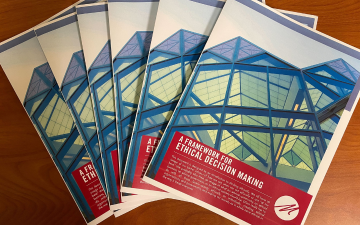
Markkula Center for Applied Ethics "Framework for Ethical Decision Making" flyers.
Facing a tough decision? All your options seem bad? Not sure how to proceed? The Markkula Center for Applied Ethics expanded its Ethical Decision Making materials into a certificate workshop helping Santa Clara University students and staff to walk through step-by-step making ethical choices with clarity and confidence. The program consists of two 2.5 hour-sessions where participants are introduceds to the ethical-decision making framework used by the Center, and are provided with hands-on help in having conversations about issues of concern. Participants come away from the workshop with new tools and lenses to use in their own decisions.
Executive Director Don Heider had the vision for the program and started it with two classes in Spring, 2025, and due to the success of the initial classes, chose to further expand the opportunities this past fall. The workshops are now taught by Heider as well as other Ethics Center directors and focus area experts.
To date, each of the offered sessions has filled almost immediately, with waitlists growing each quarter. This level of interest and popularity in the workshop reflects a broader societal truth: the ability to make ethical decisions has never been more important than now. Whether it’s navigating the use of artificial intelligence, environmental conservation, or leadership roles, it is clear that the students and faculty of Santa Clara value and are seeking guidance on how to approach situations through an ethical lens.
Subramaniam "Subbu" Vincent, director of journalism and media ethics, has observed “People don't go out and ask for "ethics training" because it could get misunderstood or invite scrutiny. But the need or gap is a real one. I think the need is felt amongst both professionals and soon-to-be professionals in this new 21st century knowledge economy that seems fraught with under-assessed ethical risks.” The Ethics Center has emphasized how crucial ethical decision making is for personal morals, but also for professional success. Heider, highlighting the importance of these skills, says, “These classes offer a chance for students to learn how to grapple with real-life ethical dilemmas using the center’s framework. These skills will help them no matter what field they go into.”
The two-session structure is intentionally designed with the purpose of moving participants from theory to practice. The course is offered over two two-and-a-half hour sessions, each a week apart, and each pair of classes is taught by a rotation of staff members from the Center. While the skills covered in each workshop are identical, each instructor may modify their sessions to accommodate personal teaching styles and offer examples and case studies relevant to their area of focus.
The first session begins with a case where participants engage with an ethical dilemma for a particular situation, and also focuses on the ethical lenses that make up the Framework for Ethical Decision Making, each rooted in major philosophical paradigms spanning centuries, drawing from philosophers like Confucius, Aristotle, and Immanuel Kant. In the second session, participants work through the full framework and apply it directly to real world cases.
Both the student and staff sessions have received excellent feedback. Participants have emphasized how the Center’s framework has helped them navigate classroom dynamics and situations, leadership and mentorship responsibilities, and general institutional challenges. Assistant Vice Provost for Student Life Finance and Administration, Jason Lau, shared his certification on LinkedIn and wrote, “I’d highly recommend this course for everyone. SCU is host to the leading applied ethics center in the world, and now you can get trained in the center’s time-tested steps in making ethical decisions.” Ann Skeet, senior director, leadership ethics, who has taught both student and SCU staff sessions, noted, “Whether the courses include students or staff, the participants have been very engaged and the discussions quite lively, which really helps bring the material covered to life for the students… Hopefully those taking the course gain knowledge they feel they can use easily.”
More workshops will be offered throughout winter and spring quarters in 2026. Registration details, dates, and additional information about the training program can be found on the Center's workshop event page. Participants who complete the workshop will leave with a practical and tested decision-making framework, hands-on experience applying ethical tools to real-world dilemmas, and a LinkedIn Certificate to display their new decision-making capabilities.
Providing an insight to the feedback from some of his course participants, Vincent added, “Participants in our workshops enjoy the rich and diverse ways to look at ethical problems and case studies. They often say they did not "know" there was this way to look at dilemmas through moral lenses and analyse diverse stakes and stakeholders.” More importantly, participants will leave the program with a deeper understanding of integrity, responsibility, and ethical leadership within the SCU community and beyond.
The Markkula Center for Applied Ethics and Santa Clara University remain committed to fostering ethical leaders prepared to face real-world challenges. Ethical decision-making is not just an exercise, but a vital life skill, and is more crucial now than ever. If you’re ready to strengthen your skills and be prepared to make ethical decisions with clarity and confidence, register now and take part in helping the Center empower people and organizations to make better decisions for a more caring world.
Find an available workshop date and reserve your space in this popular new program.
Ava Pitts, sophomore, a communication major and a2025-26 marketing and communications intern with the Markkula Center for Applied Ethics was a primary contributor to this story.