AI and the Environment
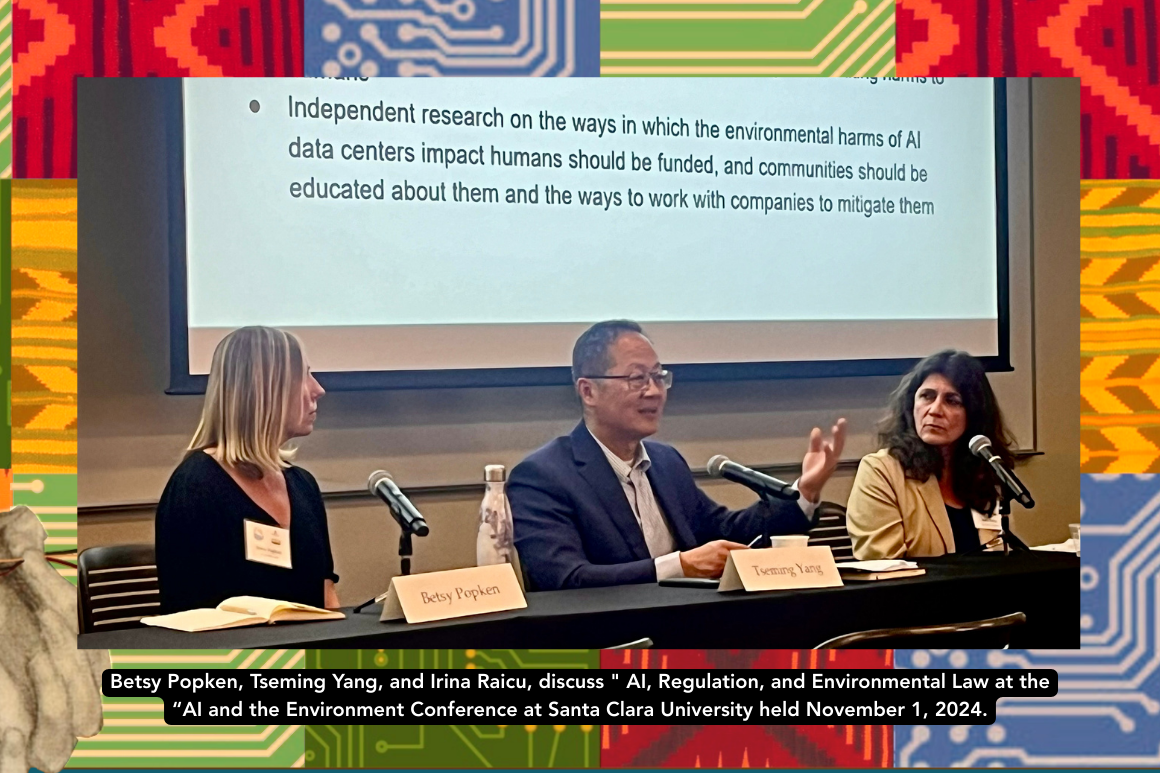
Sustainable and transparent AI development is essential in order to ensure that technological progress does not undermine environmental justice. The director of the Internet Ethics program at the Markkula Center, Irina Raicu, is working to attract attention to AI’s environmental impact both around the world and in particular Californian contexts, highlighting open questions and the need for new laws, technical innovation, and deeper ethical analysis of the growing and already widespread usage of AI tools.
As a key part of this effort, in 2024 Raicu partnered with the Next10 Foundation to convene a day-long conference, “AI and the Environment: Sustaining the Common Good.” The event brought together academics from a variety of disciplines, industry and government representatives, as well as students and the broader public, to explore a variety of key issues: “AI’s Environmental Footprint;” “AI and Water;” “Greening AI;” “AI for Sustainability;” “AI and the Environment: Business Implications;” and “AI, Regulation, and Environmental Law.”
Subsequently, Raicu and professor Iris Stewart-Frey, who directs Santa Clara University’s Water and Climate Justice Lab and teaches in SCU’s Environmental Studies and Sciences department, teamed up and were awarded a $50,000 grant from Next10 to research how AI data centers’ water usage connects to water availability and distribution in California. The Santa Clara Magazine covered their project in an article titled “Your AI queries are consuming a lot of water. These SCU researchers want to know how much.”
It is worth noting that in the city of Santa Clara alone more than 55 data centers are currently operating, and more have been approved. The power demands of such centers come with commensurate water demands, and both raise questions of justice, rights, the common good, and care for vulnerable communities.
In March, Raicu joined Kate Brandt, Google’s Chief Sustainability Officer, for a conversation with Greg Dalton, Founder and co-host of Climate One, at the Commonwealth Club in San Francisco. The event was titled “Are We Smart Enough to Curb AI’s Environmental Impacts?” Raicu answered, in part, that we are smart enough but, at least for now, not committed enough. (Part of that conversation is featured on a Climate One podcast episode.)
Although a number of technology companies have published reports highlighting their efforts to limit water consumption in their data centers, most lack the specificity that is needed to inform both consumers and policymakers and lead to clear ethical analysis and effective policies and laws. In an October Op-Ed published in The Mercury News, Irina Raicu wrote about the importance of such transparency: “As an initial step, environmental justice calls for accurate and much more granular disclosures related to each data center — of the type of cooling system involved, of the amount of water consumed, and of the sources of the water used”.
The term “AI” includes a variety of key tools for environmental research, climate modeling, and countless other efforts to promote both sustainability and human flourishing. Like other tools, however, those also come with costs, and the balancing and the distribution of their benefits and costs must be done wisely if AI is to be a force for good.
Photo credits:
Top: Panel discussion with Executive Director of the Human Rights Center at UC Berkeley School of Law, Betsy Popken, Santa Clara University School of Law Professor, Tseming Yang, and Director of the Internet Ethics Program at the Markkula Center for Applied Ethics,Irina Raicu, discussing " AI, Regulation, and Environmental Law at the “AI and the Environment Conference at Santa Clara University held November 1, 2024.
Mid: Logo for the "AI and the Environment Conference."
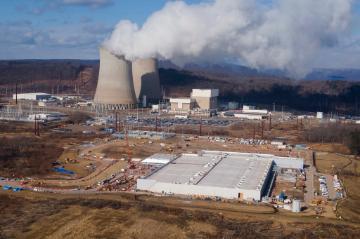
Bottom: A data center owned by Amazon Web Services, front right, is under construction next to the Susquehanna nuclear power plant in Berwick, Pa., on Jan. 14, 2025. (AP Photo/Ted Shaffrey, file)