Sustainability Internship Practicum
ENVS 195—Sustainability Internship Practicum (SIP) is an academic program for undergraduates to participate in collaborative research projects that address campus sustainability challenges.
Under the supervision of the Center for Sustainability, SIP students (formerly known as SLURP: Sustainable Living Undergraduate Research Project) work in project teams with campus partners to research and address sustainability challenges in higher education. Through active, applied learning, students develop the competencies necessary to become effective sustainability leaders while gaining project management and research skills. In addition to project deliverables, students complete and present a portfolio of their work upon completion of their project.
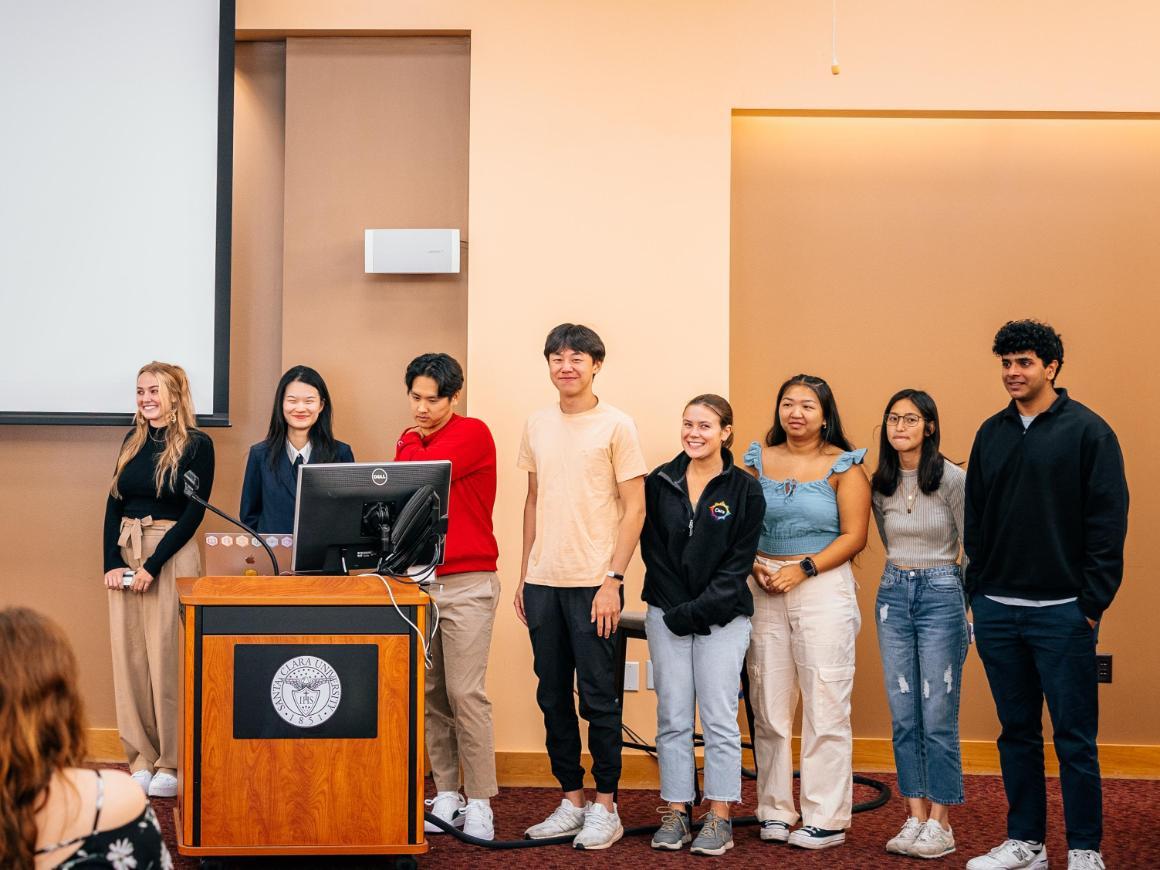
ENVS 195 students (2024 Cohort) at the Climate Research & Creativity Symposium during tUrn.
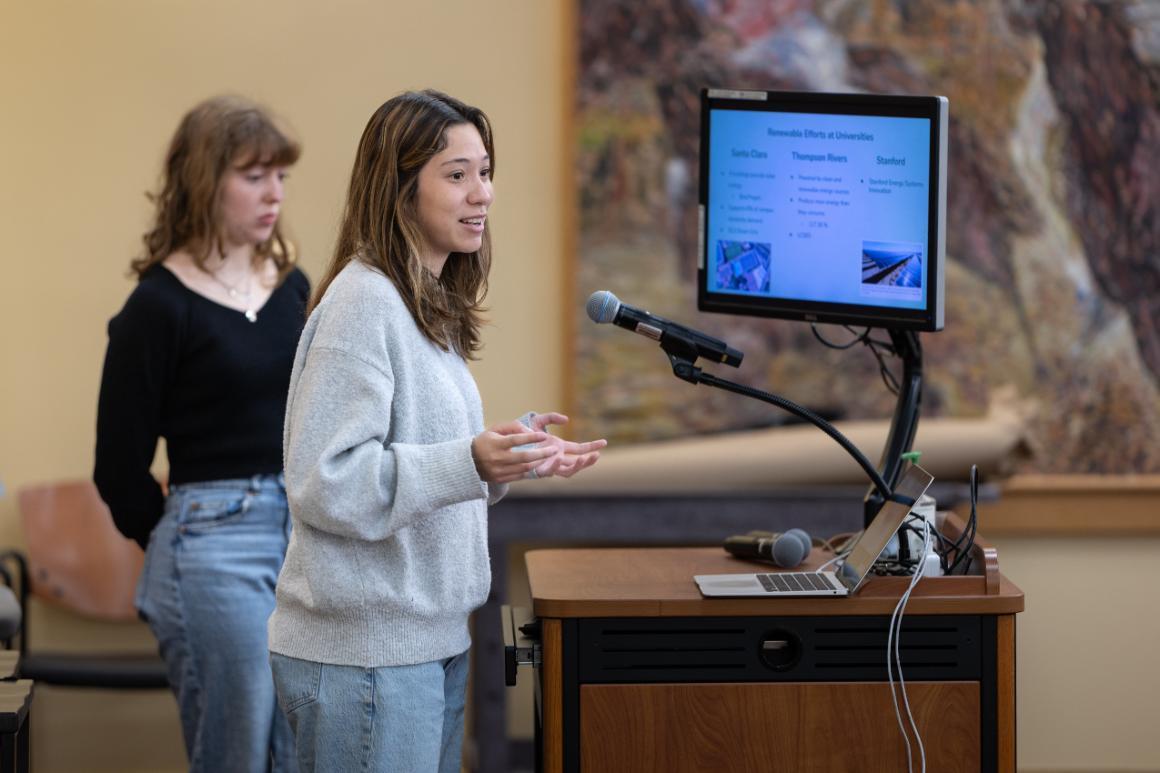
Energy Management team presenting at the 2025 Sustainability & Environmental Justice Research Symposium.
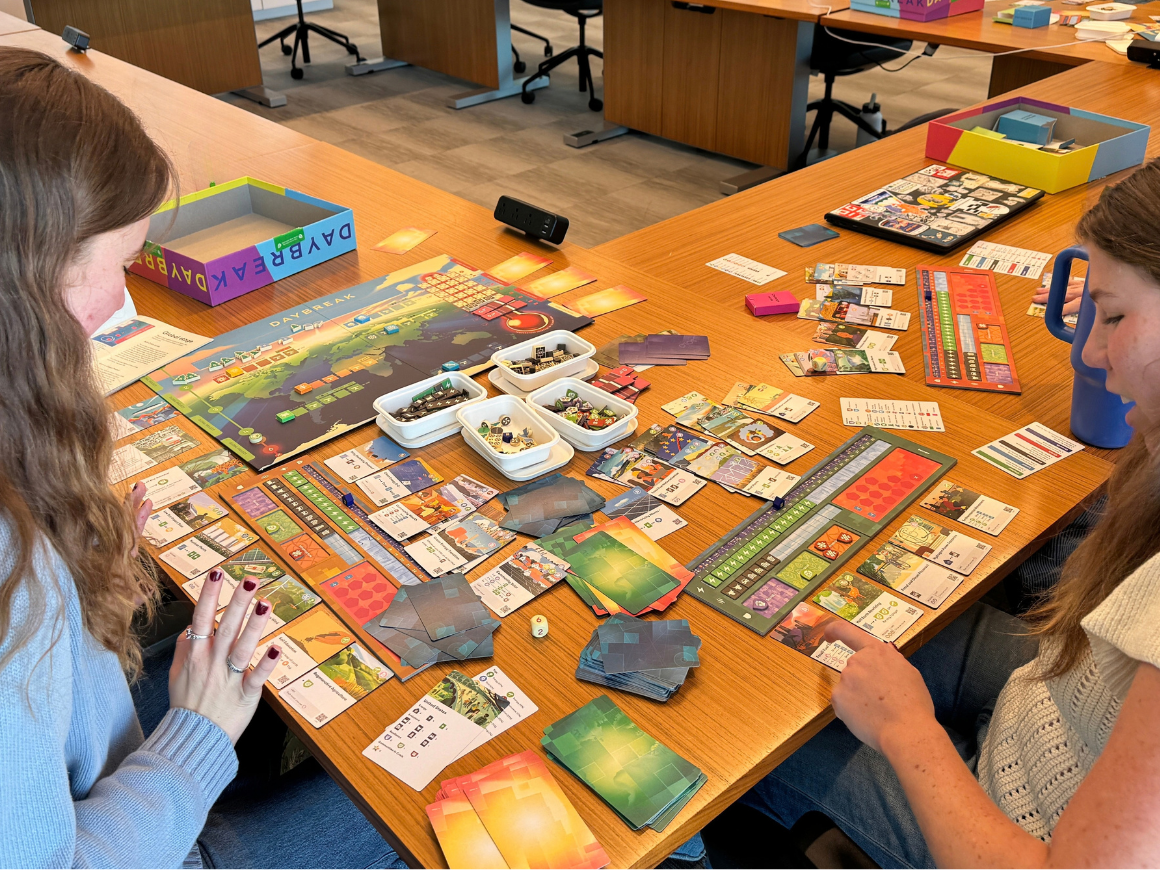
ENVS 195 students playing Daybreak, a cooperative boardgame about stopping climate change.
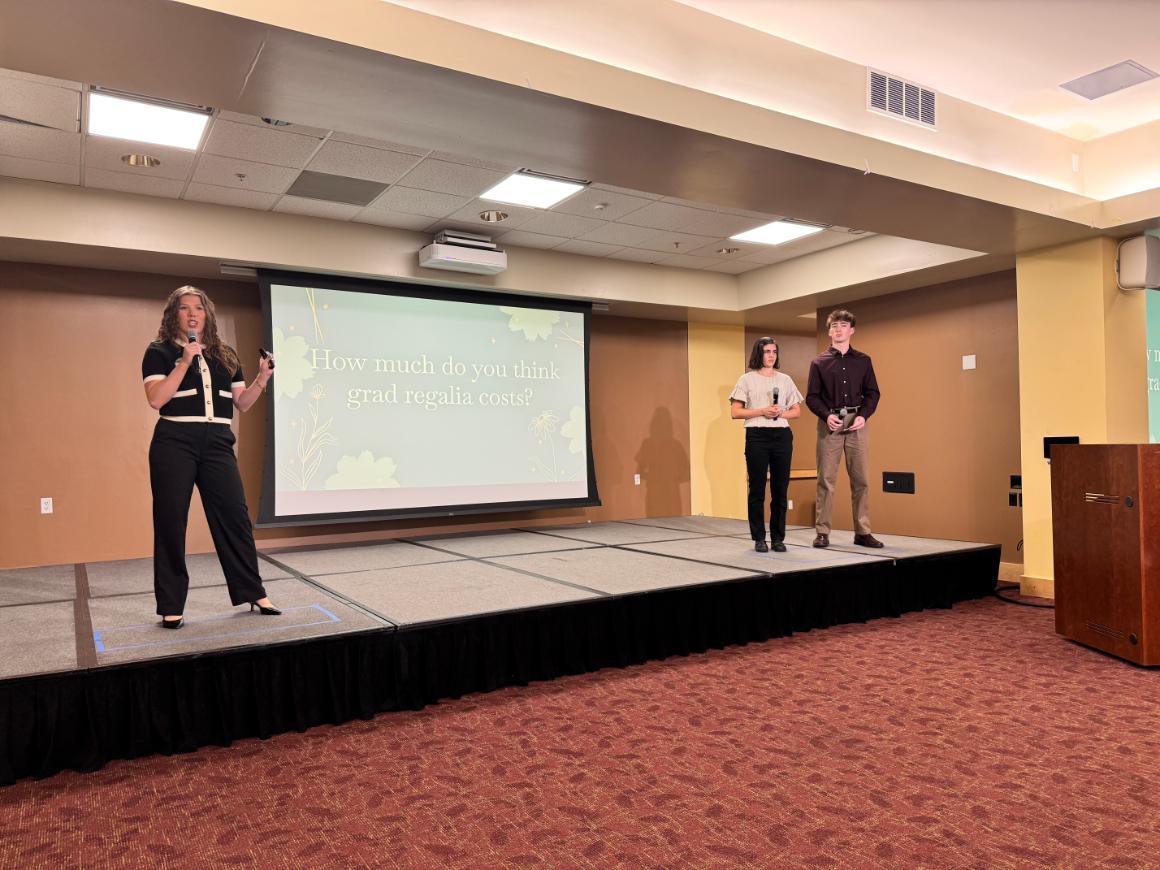
Graduation Gown Reuse team presenting at the 2026 Sustainability & Environmental Justice Research Symposium.
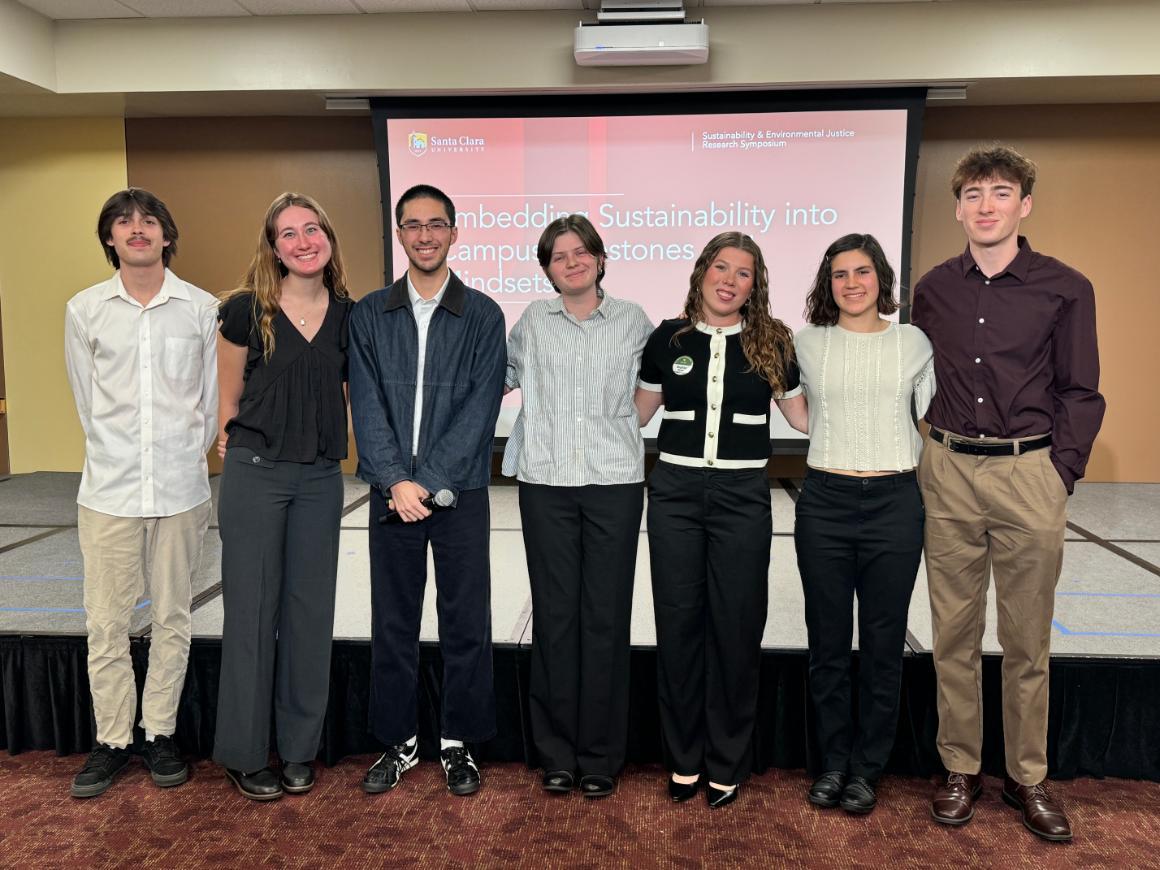
ENVS 195 students (2026 Cohort) at the Sustainability & Environmental Justice Research Symposium.
"This course is a great opportunity to complete a hands-on research project that supports SCU sustainability. I learned so much, not only about sustainability, but also about professional skills that have been extremely helpful with interviews, presenting, and project management."
Former Projects
2025-26 Projects
Reducing Waste Through Graduation Gown Reuse
Drew Rogers, Sophie Sharp, Eliana Aschheim
Campus Partner: Monica Lopez - Dean of Students Office
To reduce textile waste and ease students' financial burdens, the project team evaluated graduation gown reuse programs at peer institutions by reviewing sustainability reports, program websites, and staff interviews. The analysis identified key success factors, including effective collection systems, strong campus partnerships, and messaging that emphasizes both environmental and equity benefits. Based on these findings, the team developed a framework to implement a gown reuse program at Santa Clara University aligned with its sustainability and social justice goals.
Sustainability Training Program Proposal
Daniel Lowe, Olivia Imai, Gus Vaughan, Kelly Rickwa
Campus Partner: Angela Lucas - Center for Sustainability
To address low visibility and fragmented use of Santa Clara University’s Sustainability Playbooks, a project team partnered with the Center for Sustainability to design an action-oriented Sustainability Training Program for students and employees. The team developed a modular training template that integrates existing Playbooks, created a prototype module to demonstrate the approach, and provided strategic recommendations for integrating future orientation, evaluation, and feedback systems to drive campus-wide engagement.
2024-25 Projects
Benchmarking Energy Management
Nora McBride, Cati Tamez, Maya Bhattacharyya
Campus Partner: Kevin Jenkins - University Operations
In alignment with the Pope’s encyclical Laudato Si’, Santa Clara University committed to a Sustainability Action Plan aimed at becoming a climate-positive institution through effective energy management. To establish a benchmark, the project team thoroughly analyzed energy management strategies at comparable North American universities—primarily fellow Jesuit institutions and recent STARS Platinum recipients—by reviewing STARS reports, examining institutional websites, and interviewing sustainability managers. The team also conducted energy audits of lighting and HVAC systems across select campus buildings to gather quantitative efficiency data. The team provided these benchmarking insights and audit results directly to SCU’s Sustainability and Energy teams to help identify opportunities and upgrade the university's energy systems.
Caltrain Discount Program Feasibility Study
James Alexander, James Carlson, Gabby Canola-Leach
Campus Partner: David Herrera - Parking and Transportation Services
In alignment with Santa Clara University's sustainable transportation initiatives, the project team evaluated the need for reduced Caltrain fares for SCU students and faculty by benchmarking alternative transit programs at peer universities. The team gathered data from campus partners, conducted interviews, and researched transit policies to formulate a well-supported proposal. After analyzing the findings within a policy framework, the team finalized and delivered its recommendations in March.
Tracking for Change: Smart Solutions for Sustainable Harvests
Robby Cullen, Emma Yang, Sophia Harvey, Kate Rodman
Campus Partner: Becca Nelson - Center for Sustainability
To address food waste and promote sustainability, the project team optimized the use of untapped campus resources, such as fruit trees, by connecting surplus produce with people in need and composting initiatives. Building on prior research and collaboration with the campus Glean team, the project modernized legacy spreadsheets and data collection methods through improved technology and streamlined processes.
2023-24 Projects
EV Charging Implementation
Annaliese Bunchman, Andy Park, and Tina Zhao
Campus Partner: Leah Nakasaki-Peterson - Parking & Transportation Services
The project team addressed the growing demand for sustainable transportation at Santa Clara University by evaluating opportunities to expand electric vehicle charging station (EVCS) infrastructure in collaboration with Parking & Transportation Services. The project examined EVCS pricing, accessibility, signage, and potential expansion locations to support equitable access and sustainable transportation. Short-term objectives included analyzing local charging rates, surveying the SCU community regarding pricing equity, and assessing existing EVCS signage. Long-term objectives included proposing an equitable pricing model, developing an improved signage plan, and identifying potential locations for additional charging stations based on community feedback.
Conference Services Waste
Bri Guingona, Louis Hoffmann, and Maylin Pollack
Campus Partner: Mahal Flores - Conference Services
During the summer, Santa Clara University’s Conference Services office generated substantial waste from linens, plastic toiletry packaging, and printed materials provided to guests. As donation opportunities for heavily used linens declined, more materials went to landfills, highlighting the need for sustainable, economically feasible alternatives. The project team evaluated three areas of waste reduction: identifying alternative linen recycling or reuse options, assessing plastic-free shampoo and soap alternatives, and developing interim strategies to reduce paper waste while the office’s guest-information app remained in development. The team aimed to identify practical solutions that reduced the office’s overall environmental impact while remaining financially viable.
Sustainable Event Planning
Suveer Singh, Lucas Tan, and Tara Weinstein
Campus Partners: Clare Gordon Bettencourt - Residence Life; Tedd Vanadilok - Center for Student Involvement
The project team addressed limited resources and guidance on sustainable event planning for Santa Clara University student organizations and Residence Life staff. The team aimed to promote practical, accessible sustainability practices for campus programming while reducing the planning burden of implementing them. Short-term objectives included developing a concise sustainability guide and conducting a focus group with student organization leaders and Residence Life staff to identify relevant and engaging recommendations. Long-term objectives included creating a comprehensive guide on sustainable supplies, food choices, and event practices, and developing promotional materials to increase campus-wide awareness.
2015-16 Projects
Dunne Solar Thermal
By: Colleen Black, Sean Voelk
As a continuation of SLURPs ‘Solar Domestic Water Heating’ project from last year, this project aimed to obtain CSIF funding to install a highly efficient solar thermal water heating system on the roof of Dunne Hall in order to eliminate the need for electric or gas water heating on that part of campus. The project leaders requested CSIF funding to install an array of flat-plate collectors which have the potential to save the university over 100,000 lbs of CO2 emissions per year. The SLURP team developed an updated set of financial calculations to inform the CSIF Committee of the projected costs and payback time. The CSIF Committee agreed to fund up to $90k for this project.
Dunne Water Meter Project
By: Henry Ferguson, Kimmie Meunier, Tess Gunnels
The original goal of this project was to monitor Dunne Hall resident shower times in order to raise awareness of water consumption and hopefully change some wasteful behaviours. The team partnered with a new small company, FlowLabs, to set up a system of monitors and hubs. By doing so the project team was able to collect a set of baseline data for Dunne - monitoring the usage of every single shower in the residence hall. The original plan was to gather 2 weeks of baseline data, then create signage to educate residents on sustainable water use and then assess the success of the educational outreach via 2 additional weeks of testing. Due to communication gaps with Dunne staff, the signage was never implemented. Thus the team has 4 weeks of highly valuable baseline data. It showed that while the average shower time was 8 minutes, this varied greatly from less than 2 minutes to 1.5 hours and even a 2 hour shower! It is hoped that this valuable Excel data set could be used by future students to further evaluate shower use and develop educational information for fellow students.
SCU's Bright (but not too bright) Future
By: Alex Duncan, Clint May, Adam Murai
This project returned to 2014 and 2015 SLURP lighting data and developed a CSIF proposal for funding. In order to minimize the amount of electricity wasted on campus by lights being turned on in empty rooms, the team focused on the installation of daylight and motion sensing light controls in campus classrooms and common areas. The SLURP team estimated that with the installation of sensors in Kenna, Lucas, O’Connor and Vari halls, the university would prevent the emission of over 40 metric tons of CO2 per year,as well as save roughly $15,000/year. While the initial cost of the project was not cheap, the resultant savings were estimated pay back its entire cost in just over three years. Ultimately, the CSIF Committee and SCU Facilities decided it would be best to fund the installation of both daylight and motion sensing light controls Kenna Hall, and just motion sensing controls in Lucas Hall.
New Neighborhood Unit Landscaping
By: Alicia Manfroy, Alex Piñon
This project is focused on the lawns of SCU’s twelve neighborhood units that they have recently decided to manage, and how the school plans to maintain them in the years to come considering the severe drought being experienced by the state. Housing had indicated that they were interested in removing the lawns and replacing them with artificial turf. However, the SLURP team learned that this is not an approved alternative, according to the Santa Clara Valley Water District (because they still use water and because they heat up, they contribute to the urban heat-island effect). A survey conducted by the project team revealed that the majority of students would ideally like to have real grass in their yards, but almost half of those surveyed actually preferred artificial turf, native tall grasses, or mulch with plants, all of which are far more sustainable alternatives for grass. (Incidentally, the vast majority of those surveyed were males, and the few females that were surveyed had very different preferences.) The use of the more sustainable alternatives would significantly reduce the 4,500 gallons it would otherwise take to water the lawns of the new units. The SLURP team met with Housing and recommended that they conduct a pilot program with mulch and native tall grasses before rolling out changes to the rest of the units.
Composting in The Villas
By: Chonsa Schmidt, Kim Grandi
Being the only residence hall that provides students with full kitchens and cooking facilities, the Villas should be one of the biggest composters on campus. However, all they have are small and rarely used communal compost bins. This project is aimed at obtaining CSIF funds in order for Housing to implement compost bins in the kitchens of the Villas apartments. The SLURP team conducted a waste characterization at the Villas that revealed that over 50% of the material in the Villas landfill bin was in fact compostable. Ultimately the team was successful in obtaining CSIF funding for a pilot program for in-kitchen compost pails.
SCU Swap Shop
By: Chonsa Schmidt, Kim Grandi
This SLURP team sought to initiate a SCU Swap Shop. It would be modeled after SCU Swap for Good events, but was geared towards setting up a more permanent location where students can come in and exchange goods that they would have otherwise thrown away for something that they still like and will use for some period of time. This type of exchange and reuse prevents large quantities of still usable materials from finding their way into the landfill, fostering a culture of sustainability at Santa Clara University.
The SLURP team interviewed students at Portland State University to determine how they were able to initiate a ReUse Room on campus and seek insights about challenges they had at PSU. The SLURP students obtained significant positive feedback from the Sustainability staff and it is hoped that this project will move forward.
2014-15 Projects
Eco-Tray & Dishware Return
By: Megan Michel, Alicia Manfroy, Erin Arslanoglu
Aimed to help Santa Clara achieve it’s goal of becoming “Zero Waste”, the project objective was to limit excess waste from togo serviceware & incorrect disposal in Benson dining facilities. The project consisted of an advertised weekly one hour pick up in Swig for all eco-trays and Benson dishware in which volunteers walked the halls of Swig going from door to door collecting eco-trays and Benson serviceware from the residents. The pilot showed promising signs as well as revealed potential improvements to current dining systems such as removing the ‘to-go’ option altogether, or implementing a security system to prevent students from removing any dishes or utensils from the Benson building.
Improving Santa Clara University’s Waste System and Habits
By: Vanessa Caustrita, Zachary Chien, Marianna Moore
This project helped improve student waste diversions at the university through a week long event called ‘Waste Week’, as well as use of walkthroughs and worker trainings to help improve kitchen worker diversions. Waste characterization results show that 80-90% of Benson waste headed for the landfill was recyclable or compostable. The project uncovered the need for more/ continued staff training in the future, due to frequent turnover and other demands on staff time. There remain significant opportunities to reduce the quantity of waste SCU sends to the landfill.
A Colder Load for a Cleaner Conscience
By: Annie Underwood, Sammie Yamashita
This project facilitated discussions with underclassmen in order to educate them on the effects of using sustainable laundry practices in an attempt to lower the CO2 emissions of SCU’s student body. The team conducted surveys on people’s knowledge of how to do laundry sustainably and worked with Housing to create permanent signage in residence halls about completing work orders for broken machines.
Zagster: Taking Off the Training Wheels
By: Christy Chow
The Zagster bikes were brought to SCU as the result of a SLURP project in 2014 in which one SLURP student worked closely with Transportation Services to evaluate bike share options. Zagster was subsequently brought to campus. This Year 2 project focus was to conduct outreach and determine why the bikes were getting such little use. Initially the greatest obstacle faced by the project was a lack of promotion and public knowledge, however with increased signage, advertisement, and tabling, it is hoped that Zagster will see increases in usage.
Water Conservation at SCU: On-Campus Fixture Audit
By: Dylan O’Reilly, Gabriella Carne
In order to remediate the effects of the drought and to preserve water in case of future droughts, it is imperative that SCU do all it can to limit its use of potable water. This project focused on unnecessary water usage resulting from inefficient fixtures around campus, included a water fixture audit in some older and at-risk buildings, as well as determined other areas of weakness in order to establish recommendations for future SLURP projects & Facilities action. Research showed that some sink aerators in campus residence halls actually function at lower flow rates than they were rated at (which is a good thing!) perhaps due to calcification resulting from the high mineral content of the groundwater restricting water flow. Therefore, rather than changing aerators in campus sinks, the better way to reduce water use from sinks is to reduce time of use.
SCU Water Conservation
By: Julia Homaechevarria, Lauren Hall
Taking one step closer to achieving Santa Clara’s goal of becoming Zero Waste and Climate Neutral, this project attempted to reduce potable water use in campus buildings through toilet and sink fixture audits in older residence halls as well as assessments of the last three years of SCU toilet maintenance. Results showed that some campus buildings have toilets that are operating at more gallons per flush than modern efficient toilets. Facilities staff, however, have indicated that the amount of water per flush is dependent on what floor the toilets are on. Upper floors of a building have lower water pressure and therefore demand more water per flush in the toilet bowl.
Sustainable Landscaping at SCU
By: Allison Carmody, Leigh Pond
With the ever increasing severity of the drought faced by California, this project aimed to make landscaping recommendations to Facilities that would reduce water consumption while maintaining the campus beauty and aesthetic appeal. The most significant changes would be the repurposing of all lawn areas not regularly used for special events or student recreation, as well as replacing current landscape with native plants that are drought and/or recycled water tolerant. Research and calculations showed that roughly 8.3 acres of lawn could be converted into native landscape, and that by using drought and recycled water tolerant plants the University would save up to 244,194 gallons of water per watering session.
Sensors for Savings
By: Ayesha Ahmed, MingFei Xiong, Matt Randolph
Every week roughly 2225 kWh of electricity (equivalent of $270 or 581 Kg of CO2) is wasted as a result of lights being left on in unoccupied rooms around campus on nights and weekends. This project involved conducting fixture audits of classrooms, labs, and conference rooms in Alumni Science, Kenna, Vari, and Lucas Halls in an attempt to save as much of the energy being wasted in empty rooms as possible through the installation of infrared and ultrasonic light sensors. According to research done on campus buildings, over 50% of the time that the lights spend switched on, the room is not being used. The ‘Sensors for Savings’ project hoped to provide insights to Facilities to change that.
Solar Domestic Water Heating
By: Kayla Ayres, Vince Heyman, Nick Matera
This project encouraged the adoption of solar water heating systems on the roof of Dunne Hall. With the use of 30 Heliodyne Gobi 410 solar collectors to trap solar radiation and heat water for Dunne residents the university would save about 84,400 kWh, or about 101,260 lbs in CO2 emissions per year. While initially the system is quite costly, the project was estimated to have a payback period of only 9 years with a forecasted lifespan of 20 - 25 years, resulting in both an increase in the sustainability of the campus as well as significant savings for the University in the long run.
2013-14 Projects
EcoMug
By: Allison Carmody, Kayle Sinnot, Nita Sridharan
This project sought to reduce source waste on campus through single-use coffee cups and promote a reusable mug culture. It was found that many coffee cups are improperly diverted and are excess waste. Limiting the number of necessary single-use cups will help bring Santa Clara University closer to carbon neutrality. Proposed ideas from collected data include an express idea for reusable mug users, an economic discount for bringing a reusable mug as opposed to a disposable one, selling "EcoMugs" and increasing discount incentives on a strategic marketing day (Bring Your Own Mug Monday).
EcoTray
By: Vivian Duong, Lauren Moore, Samantha Yamashita
This project aimed to increase the use of EcoTrays on campus in order to reduce single-use container waste and understand students' resistance to the EcoTray system. The main findings showed that most students were not aware of the eco-tray program; those who were, perceived them to be inconvenient. Some suggested solutions include the creation of EcoTray drop-off stations as well as more marketing to encourage knowledge about the EcoTray prgoram.
Orientation
By: Drea Modugno, Dominic Leventini, Willy Lamb, Logan Morey
This group project's primary objective was to add a sustainability awareness and education portion to Santa Clara University's freshmen orientation by creating something tangible to highlight the current programs and projects available to incoming students. Prior to implementing this component, research about what current students needed to know and would have liked to know was needed first. Results from data collection indicate that SCU students were confident in their ability to divert waste, that sustainability is a defining feature of SCU and that the majority of students wish to learn more about sustainability but were unaware of such programs upon arrival to campus or during their freshmen year. This year's project resulted in the development of a sustainability flyer that all incoming freshmen will receive and a script for a film being produced by student orientation directors.
Powering Down for a Brighter Campus
By: Nathan Ng, Nolin Sasaki, Michael Whalen
By targeting the behavior of professors, the goal of this project was to reduce energy usage. During research, it was discovered that after the last class session of the day, many lights, computers, and monitors are left on overnight and over weekends. Prompts to spur behavior change were implemented in pilot buildings (Lucas Hall and Arts & Sciences) to affect change.
Tackling Climate Change Through Laundry
By: Hailey Kennedy, Déjà Thomas
According to The Alliance to Save Energy as much as 90% of energy consumed by washing machines is simply used to heat the water. The goal of this project was to educate students on the benefits of washing their clothes with cold water as well as incentivize them to use cold water through machine changes and discounts. The team conducted a 3-week test at Campisi, with the help of the Housing Department. They temporarily reduced the price of 4 clothes washers for which the hot water had been turned off . Results from the project showed that by charging a quarter less for cold water laundry and educating the users about it’s benefits, more than half of the students in Campisi used cold water to do their laundry during the time tested. If the school were to converted half of all campus washing machines to use cold water only, it would prevent the emission of roughly 35,000 lbs of CO2 annually. (NOTE: Housing really liked this pilot project. They would like to permanently have an option for cold water washes at a lower price but there are issues with the Access cards.)
De-Lamping
By: Meredith Riley, Sophia Huang
Lighting in classrooms is very important for student performance and should always be sufficient. The ideal classroom light intensity lies around 30 foot-candles, however it is not uncommon for lighting in classrooms to greatly exceed this value. The purpose of this project was to conduct tests to determine the light intensity in all Arts & Sciences, Lucas, O’Connor, and Kenna classrooms for four different situations: daytime with the lights on and the blinds completely open, half closed, and completely closed, and night time with all the lights on. From these results the team hoped to determine how many light bulbs could be removed from each classroom while still maintaining the ideal 30 foot-candle illumination. Results showed that the removal of these excessive bulbs would save the school $10,200 and 50,400 lbs of CO2 emissions per year.
Divestment at SCU
By: Lisa McMonagle, Blair Libby
SCU is an institution with a great focus on sustainability and a goal to become carbon neutral by 2020, however the school continues to have large amounts of money tied up in fossil fuel related investments. This project aimed to support the Fossil Free SCU movement which has a goal of freezing any new investment in fossil fuel extraction companies, as well as within the next five years divesting from any commingled funds or direct ownership in fossil fuel public equities and/or corporate bonds. By focusing on support outside of the student body and targeting alumni, faculty, staff, and the press, the team was able to become an integral part of the divestment campaign and gain support from high ranking administration as well as receive coverage from a huge range of popular media networks. (Note: Both team members later became leaders of the on-campus campaign, and this SLURP project gave them the time to research this issue and become passionate about the campaign.)
SCU Spins - Bike Share Program
By: Colleen Henn
Bikes are an incredibly convenient form of transportation that are too rarely utilized. The goal of the SCU Spins project was to determine why it was that so few students were using bikes as their primary mode of transportation, and what changes the school could make to promote bicycle use. Surveys conducted by the SLURP student showed that the number one reason for students not riding bicycles is not owning one or not having access to one, something that could easily be solved with a campuswide bike share program. The student worked directly with Transportation Services to research the most suitable bike share programs. The student reviewed both Zagster and On Bike Share for Transportation Services. The student also surveyed students and found that over forty percent of people surveyed said that they would use frequently if it was available to them. Transportation Services contracted with Zagster due to the findings of this project.