blog posts

Femme and Its Joyful Rebellions
In my Feminist Theory class this past Spring quarter, one sentiment expressed consistently by my students was frustration and anger at the silencing of women and girls and the pressure to take up less physical, emotional, and even sonic space. What I sensed in their personal narratives about navigating the various iterations of misogyny in their lives was a felt constriction in how they move through the world and the impact it has on their comportment and identity. This has certainly been my experience, too. I still struggle with anxiety about whether I talk too much or too loudly, gesticulate with my hands too much, am a gossip, or am too selfish and not sacrificial enough whenever I do something solely for myself, etc. Yet, what I also found through our class discussions was that, for as much as we all feel compelled to contain our various expressions of femininity for fear of being too much, there’s also joy, pleasure, and resistance in reveling in the excess of some of femininity’s most salient signifiers, such as care.
A photo strip of the author in her youth from a booth at the Santa Cruz Boardwalk
Throughout the quarter, we came to understand the centrality of care to feminist and queer movements and how radical forms of care, such as mutual aid, transformative justice, and rest, evade racist, ableist, and carceral logics. As with femininity, patriarchal logic has always had a difficult time taking care work seriously. Or, as feminist writer Sophie Lewis so aptly explains in her new book, Femmephilia, “When certain feminists first turned against girly things, it was a giant error in Western women’s liberation history. In its joy-oriented solicitousness and relational self-pleasuring, femininity is the domain not only of oppression and stricture but of most of the things that make life worth living, including not only the subsistence of bodies, but also gratuitousness and excess” (Lewis 1).
There’s something about how the privilege of care is transformed into a burden and a curse that makes me reflect on my students’ embodied knowledge of the many constraints placed on women. Our conversations this quarter conjured memories of my own girlhood and the demands placed on me to comport myself and make myself small. Yet when I imagine the feminist potentials of joyful rebellion, I envision movement and can’t help but think of the word femme. In fact, it might be that femme joyfully rebels or moves against femininity. I’m fortunate that so much of my girlhood was spent listening to feminist punk music. Kathleen Hanna, the lead singer of the infamous riot grrrl bands Bikini Kill and Le Tigre, inspired me not only because she was unapologetically feminist and angry, but also because of her disidentification with the figure of the girl. Though such a figure is inevitably mediated by race and class, and I couldn’t identify with Hanna’s whiteness, I was nonetheless fascinated by how she performed hyper-femininity and girliness in her babydoll dresses and through a vocal style that oscillated between an innocent little-girl voice and a rageful, growling, and screaming one. Hanna seemed acutely aware that culture both desired and wished to consume femininity as much as it held it in contempt. In response, she played with that repulsion/desire and, instead of disavowing her own “girliness” in an attempt to be taken seriously, revered the girl in her and used it as a mirror to reflect misogyny more broadly and within the punk scene specifically.
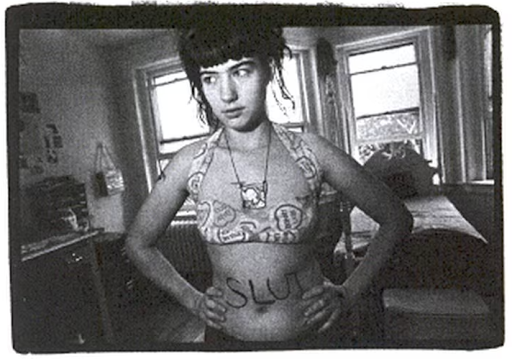
An image of Kathleen Hanna in the 90s with the word “SLUT” written on her torso in lipstick. Photo credit: Linda Rosier
In writing this, I am reminded of the Le Tigre song “Eau D’ Bedroom Dancing.” It’s a short, ephemeral pop song that’s basically about the joys of daydreaming alone in your room. “I'm in the sky when I’m on the floor/The world’s a mess and you're my only cure/There’s no time for me to act mature/ The only words I know are ‘more,’ ‘more,’ and ‘more.’” And the chorus goes, “No one to criticize me then/No one to criticize/No one to criticize me then/No one to criticize.”
I love this song for its simplicity, which makes you feel almost like you’re floating. But I also love it because it reminds me of how spatial ideas such as joyful rebellion or femme function. When I was a girl, it was the bedroom, where I got to daydream and rest, sleep and listen to my favorite band, dance and jump on the bed. This song reminds me of my childhood room, and that it’s okay to go back, to be that girl again, the joy of discovering yourself and your politics, who you might be in the world, who you are already. Like my students reminding me that I, too, still carry the weight of femininities many antagonisms, the song also transports me to the very space where I escaped those antagonisms—my bedroom. It’s also the place where I would discover and deepen my feminist politics, reading Zora Neale Hurston, Angela Davis, Dorothy Allison, and listening to riot grrrl on my CD player. I’d lie on the carpet next to the stereo and think about all the words I was learning that I hadn’t known before. My feminist vocabulary was growing, and so was I.
Joyful rebellion, then, for me, is a celebration of all things femme, of all that nurtures care. Femme’s gratuitousness and excess are the insatiable desire for more. Often, this insatiability for more life, more community, more freedom is shrouded in the quotidian terrors that women and girls live amid every day, including the carceral state, intimate partner violence, labor that never ends, and poverty. Yet rebellion and resistance are how femmes have lived with, and against, such gender terror. Mutual aid, whisper networks, and gossip, along with the understanding that deep love and care aren’t a sign of weakness but instead the literal reproduction of the social that keeps us alive and fed. If femmephobia and the extraction of femme labor transformed such care work into servitude, we must resist that servitude every day.